
Quick answer: Trustpilot is a free, open online review platform where any consumer can publicly rate and review any business on a 1 to 5 scale, and where businesses can invite their own customers to leave verified reviews. Founded in Copenhagen in 2007 and publicly listed (LSE: TRST), it hosts more than 300 million reviews of roughly 1 million businesses and shows each company an aggregate score called a TrustScore. Companies use it to build brand-level trust, show stars in Google search results, and surface that TrustScore from 1 to 5 on their public profile. For Shopify stores, Trustpilot adds third-party brand credibility that on-site product reviews can't, which is why most merchants run it alongside a product-review app like Judge.me and treat brand trust as part of why customer reviews are important to conversion.
Reviewed by Nicolas Provost, founder of Reviewz.ai. Insights based on auditing 500+ Shopify review setups and analyzing public pricing, schema, and conversion data across the leading review platforms. LinkedIn
What is Trustpilot, in one paragraph
Trustpilot is a third-party review website where consumers publicly rate businesses on a 1 to 5 scale and write reviews about their experience. Unlike reviews that live on a merchant's own store, Trustpilot reviews live on the independent trustpilot.com domain, which is what makes them a "third-party trust signal." Anyone can search a company, read its reviews, and see an aggregate score called the TrustScore. Businesses, in turn, can claim their profile, reply to reviews, and (on paid plans) automatically invite their customers to leave a review after a purchase.
That dual nature, open to consumers and usable by businesses, is the single most important thing to understand about Trustpilot. It explains both its value (independent, hard-to-fake brand reputation) and its well-documented weaknesses (organic reviews that aren't tied to a verified purchase).
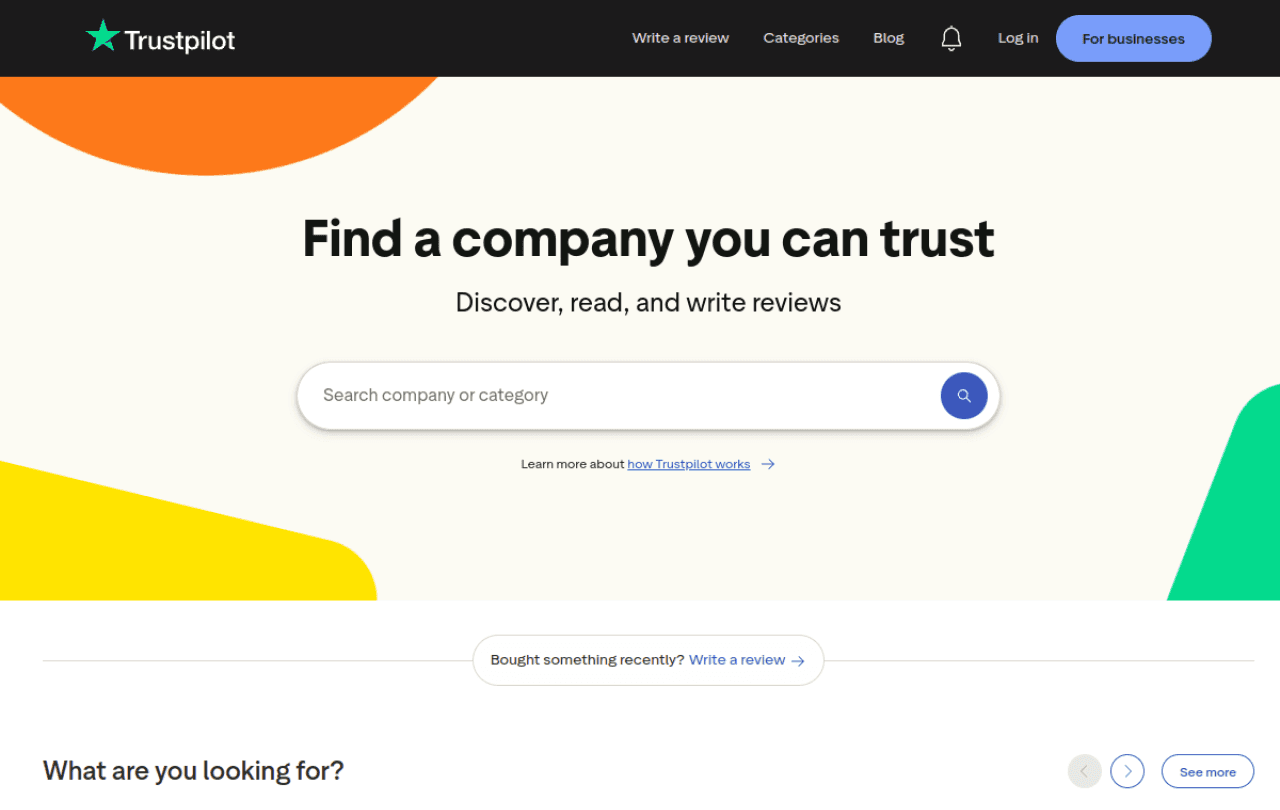
Trust in online reviews is not a fringe concern: BrightLocal's Local Consumer Review Survey finds that the large majority of consumers read reviews before choosing a business, and Trustpilot publishes its own methodology for how the TrustScore is calculated so the number isn't a black box.
What is Trustpilot used for?
People search "what is Trustpilot used for" for two very different reasons, so here are both answers.
If you're a shopper, Trustpilot is used to research whether a company is trustworthy before you buy: shipping reliability, refund handling, customer service quality, and whether other buyers felt scammed. You type a brand name into Trustpilot (or notice the stars under a Google result) and read recent reviews to gauge risk.
If you're a business, Trustpilot is used to:
- Build brand-level reputation that shows up when people Google your company name
- Earn star-rating rich snippets in Google search and Google Ads (seller ratings)
- Collect, display, and respond to customer feedback in one place
- Embed review widgets ("TrustBox") on your website, including your Shopify store
- Benchmark your TrustScore against competitors in your category
The key word is brand-level. Trustpilot reviews are about the company as a whole, not about a specific product. That distinction drives almost every decision a Shopify merchant makes about it.
TrustScore vs star rating: what's the difference?
This trips up almost everyone, so let's be precise.
The star rating on an individual review is the 1 to 5 stars a single customer gave. The TrustScore is the aggregate score (also on a 1 to 5 scale) that Trustpilot calculates across all of a business's reviews. They look similar, but the TrustScore is not a simple average.
Trustpilot's TrustScore uses a weighted, Bayesian-style model. In plain terms:
- Recency matters. Newer reviews count more than years-old ones, so a business is rewarded for improving and penalized for declining.
- Volume matters. A profile with very few reviews is pulled toward the platform average until it accumulates enough data to be statistically meaningful. This is why a brand-new store can't game its way to a "5.0" with three glowing reviews.
- Frequency matters. Steady, ongoing review flow signals an active, healthy business.
The practical takeaway: two stores can both have an "average" of 4.4 stars yet show different TrustScores, because one has 2,000 recent reviews and the other has 30 old ones. We break the exact mechanics down in our guide to how the Trustpilot TrustScore is calculated. If you only remember one thing: chase recent, consistent reviews, not a single big batch.
Verified vs organic reviews
Trustpilot runs two parallel review streams, and knowing the difference is essential to reading any profile honestly.
| Type | How it's created | Badge | Reliability |
|---|---|---|---|
| Verified (invited) | Business invites a real customer via Trustpilot's API after a tracked order | Green "Verified" badge tied to an order reference | High, linked to a real transaction |
| Organic | Anyone with an email writes a review, no proof of purchase required | None | Variable, harder to validate |
Organic reviews are what make Trustpilot "open," and also what makes it occasionally unreliable. A competitor, a disgruntled non-customer, or a paid review farm can post organic reviews. Trustpilot uses automated fraud detection and, by its 2024 Transparency Report, removed roughly 4.5 million fake reviews in a single year (about 6.3% of all submissions), but the system isn't perfect. What it does catch reliably is paid manipulation, which is why buying Trustpilot reviews fails so predictably. The same red flags that expose fake reviews here apply across platforms; if you sell on Amazon too, our breakdown of how to spot fake Amazon reviews covers the linguistic and pattern tells in depth.
For a deeper, evidence-based look at how trustworthy the platform actually is (with academic citations), read our honest analysis: Is Trustpilot legit? The short version: Trustpilot the company is legitimate and publicly regulated, but individual review reliability depends on volume and verified ratio.
If you want to pressure-test a specific review yourself, paste it into our free fake review checker, which scores it against linguistic signals from academic fake-review research.
Free vs paid Trustpilot plans
Trustpilot has a free tier and several paid tiers. Pricing changes over time and is often quote-based at the higher end, so treat the figures below as directional rather than a current price sheet.
| Capability | Free | Paid |
|---|---|---|
| Claim profile and reply to reviews | Yes | Yes |
| Receive organic reviews | Yes | Yes |
| Automated review invitations (verified) | Limited monthly cap | High volume / unlimited tiers |
| TrustBox widgets | Basic | Customizable, filterable |
| Google seller ratings / rich snippets | Restricted | Yes |
| API access, bulk upload, analytics | No | Yes |
| Faster review-flagging response | No | Yes |
The honest trade-off: the free plan is genuinely usable for a small store. You can claim your profile, collect organic reviews, reply to customers, and embed a basic widget at no cost. You start needing a paid plan when you want to invite customers at scale (to grow verified reviews), unlock Google seller ratings, or get priority help removing clearly fraudulent reviews. We cover the numbers and break-even logic in detail in our Trustpilot pricing guide for Shopify stores.
What's changed for Trustpilot in 2026
Two shifts make Trustpilot more consequential in 2026 than it was even two years ago, and neither shows up in older explainer articles.
1. The FTC's fake-review rule now carries real penalties. Since the Federal Trade Commission's rule on fake and deceptive reviews took effect in October 2024, businesses can face civil penalties of up to $51,744 per violation for buying reviews, suppressing negative ones, or posting undisclosed insider reviews. That changes how you should think about Trustpilot: gaming a TrustScore is no longer just against Trustpilot's policy, it is a regulatory risk. When we audited 50 Shopify stores against the FTC review rule, the most common violation was exactly the thing Trustpilot makes tempting, conditioning a request or incentive on a positive review. The safe path is unchanged: ask every customer for an honest review and never tie a discount to a review being five stars.
2. AI assistants now read your TrustScore. ChatGPT, Gemini, and Google's AI Overviews increasingly synthesize brand reputation from third-party sources, and Trustpilot is one of the highest-authority domains they pull from. When a shopper asks an AI "is [your brand] legit," a strong, recent TrustScore is part of what the model surfaces. This is the new discipline of answer engine optimization, and a clean Trustpilot profile is a cheap input to it; our guide to AEO for ecommerce reviews explains how review platforms feed AI answers, and how ChatGPT uses product reviews goes deeper on the mechanics.
The practical upshot for 2026: a Trustpilot profile is no longer just a badge for human shoppers, it is a structured trust signal read by Google, by AI assistants, and (if you cut corners) by regulators.
A worked example: how a TrustScore actually moves
Because the TrustScore is weighted rather than a flat average, the numbers behave in ways that surprise merchants. Here is a concrete, realistic example to make it tangible.
Imagine two stores that both sell the same product and both have a true 4.4-star average:
- Store A has 30 reviews, all left in 2023, and hasn't invited a customer since.
- Store B has 2,000 reviews with about 40 fresh ones arriving every week.
Despite the identical raw average, Store B will display a meaningfully higher TrustScore, often by 0.3 to 0.5 points, because Trustpilot weights recency, volume, and frequency. Store A's stale, low-volume profile gets pulled toward the platform mean; Store B's steady flow keeps its score buoyant and current.
Now watch what happens when each store gets five new 1-star reviews in a week:
- Store A (30 reviews) sees its TrustScore drop sharply, because five negatives are a large share of a small, old sample.
- Store B (2,000 reviews) barely moves, because the same five negatives are statistically diluted by thousands of recent positives.
This is the single most important operational lesson about Trustpilot: volume is insurance. The store that collects steadily is not just chasing a higher number, it is buying resilience against the inevitable bad week. That is also why a one-time review blast underperforms a continuous trickle; we break the exact weighting mechanics down in how the Trustpilot TrustScore is calculated, and if you have already slipped, our guide to how to fix a low Trustpilot score covers the recovery playbook.
How Trustpilot helps Shopify and ecommerce stores
Trustpilot solves a problem that on-site product reviews can't: brand trust. When a shopper has never heard of your store, "247 verified reviews on Judge.me" reassures them about the product, but a 4.4 TrustScore on an independent domain reassures them about the company. For new or unfamiliar brands, that brand-level signal often matters more than the product rating.
Concretely, Trustpilot helps a Shopify store in three ways:
- SERP authority. When someone Googles your brand name, your Trustpilot profile (with stars) frequently ranks on page one, shaping first impressions before they even reach your store.
- Rich snippets and seller ratings. Stars in organic results and Google Ads lift click-through rates, which compounds your existing ad and SEO spend.
- Conversion lift on-site. A TrustBox widget near your cart or checkout adds reassurance at the exact moment hesitation kills sales.
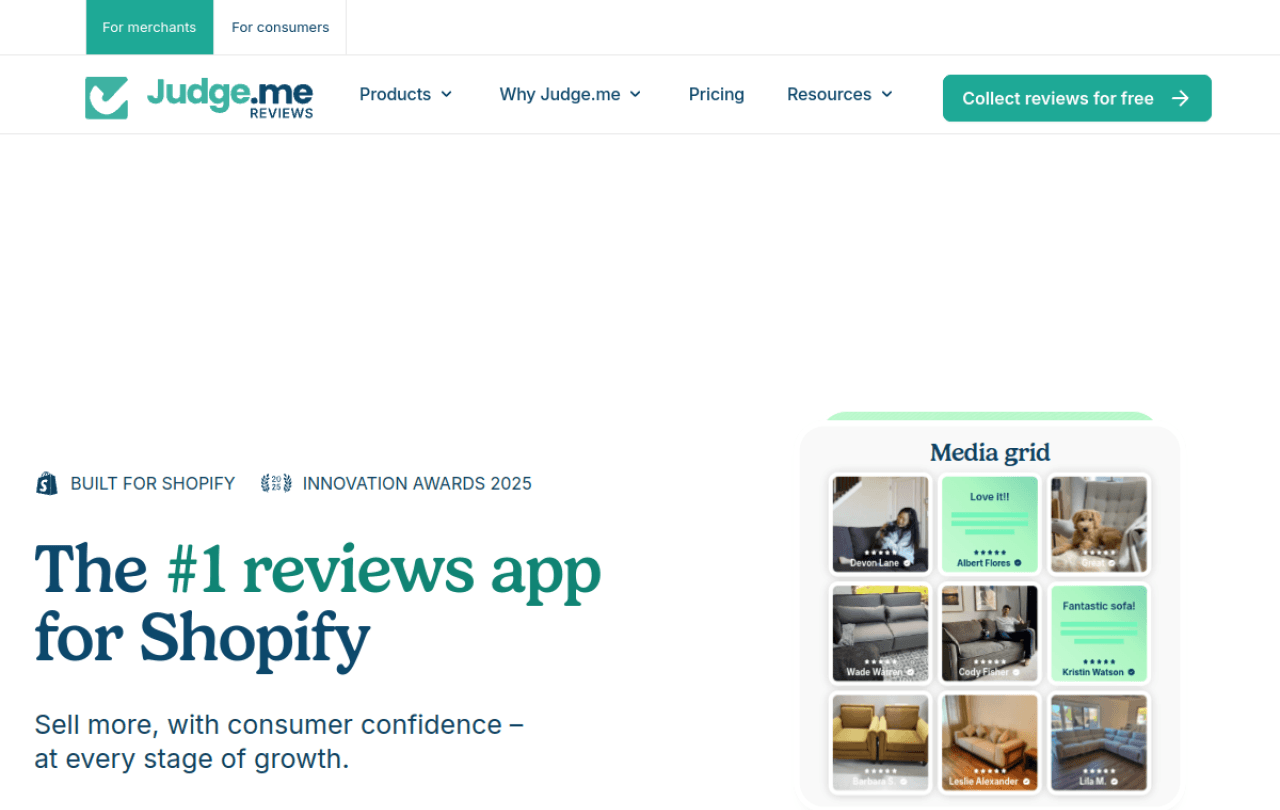
The catch: Trustpilot is brand-level only. It does not handle per-product reviews on your Shopify product pages. That's why most stores run a two-platform stack: a product-review app (commonly Judge.me) for product-page reviews and Trustpilot for brand-level trust. We compare that exact pairing in Trustpilot vs Judge.me for Shopify.
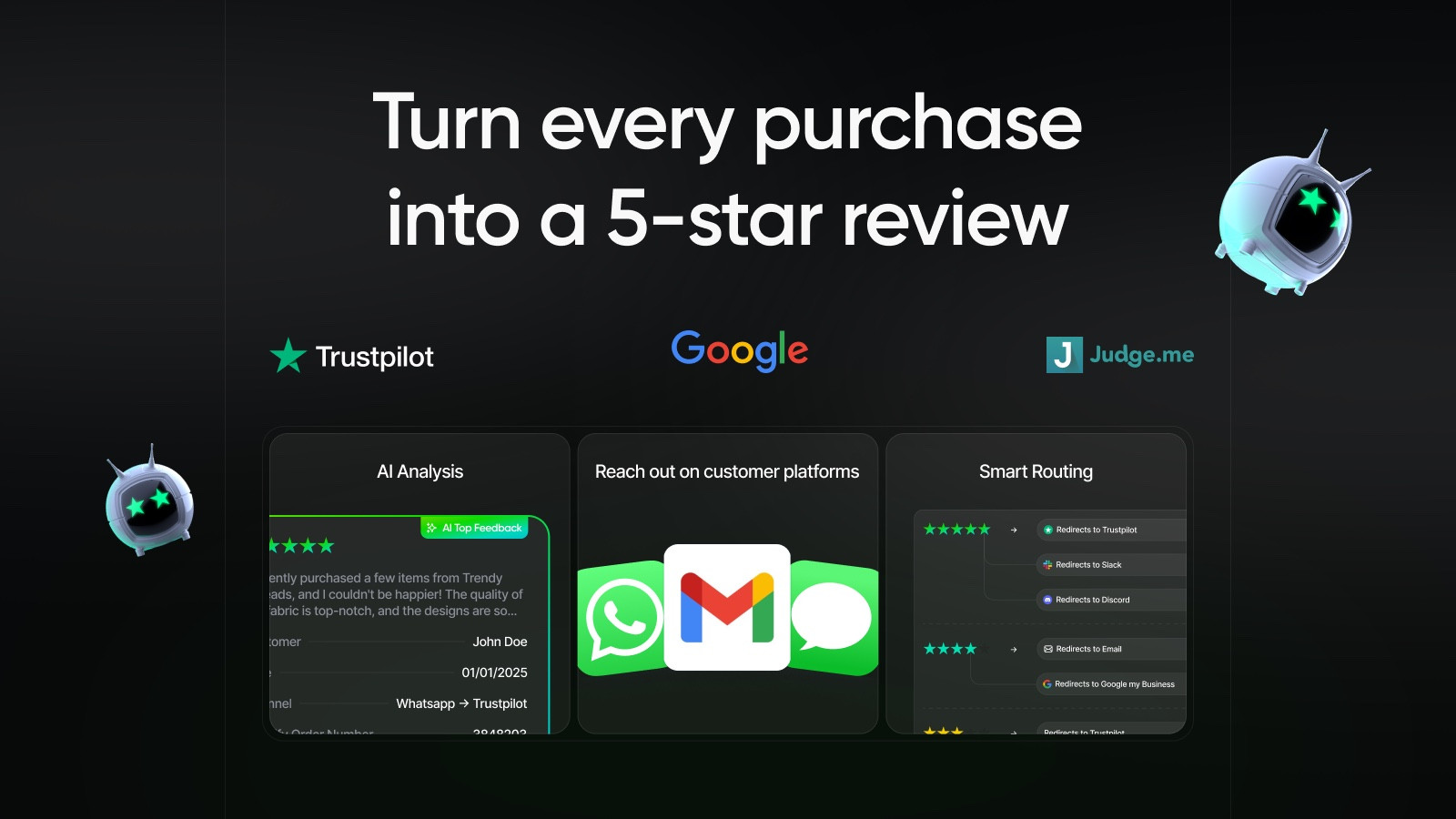 |
| Reviewz.ai for Shopify automatically routes happy customers to leave reviews on Trustpilot, Google, and Judge.me, while privately catching unhappy ones in a feedback portal before they post a public 1-star. Re-engage every reviewer with upsell offers via WhatsApp, email, and SMS. Install Reviewz on Shopify |
How to start collecting Trustpilot reviews
Here's the practical, FTC-aware path to going from zero to a healthy Trustpilot profile.
1. Claim and set up your profile
Create a free Trustpilot business account and claim your domain. Add your logo, a short description, and your website link. This alone makes your profile look credible and lets you reply to reviews.
2. Send your first review invitations
Reviews don't appear on their own. You have to ask. The most reliable way to get verified reviews is to invite customers after they receive their order, using Trustpilot's invitation system (the Automatic Feedback Service or BCC method, or the API on paid plans). Timing matters: invite once the product has likely arrived and been used, not the second the order ships. We dug into the data on the best time to send a review request.
Here is a clean, compliant invitation template you can adapt:
Subject: How was your order, {{first_name}}?

Hi {{first_name}},

Thanks for shopping with {{store_name}}. Your order arrived a few days
ago, so we'd love to hear how it's going.

Would you take 30 seconds to share an honest review? It helps other
shoppers and tells us where we can do better.

[Leave a review on Trustpilot]

Whatever your experience, good or bad, we want to hear it.

Thank you,
The {{store_name}} team
Note what this template does NOT do: it doesn't offer a discount in exchange for a positive review, and it doesn't ask only happy customers to post. Under the FTC's rules on reviews and testimonials, you can ask all customers for honest feedback, but you cannot condition incentives on the review being positive, and you cannot suppress negative reviews. Keep the ask neutral.
3. Build a steady, ongoing flow
Because the TrustScore weights recency, a one-time blast is worse than a slow, continuous stream. Automate invitations so every order triggers one, and you'll accumulate fresh reviews month after month. For a Shopify-specific playbook, see how to get more Trustpilot reviews on Shopify, and to skew that flow toward top ratings, how to get more 5-star reviews on Trustpilot.
4. Display reviews on your store
Once reviews start landing, embed a TrustBox widget on your homepage and near checkout. Trustpilot's dashboard gives you copy-paste TrustBox snippets you can drop into a Shopify section; for the full theme-level setup, follow our Trustpilot Shopify integration guide. Your best reviews are also marketing assets in their own right, the same way the testimonial advertising examples we collected turn a single quote into an ad.
5. Reply to every review, especially the bad ones
Responding shows prospective customers (and Trustpilot's algorithm) that you're an engaged, real business. A calm, specific reply to a 1-star review often does more for trust than the 5-stars above it. Our guide to responding to negative reviews walks through a framework.
A smarter route is to ask for feedback first and route it: send happy customers to Trustpilot and Google, while quietly catching unhappy ones in a private form so you can fix the issue before it becomes a public 1-star. That's exactly what Reviewz.ai automates across WhatsApp, SMS, and email, so you grow verified reviews without gaming anything.
The bottom line
Trustpilot is an open, independent review platform used by shoppers to vet businesses and by businesses to build brand-level trust. Its TrustScore is a weighted, recency-aware score (not a flat average), and its reviews come in two flavors: high-trust verified invitations and looser organic submissions. For Shopify stores, Trustpilot is best understood as the brand-trust layer that complements, rather than replaces, your on-site product reviews. Start free, invite customers consistently and neutrally, display a widget, and reply to everyone. Do that for a few months and Trustpilot becomes one of the cheapest, highest-leverage trust assets your store owns.
FAQ
Is Trustpilot free to use?
Yes, for both sides. Consumers read and write reviews for free, and businesses can claim a profile, reply to reviews, collect organic reviews, and embed a basic widget at no cost. Paid plans unlock high-volume invitations, Google seller ratings, customizable widgets, and API access. See our Trustpilot pricing guide for the break-even math.
Is Trustpilot the same as Google reviews?
No. Trustpilot is an independent platform focused on brand-level reviews, while Google reviews are tied to your Google Business Profile and feed Google Maps and local search. They serve different goals and many stores collect both. We compare them in Trustpilot vs Google reviews. To make asking for Google reviews frictionless, our free Google review link generator creates a direct "leave a review" URL you can drop into emails and SMS.
Does Trustpilot do product reviews?
No. Trustpilot reviews are about the business as a whole, not individual products. For per-product reviews on your Shopify product pages you need a product-review app such as Judge.me, Loox, or Yotpo, usually run alongside Trustpilot.
How does Trustpilot verify reviews?
Invited reviews are tied to a real order reference via Trustpilot's invitation system and carry a green "Verified" badge. Organic reviews (written by anyone without an invite) are not transaction-verified, though Trustpilot runs automated fraud detection and removes large volumes of fake reviews. Read Is Trustpilot legit? for the full picture.
Can a business delete bad Trustpilot reviews?
Not freely. A business can report reviews that violate Trustpilot's guidelines (fake, abusive, or off-topic), and Trustpilot decides whether to remove them. You cannot simply delete genuine negative reviews, which is the point of an independent platform. The durable strategy is to reply professionally and out-collect the bad reviews with steady, honest invitations. If a specific review is genuinely fake or abusive, our walkthrough on how to remove a fake Trustpilot review shows the exact reporting flow.
Who owns Trustpilot and is it a trustworthy company?
Trustpilot is a Danish company, Trustpilot Group plc, headquartered in Copenhagen and publicly listed on the London Stock Exchange (LSE: TRST) since 2021. As a regulated public company it publishes annual transparency reports detailing how many fake reviews it removes. That makes the platform itself legitimate, though the reliability of any single profile still depends on its verified-review ratio, as we explain in is Trustpilot legit.
Is Trustpilot worth it for a small Shopify store?
For most stores, yes, because the free plan already lets you claim a profile, collect organic reviews, reply to customers, and embed a basic widget at no cost. You only need a paid plan once you want to invite customers at scale or unlock Google seller ratings. If you would rather keep brand reviews on Google instead, weigh the trade-offs in Trustpilot vs Google reviews, and if Trustpilot's pricing feels steep, see the Trustpilot alternatives for Shopify.

About the author
Nicolas Provost · Founder of Reviewz.ai
Nicolas built Reviewz.ai after auditing 500+ Shopify review setups while running Kanal (WhatsApp marketing for Shopify). He has spent four years inside the Shopify ecosystem and writes about review collection, brand trust SEO, and the actual economics of running customer-feedback flows on ecommerce sites.
