
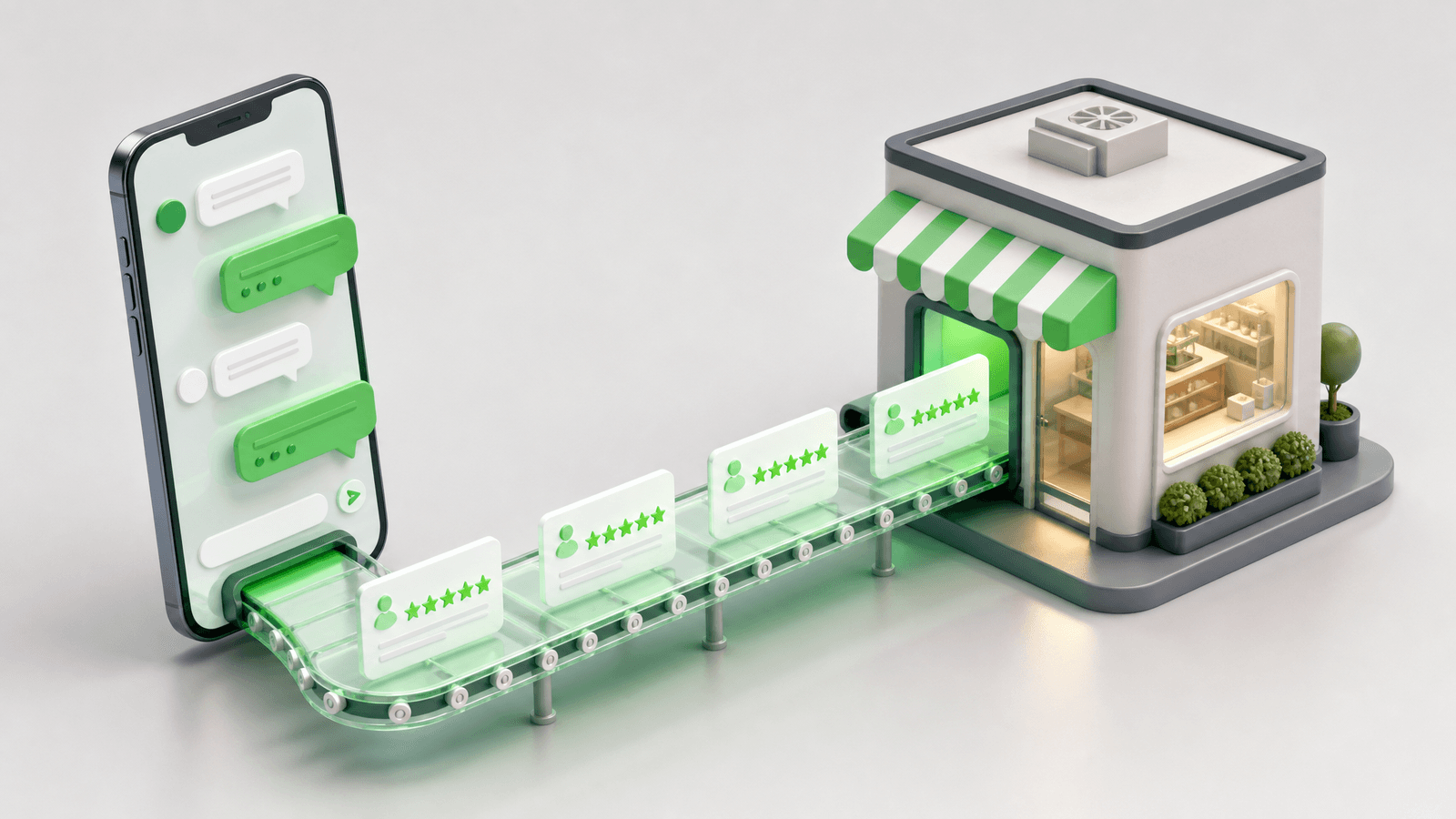
The fastest way to get more 5-star reviews on Trustpilot is to ask every happy customer at the right moment across the right channel, not to wait and hope. Trustpilot weighs review volume and recency heavily, so a steady stream of recent 5-star reviews lifts your score far more than a handful of old ones; the stores that win simply run a process that turns satisfied buyers into public reviewers on autopilot.
To get more 5-star reviews on Trustpilot: send the invite 7-14 days after delivery (not after order), ask across WhatsApp, SMS, and email instead of email alone, and pre-filter with a quick NPS question so promoters get the Trustpilot link while unhappy buyers reach a private feedback form first. Never gate, buy, or incentivize for a specific rating; that violates Trustpilot policy and the FTC rule and can wipe your score. Volume and recency drive the TrustScore, so consistency beats one-off campaigns.
Reviewed by Nicolas Provost, founder of Reviewz.ai. Insights based on auditing 500+ Shopify review setups and analyzing public pricing, schema, and conversion data across the leading review platforms. LinkedIn
Why 5-star volume matters more than your average
Most merchants obsess over their average star rating and ignore the two things Trustpilot actually weighs hardest: how many reviews you have and how recent they are. The TrustScore is not a simple average; it is a Bayesian-style calculation that gives recent reviews more pull and discounts old ones over a roughly 12-month window. A store with 40 reviews from two years ago is fragile. A store collecting 30 fresh 5-star reviews every month is durable, because each new positive review dilutes the impact of the occasional 1-star.
This is why "get more 5-star reviews" is really a volume-and-recency problem, not a sentiment problem. If your store does 1,000 orders a month and collects reviews passively, you will get maybe 5 to 15 a month, heavily skewed negative, because angry customers self-select to write reviews about 3x more often than happy ones. The customers who loved their order move on with their day and never think to post. Your public Trustpilot profile ends up reflecting your worst week, not your typical one.
The fix is a repeatable process that proactively invites every satisfied buyer, so the ratio of positive to negative reviews matches your real satisfaction rate. That is the entire game, and the rest of this guide is the playbook.
Ask at the right moment, not the wrong one
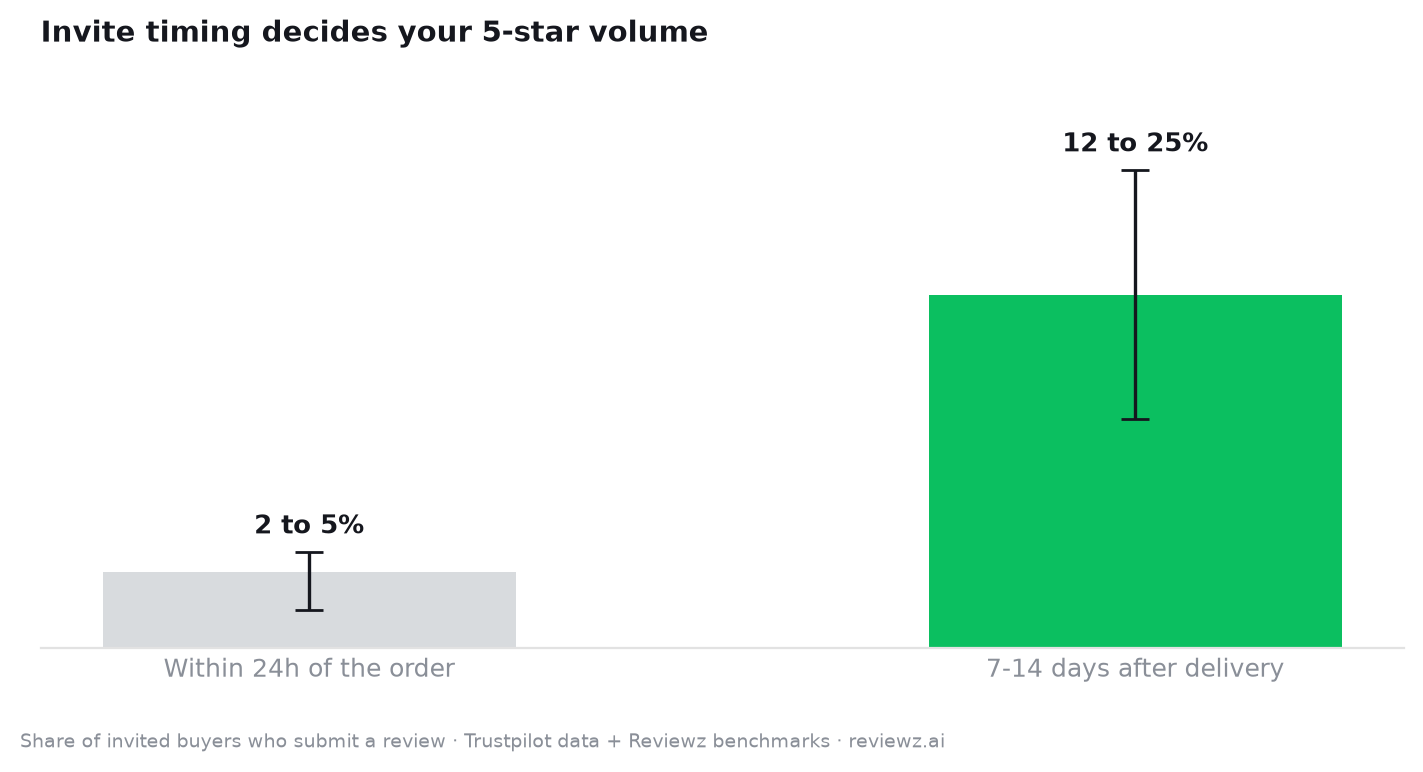
Timing is the single highest-leverage variable in review collection. Trustpilot's own data and our cross-store benchmarks agree: invites sent within 24 hours of the order get under 5 percent submission, while invites sent 7 to 14 days after delivery hit 12 to 25 percent. The reason is simple. A customer cannot honestly rate a product they have not used yet, and a review of the buying experience alone is generic and forgettable.
The trigger that matters is delivery, not order placement. Most Shopify review apps default to "X days after order," which fires while the package is still in transit and produces confused responses, accidental shipping 1-stars, or silent deletes. Switch the trigger to the fulfillment or delivery webhook and the same email content roughly doubles its submission rate.
The optimal delay then varies by category:
- Consumables, food, supplements: 3 to 7 days after delivery
- Apparel, beauty, accessories: 7 to 10 days
- Home goods, furniture, electronics: 10 to 21 days
For the full breakdown by category, day of week, and time of day, see our guide on the best time to send a review request.
Ask across multiple channels, not just email
Email-only review invites top out around 15 to 25 percent click-through for the best Shopify brands. Adding WhatsApp and SMS to the sequence, staggered a few days apart, typically lifts total review collection by 35 to 50 percent because you reach buyers where they actually read.
The sequence that works best:
- Day 10 after delivery: a WhatsApp message, which over-indexes hard for ecommerce with open rates near 98 percent versus roughly 22 percent for email
- Day 13: an email follow-up to catch anyone who skipped WhatsApp
- Day 17: an SMS reminder as the last touch for habitual non-responders
Each channel covers a different slice of your audience, and the combined reach is what drives volume. A buyer who ignores email may reply to a WhatsApp message in seconds. The deeper tactical playbook lives in how to get more Trustpilot reviews on Shopify.
Pre-filter with NPS so happy buyers reach Trustpilot
This is the move that separates stores with a 4.7 from stores stuck at 3.9. Instead of blasting a Trustpilot link to everyone, ask one quick question first: "How likely are you to recommend us to a friend, 0 to 10?" Then route based on the answer:
- 9-10 (promoters): send the Trustpilot invite immediately. These buyers are pre-qualified to leave a 5-star.
- 7-8 (passives): send a softer "we would love your thoughts" message with an open-text box, no public push.
- 0-6 (detractors): route to a private feedback form where they tell you directly what went wrong, so you can fix it before they post publicly.
To be precise about the line here: this is not deceptive review gating. You are not blocking anyone from posting on Trustpilot; detractors remain free to leave a public review on their own, and most will not bother once they have vented privately and felt heard. You are simply choosing not to actively recruit reviews from people who just told you they had a bad experience. That distinction matters, and Trustpilot draws it the same way. Our free NPS calculator shows the math: in aggregate, each detractor review roughly cancels out five promoter reviews, which is why pre-filtering moves your score so fast.
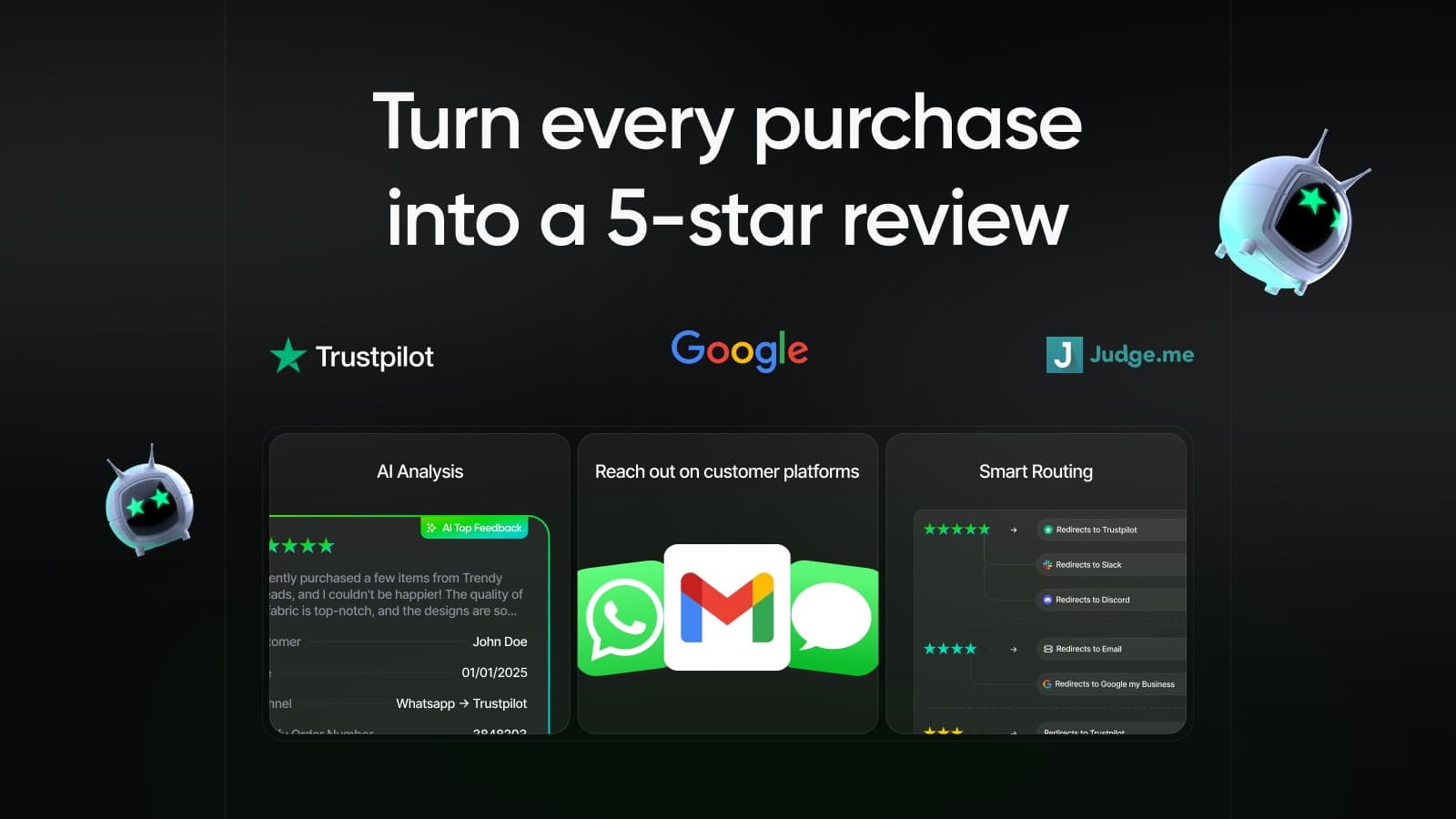
Route happy customers to Trustpilot & Google, capture negatives privately.
Install Reviewz on ShopifyWhat a strong 5-star review actually looks like
Not all 5-star reviews are equal. A review that says "Great, thanks" helps your count but does little for conversion. The reviews that sell for you are specific: they name the product, mention a concrete benefit, and address an objection a future buyer is silently worried about.
Compare these two real-pattern examples:
- Weak: "Good product, fast shipping. Recommend."
- Strong: "Ordered the linen midi dress sceptical about the fit from photos. It runs true to size, the fabric is heavier than I expected (a good thing), and it arrived in four days. Support answered my sizing question on WhatsApp within an hour before I bought. Second order already placed."
The strong one converts because it preempts doubt (fit, fabric quality, support responsiveness, delivery speed). You can nudge buyers toward this kind of review without scripting it by asking an open question in the invite, such as "What surprised you most about your order?" or "What would you tell a friend who is on the fence?" Those prompts pull out specifics instead of one-liners. You can never tell a customer what rating to leave, but you can absolutely shape how richly they describe a genuine experience.
Automate the whole thing on Shopify
Done manually, this process collapses the first busy week. Done automatically, it compounds. On Shopify the pieces are: capture the delivery event, wait the right delay by category, fire the NPS question across WhatsApp, SMS, and email, then route promoters to your Trustpilot review link and detractors to a private form, and finally display the reviews you collect back on your storefront to create a reciprocity loop.
That last step matters more than people expect. Buyers who see Trustpilot reviews on your product pages and footer are measurably more likely to leave their own afterward. Trustpilot's own free TrustBox widgets let you embed your reviews natively in your theme without a paid Trustpilot plan, and a Trustpilot review URL generator gives you the direct, friction-free link to drop into every invite so buyers land on the review form instead of a login wall.
This end-to-end flow, timed multi-channel invites, NPS pre-filtering, smart routing, and private detractor capture, is exactly what Reviewz.ai for Shopify automates. For the full setup including the widget embed, our Trustpilot Shopify integration guide is the pillar to start from.
What NOT to do (gating, buying, incentivizing a rating)
Every shortcut below feels tempting and every one of them can wipe out the score you worked to build. Trustpilot actively polices these, and the FTC final rule banning fake reviews and testimonials makes several of them illegal in the United States.
- Buying reviews. Purchased Trustpilot reviews are detectable, get removed in bulk, and can trigger a public "this company has been using fake reviews" warning flag on your profile. The FTC penalty can reach tens of thousands of dollars per fake review.
- Incentivizing a specific rating. Offering a discount "for a 5-star review" is prohibited. You may invite reviews and even offer a small thank-you for any honest review, but the moment the reward is tied to the rating, it is a violation and the disclosure rules kick in.
- Hard review gating. Showing the Trustpilot link only to happy customers while technically blocking unhappy ones from a public path is deceptive gating and against Trustpilot policy. NPS routing is fine because detractors stay free to post; a hard block is not.
- Posting reviews yourself or asking staff and friends. These get flagged as conflicts of interest and removed, and they erode the very trust the reviews are meant to build. (Worth understanding whether Trustpilot is legit and how it catches this.)
- Filtering out negative reviews after the fact. You cannot delete genuine negative reviews. The compliant move is to respond well using a framework like the one in our guide on how to respond to negative reviews, which research links to a measurable lift in future positive reviews.
If your score is already low from past mistakes, the recovery path is volume of fresh, genuine 5-star reviews plus good responses, not removal tricks. Our walkthrough on how to fix a low Trustpilot score covers the full repair sequence.
The bottom line
Getting more 5-star reviews on Trustpilot is not a clever-template problem or a hack. It is a process: ask every happy buyer at the right moment, across the right channels, pre-filtered so promoters reach Trustpilot and detractors reach you privately, with everything automated and your reviews displayed back on your store. Run it consistently and the TrustScore's volume-and-recency weighting works in your favor month after month. Skip it and you stay at the mercy of whichever angry customer happens to remember your name.
For Shopify stores, the simplest way to run all of this on autopilot is Reviewz.ai: timed multi-channel invites over WhatsApp, SMS, and email, NPS pre-filtering, smart routing to Trustpilot or Google, and private detractor capture so 1-stars never become public.

About the author
Nicolas Provost · Founder of Reviewz.ai
Nicolas built Reviewz.ai after auditing 500+ Shopify review setups while running Kanal (WhatsApp marketing for Shopify). He has spent four years inside the Shopify ecosystem and writes about review collection, brand trust SEO, and the actual economics of running customer-feedback flows on ecommerce sites.
