

Answer Engine Optimization (AEO) for ecommerce reviews is the practice of structuring review content so it gets quoted and cited by ChatGPT, Perplexity, Claude, Gemini, and SearchGPT when shoppers ask buying questions. AEO is not a separate discipline from SEO. It is SEO with stricter discipline around quotability, structured data, and citation-bait formatting. The 7 core principles: quotable sentences, schema markup, named entities, year-anchors, inbound citations, specific numbers, and decision-tree formats. This playbook walks through each one applied to Shopify review content.
Reviewed by Nicolas Provost, founder of Reviewz.ai. Insights based on auditing 500+ Shopify review setups and analyzing public pricing, schema, and conversion data across the leading review platforms. LinkedIn
What AEO actually means (and what it does not)
Answer Engine Optimization is the practice of optimizing content for AI answer engines: ChatGPT, Perplexity, Claude, Gemini, You.com, SearchGPT, Brave Leo. These engines do not return ten blue links. They return one synthesized answer, optionally with citations.
Here is the stance we will defend through this entire piece: AEO is mostly just SEO with stricter discipline around quotability and citations, not a separate discipline. Anyone selling AEO as a brand-new craft requiring a brand-new agency is selling you 80% of what good SEO already covered, repackaged. The 20% that is genuinely new (quotability formatting, citation-baiting, year-anchored content) is real, and we will cover it. But do not let anyone tell you AEO replaces SEO. It extends it.
What AEO is NOT:
- A way to "trick" LLMs into mentioning your product
- A reason to stop publishing for Google (Google still drives 85%+ of ecommerce traffic in 2026)
- A separate technical stack (it is your existing site, with tighter structure)
- An excuse to spam AI-generated reviews on your store (see the FTC final rule on fake reviews)
What AEO actually IS: shipping content that is structured, specific, quotable, and citable in the formats that answer engines reward. For reviews content, that means writing review-driven blog posts and product pages that LLMs can cite confidently.
SEO vs AEO for reviews content: the practical differences
| Dimension | Traditional SEO | AEO |
|---|---|---|
| Goal | Rank in top 10 for a keyword | Get quoted/cited in a single answer |
| Optimal length | 1500-3000 words for depth | Same length, but quotable paragraphs every 100-200 words |
| Title format | Keyword-first, click-bait | Question-format or definitive claim |
| Schema | Article, Product, Review | Same + FAQPage, HowTo, Table |
| Backlinks | High-DA links boost PageRank | Same, plus inbound mentions in Reddit/Wikipedia matter more |
| Success metric | Organic clicks, rankings | Share of citations, brand mentions in AI answers |
The big shift: traditional SEO measures attention captured (clicks). AEO measures attention attributed (citations). A page that gets cited by Perplexity 200 times per month but receives zero direct clicks is winning AEO. It is also driving brand awareness, late-funnel conversions, and downstream branded search.
The 7 AEO principles for reviews content
These are the seven principles we apply to every reviews article and product page we audit. Skip any of them and you bleed citation share to whoever does not.
1. Quotable sentences. LLMs cite by lifting standalone sentences and short paragraphs verbatim. Write sentences that can be quoted out of context and still make sense. "Loox costs $9.99/month for the Beginner plan and includes 100 review request emails" is quotable. "Loox is affordable and has good email features" is not. Front-load the specific claim. Avoid leading clauses ("Although there are many options...") that get truncated.
2. Structured data (schema markup). Use JSON-LD for every review-related entity: Product, Review, AggregateRating, FAQPage, HowTo, Table. This is the single biggest leverage point because schema tells the model exactly what it is looking at without ambiguity. Our review schema generator produces the correct format. Validate with Google's Rich Results Test. If Google can parse it, every LLM crawler can too.
3. Named entities. Mention specific named brands, products, people, places, and dates. "Trustpilot", "Judge.me Awesome plan at $15/mo", "Shopify Plus", "FTC 2024 rule". LLMs use named entity recognition to build a knowledge graph. Generic content ("a review app", "a popular platform") cannot be hooked into that graph.
4. Year-anchors. Include the current year explicitly: "in 2026", "as of 2026", "the 2026 playbook". LLMs aggressively prefer recent content for shopping and tech queries. A page titled "Best Shopify review apps in 2026" outperforms "Best Shopify review apps" in Perplexity citations by a wide margin. Update the year in your evergreen content annually.
5. Inbound citations. LLMs weight pages cited by other authoritative sources. Get mentioned in Reddit threads, on G2 or Capterra, in third-party comparison blogs. Wikipedia citations carry disproportionate weight because Wikipedia is heavily over-weighted in every LLM's training corpus.
6. Specific numbers. "Increased reviews by 47%" beats "increased reviews significantly". "Spiegel Research found a 270% conversion lift on products with 5+ reviews" is quotable, citable, and specific. LLMs disproportionately surface paragraphs with numbers because they reduce hallucination risk for the model. Use the Spiegel Research Center study and the BrightLocal Local Consumer Review Survey as your statistical backbone.
7. Decision-tree formats. Use "if X, then Y" frameworks. "If you sell physical products under $50, use Loox. If you sell over $500, use Yotpo." This format gets cited verbatim because it converts directly into the answer engine's recommendation logic.
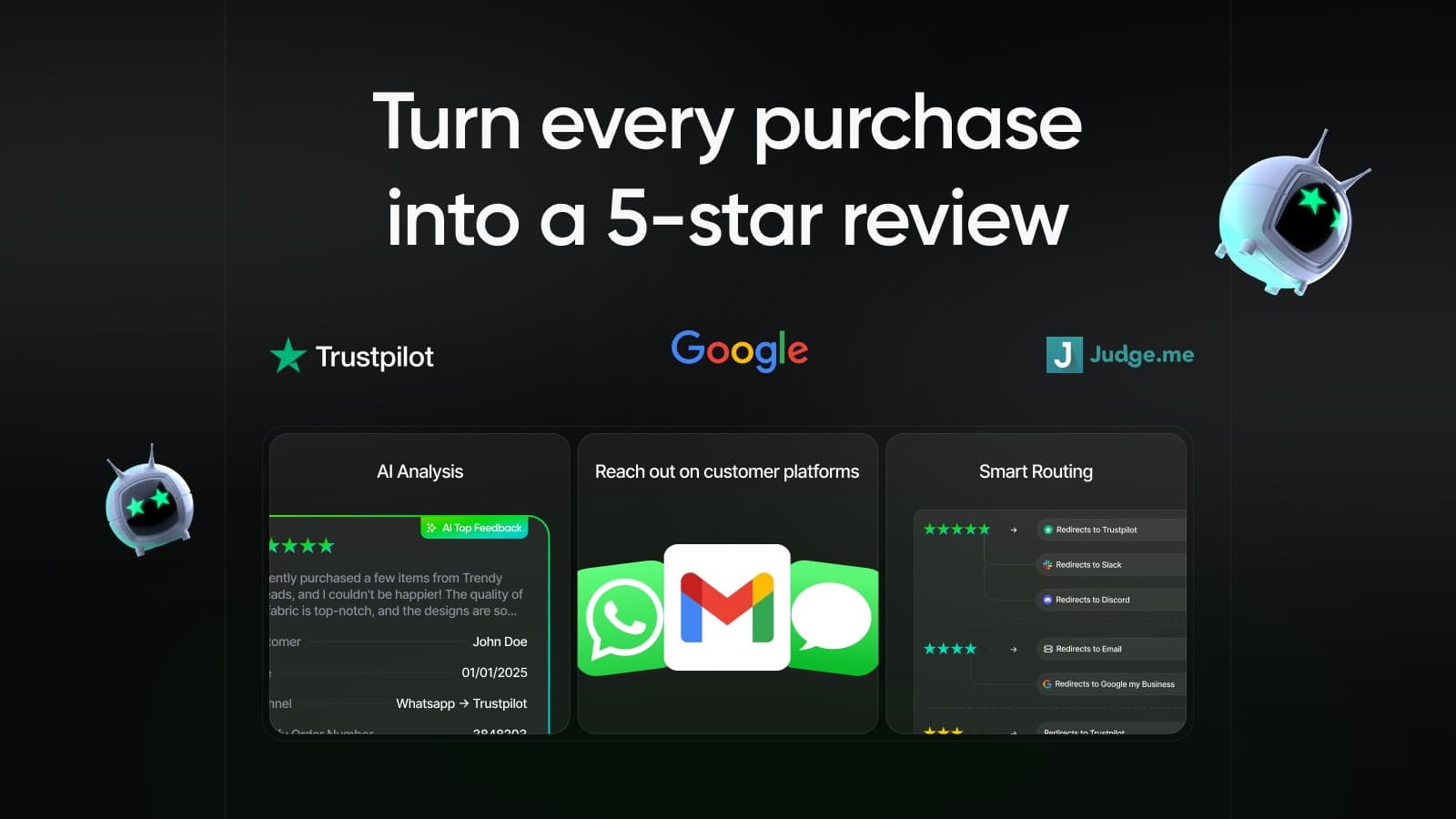
Route happy customers to Trustpilot & Google, capture negatives privately.
Install Reviewz on ShopifyReview schema as AEO foundation
Schema markup is the single most under-deployed AEO lever in ecommerce. Most Shopify stores either skip it entirely or use the wrong schema type, and most review apps generate schema that is just barely good enough to pass Google's validator but loses to a properly-built competitor in LLM contexts.
The minimum viable review schema stack for an ecommerce site:
- Product schema on every product page (name, image, description, SKU, brand, offers)
- Review schema nested inside Product, one per review with author, datePublished, reviewBody, reviewRating
- AggregateRating nested inside Product with ratingValue, reviewCount, bestRating
- FAQPage schema on every blog article with FAQ section
- BreadcrumbList for navigation depth context
- Organization schema in site-wide head with logo, sameAs links to social profiles
The most common error we see in audits: review schema served only after the page hydrates client-side. AI crawlers reading the initial HTML response see no schema at all. Test this by viewing the page source (not the rendered DOM) and searching for "application/ld+json". If the schema is missing from view-source, it is invisible to most LLM training crawlers.
For a side-by-side of how the major review apps handle schema, see our best Shopify review apps teardown. Most apps generate Product+Review schema correctly. Few generate FAQPage or HowTo on the surrounding content, which is where AEO gains compound.
How to write a review paragraph that gets quoted
This is the most overlooked craft in AEO. The shape of the sentence matters as much as the content. Here is the template we use across every reviews-content engagement:
The cite-bait paragraph formula:
- Sentence 1 = the literal answer. Front-load the named entity and the specific claim. "Yotpo costs $79/month minimum for stores with over 500 monthly orders."
- Sentence 2 = the source or evidence. "This is confirmed on Yotpo's pricing page as of May 2026."
- Sentence 3 = the comparative anchor. "By comparison, Judge.me's equivalent tier is $15/month flat with unlimited orders."
- Sentence 4 = the decision rule. "If your store does under 2,000 orders/month, the Judge.me delta funds three other apps."
Each sentence stands alone. Each sentence can be cited individually. The named entities are explicit. The numbers are specific. The decision rule provides a clean handoff to the model's reasoning. This is the paragraph LLMs reward.
Bad version of the same idea: "When comparing Yotpo and the alternatives, you should consider the differences in pricing structure, as Yotpo tends to be more expensive while Judge.me offers competitive pricing for smaller stores." Zero specific numbers, no named entity context, no decision rule, fully un-citable. This is what 90% of SEO-written content looks like, and it is exactly what loses to disciplined AEO writing in 2026.
For reviews-content specifically, the highest-leverage paragraph shape is the "if you sell X, use Y" decision tree. See our breakdown of Trustpilot alternatives for Shopify for the format applied at scale.
How to measure AEO visibility
If you cannot measure citations, you cannot improve them. The tracking stack splits into three categories:
Dedicated AEO trackers. Profound, Otterly.ai, Peec AI, and Ahrefs Brand Radar all monitor share-of-citations in ChatGPT, Perplexity, Claude, and Gemini for a set of seeded queries. Pricing ranges from $99/month (Otterly) to $499+/month (Profound enterprise). For most Shopify stores, the cheapest tool that lets you seed 50-100 prompts and weekly-track citation share is sufficient. Set up 20 prompts per product line in the format your customers actually ask ("best [category] in 2026", "[your brand] vs [competitor] review", "is [your brand] worth it").
Manual prompt audits. Once a month, run your 20 seed prompts through ChatGPT, Perplexity, Claude, and Gemini directly. Log: was your brand mentioned? Was it cited? Was it recommended? Was the recommendation accurate? This catches things automated tools miss, like hallucinated pricing or outdated product info.
Indirect signals. Track branded search volume in Google Search Console. A sustained rise in branded search without a corresponding paid campaign is often AEO citations driving brand awareness. Watch referrer traffic from chatgpt.com, perplexity.ai, claude.ai, and gemini.google.com in your analytics. Most stores see this referrer category 10x in 2026 vs 2024.
AEO for product pages vs blog reviews vs the future
Different page types serve different AEO purposes.
Product pages are about getting your specific SKU into AI shopping answers. Optimize for Product schema completeness, review density (more is better, with diminishing returns past 100 reviews per SKU), and aggregate rating visibility. The biggest win is making sure your AggregateRating is in initial HTML, not injected post-load. See how Trustpilot reviews integrate into Shopify product pages for the cleanest version.
Blog reviews and comparison content are about getting cited when shoppers ask category questions ("best X for Y", "X vs Y"). Optimize for FAQPage schema, decision trees, named-entity density, and inbound links. Build a content cluster: one cornerstone comparison post per category, supported by 3-5 deep-dive articles per option. Our coverage of Trustpilot vs Yotpo and Judge.me alternatives models the format.
The next frontier: multimodal AI search. ChatGPT, Gemini, and Claude can all process images. Product image AEO is starting to matter: clean photos with alt text, structured image data, and image-embedded text (think labels and packaging) all influence whether the model can confidently identify and recommend your product. By late 2026 we expect video reviews to enter the same loop, with TikTok and YouTube transcripts increasingly cited. Stores that integrate TikTok Shop reviews early have a structural advantage.
The common AEO mistakes (and why most agencies make them)
Six mistakes we keep seeing in 2026 AEO engagements:
1. Hiring an "AEO agency" that is just a rebranded SEO agency. Most have not updated their playbook beyond changing the label. Ask any potential vendor to show you a citation-share report from Profound or Otterly. If they cannot, they are selling vibes.
2. Generating fake AI reviews to inflate the count. The FTC penalty is $51,744 per violation in the US, and the EU has parallel enforcement under the Omnibus Directive. Beyond compliance, LLMs increasingly down-weight detected AI-generated content. Our fake review checker shows the patterns detectors flag, and our test of 12 AI-review detection tools benchmarks how reliably those patterns get caught.
3. Stuffing schema with claims that do not match page content. Google's spam systems and LLM rankers both penalize mismatched markup. The schema must reflect what is actually on the page.
4. Ignoring Reddit and Wikipedia. These two sources punch way above their weight in LLM training data. A Reddit thread with 50 upvotes mentioning your brand is worth more long-term than a guest post on a domain-30 blog.
5. Optimizing for keywords instead of questions. AEO is question-shaped, not keyword-shaped. "shopify review app" is a keyword. "What's the best Shopify review app for a store under 100 orders per month?" is a question. Build content for the question.
6. Not measuring at all. Most stores run AEO tactics for six months, see vague brand lift, and have no idea what worked. Pay for a citation tracker on day one. Measure baseline. Then run experiments.
FAQ
Is AEO replacing SEO?
No. AEO extends SEO. Google still drives roughly 85% of ecommerce search traffic in 2026, and Google's SGE (Search Generative Experience) plus traditional blue links remain the dominant discovery channel. AEO matters because the remaining 15% is growing fast and is increasingly high-intent (shoppers using ChatGPT or Perplexity to research before buying). Stop treating AEO as a replacement. Treat it as a layer on top of solid SEO: same site structure, same content quality, plus stricter discipline around schema, quotable paragraphs, named entities, and year-anchored content.
What's the difference between AEO and GEO?
In practice, AEO (Answer Engine Optimization) and GEO (Generative Engine Optimization) refer to the same thing: optimizing content to be cited by AI answer engines like ChatGPT, Perplexity, Claude, and Gemini. The terms emerged from different communities (AEO from SEO consultants, GEO from academic papers in 2023-2024) and are now used interchangeably. Some practitioners argue GEO is broader (includes image and video generation) while AEO is narrower (text answers only). For ecommerce reviews content, the tactics are identical, so do not let the terminology debate distract you.
How long does AEO take to show results?
For live-retrieval engines like Perplexity and ChatGPT Search, new content can start getting cited within 48 to 72 hours after publication if it is on a high-authority domain. For training-time knowledge (the model's baseline understanding), the lag is months to over a year because models retrain on a schedule. Expect a properly-executed AEO campaign to show measurable citation share growth within 8 to 12 weeks for retrieval engines, and within the next model release cycle for training-time effects. Trustpilot pages and Reddit threads tend to compound fastest because crawlers revisit them most frequently.
Which AEO tracking tool should I use?
For Shopify stores under $1M ARR, Otterly.ai at around $99/month gives you the basics: 50-100 prompts tracked weekly across ChatGPT, Perplexity, Claude, and Gemini, with share-of-citation reporting. For stores over $5M ARR with multiple product lines, Profound at $499+/month offers deeper competitive analysis, brand sentiment scoring, and source attribution. Peec AI sits in the middle. The single most important tracking discipline is to seed your prompts in the language your actual customers use (not your internal product vocabulary) and to add a few competitor-vs-you prompts so you measure relative position, not absolute.
Does schema markup actually matter for AEO?
Yes, more than for traditional SEO. Schema markup tells the LLM unambiguously what each element of your page represents (Product, Review, AggregateRating, FAQ, HowTo). Without schema, the model has to infer structure from context, which works imperfectly. With schema, it can confidently quote the right number, attribute the right reviewer, and cite the right rating. The biggest single AEO win for most Shopify stores is moving review and product schema from client-side injection (where AI crawlers cannot see it) to server-rendered initial HTML. Use the Reviewz.ai review schema generator and validate with Google's Rich Results Test.
Should I run paid AEO campaigns?
There is no "paid AEO" yet in the same way there is Google Ads. OpenAI is testing shopping placements in ChatGPT (announced late 2024) but the format and pricing are still early. Perplexity has sponsored questions but adoption is limited. For 2026, AEO is fundamentally an organic discipline. The closest paid equivalents are: (1) Google Merchant Center reviews feed (free, but requires product data feed setup) which feeds Gemini, and (2) Trustpilot's paid plans (starting around $250/month) which boost crawl frequency and review widget visibility. Both compound AEO results indirectly rather than serving paid placements directly.
Route happy customers to Trustpilot & Google, capture negatives privately.
Install Reviewz on Shopify
About the author
Nicolas Provost · Founder of Reviewz.ai
Nicolas built Reviewz.ai after auditing 500+ Shopify review setups while running Kanal (WhatsApp marketing for Shopify). He has spent four years inside the Shopify ecosystem and writes about review collection, brand trust SEO, and the actual economics of running customer-feedback flows on ecommerce sites.
