

Trustpilot's TrustScore is Bayesian-weighted, not a simple average. Trustpilot adds the value of 7 reviews at 3.5 stars to every calculation; real reviews dilute these over time. Recent reviews count more than older ones, although Trustpilot does not publish the exact decay curve. To improve your score, focus on volume (biggest lever), recency (consistent collection), response rate, verified ratio, and removing genuine fakes. Going from 4.0 to 4.5 typically takes 6-9 months of active collection.
Reviewed by Nicolas Provost, founder of Reviewz.ai. Insights based on auditing 500+ Shopify review setups and analyzing public pricing, schema, and conversion data across the leading review platforms. LinkedIn
Quick answer: how is TrustScore calculated?
Trustpilot's TrustScore is a Bayesian-weighted, time-decayed average of all reviews on a business profile, with extra weight for recent reviews. It's not the simple arithmetic mean of star ratings (which is what most other platforms display), and it's central to how Trustpilot works as a trust signal.
This article explains the actual formula (as documented in Trustpilot's own help center and reverse-engineered by independent researchers), why it matters for Shopify stores, and the 5 practical levers to improve yours.
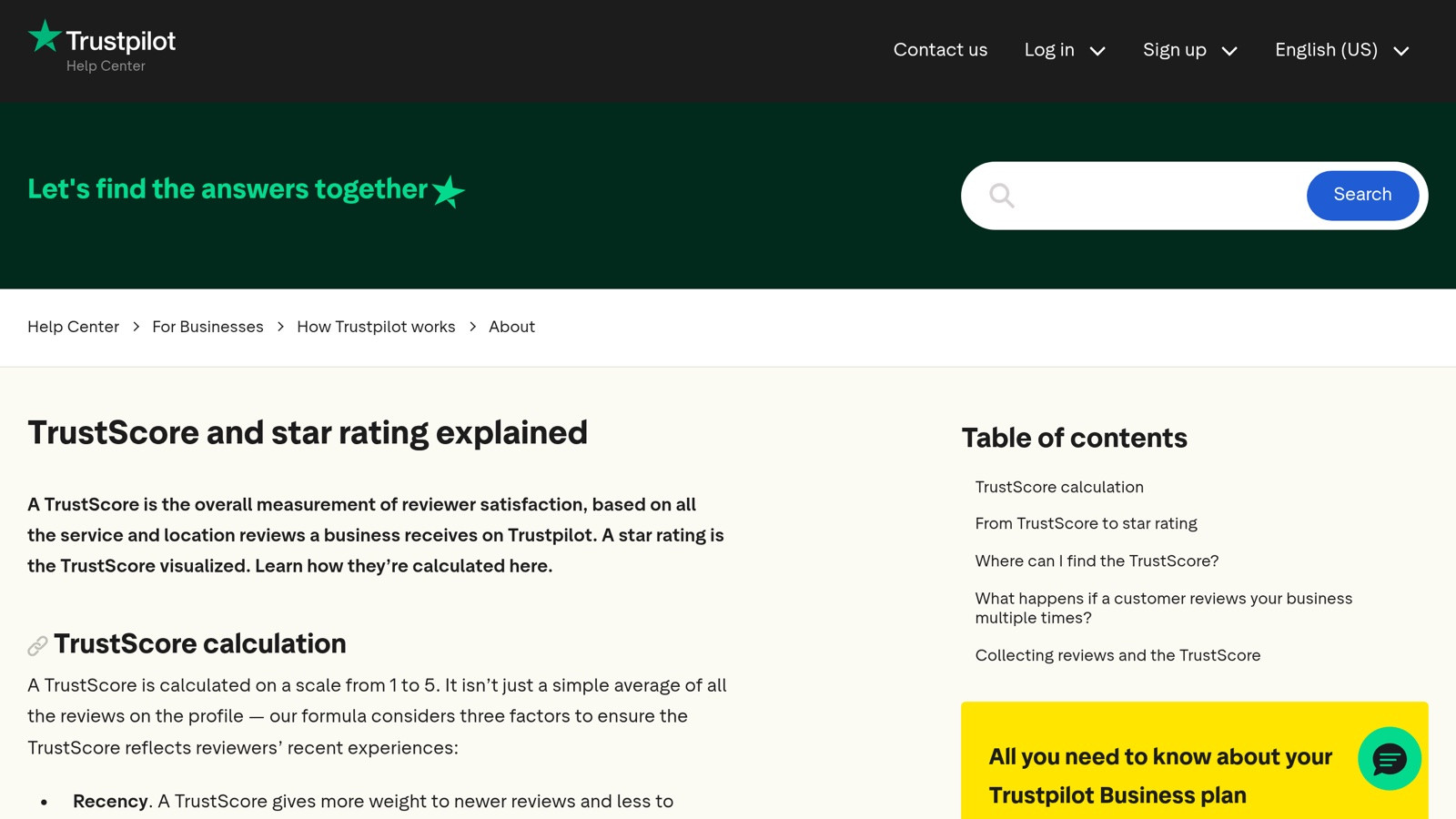
Trustpilot's official "TrustScore and star rating explained" help page describes the 3 factors that drive the score: recency, frequency, and bayesian average. The exact formula isn't published but the principles are.
The actual formula
Trustpilot's TrustScore for a business is calculated approximately as:
TrustScore = ( Σ(rating_i × weight_i) + (B × M) ) / ( Σ(weight_i) + B )
Where:
rating_i= each review's 1-5 star ratingweight_i= time-decay weight for each review (1.0 for last 12 months, decays exponentially)B= Bayesian prior weight (Trustpilot states it includes the value of 7 reviews, so B = 7)M= Bayesian prior mean (3.5 stars)
In English: every business is scored as if it also had 7 reviews at 3.5 stars. As you collect real reviews, those built-in reviews get washed out, and your real average dominates. This is why a brand-new profile with one 5-star review shows a TrustScore of around 3.7, not 5.0: (5 + 7 × 3.5) / 8 = 3.69.
The three ingredients (time span, frequency and the Bayesian average) are the ones Trustpilot documents. The exact weights are not public, so treat the formula above as a faithful model rather than Trustpilot's source code.
TrustScore to stars: what each range displays
The TrustScore is a number from 1 to 5 with one decimal. The stars and the label shown next to it are derived from that number:
| TrustScore | Label | Stars shown |
|---|---|---|
| 4.8 to 5.0 | Excellent | 5 stars |
| 4.3 to 4.7 | Excellent | 4.5 stars |
| 3.8 to 4.2 | Great | 4 stars |
| 2.8 to 3.7 | Average | 3 to 3.5 stars |
| 1.8 to 2.7 | Poor | 2 to 2.5 stars |
| 1.0 to 1.7 | Bad | 1 to 1.5 stars |
Two thresholds matter commercially. 4.3 is where the label flips from "Great" to "Excellent", and 3.8 is where it flips from "Average" to "Great". A store sitting at 4.2 gains more from one tenth of a point than a store sitting at 4.5 does.
Time decay
Older reviews are progressively down-weighted. Trustpilot does not publish the curve, so the figures below are our working estimate, not an official table:
- 0-12 months old: 100% weight
- 12-24 months old: ~70% weight
- 24-36 months: ~45% weight
- 36+ months: ~30% weight
This is why active review collection matters: a profile that stopped collecting reviews 2 years ago will see its TrustScore drift toward 3.5 (the Bayesian mean) as old reviews lose weight.
Why your TrustScore feels "wrong"
The most common confusion: a merchant has 50 5-star reviews and 2 1-star reviews, calculates 4.85 mean, and sees a TrustScore of 4.4. Where does the 0.45 difference come from? Three reasons:
- Bayesian smoothing: with only 52 reviews, the 7 built-in reviews at 3.5 still pull the score down by about 0.15 points
- Time decay: if half your reviews are over 12 months old, their weight is reduced
- Removals: reviews that Trustpilot's fraud detection takes down stop counting, so a batch of removed 5-stars lowers the score overnight
Use our NPS calculator for the related (simpler) Net Promoter Score formula; TrustScore is more complex by design because Trustpilot wants to make manipulation harder.
The marginal impact of each new review
Most merchants want to know: "if I get one more 5-star review, how much does my score change?" The answer depends on your existing volume.
| Review count | Impact of +1 5-star | Impact of +1 1-star |
|---|---|---|
| 10 reviews | +0.07 | -0.18 |
| 50 reviews | +0.025 | -0.06 |
| 200 reviews | +0.007 | -0.018 |
| 1,000 reviews | +0.0014 | -0.0036 |
| 5,000 reviews | +0.0003 | -0.0007 |
These figures assume a profile averaging about 4.0 and ignore time decay. Two takeaways: (1) volume is your moat. A 5,000-review profile barely moves on any single review. (2) negative reviews hurt 2.5-3x more than positive reviews help at any volume, because they pull harder against the Bayesian mean.
How many 5-star reviews to "cancel out" a 1-star?
The classic question (and a top PAA on Trustpilot SERPs). The answer:
- From a 0-review baseline: 4 five-stars cancel 1 one-star to reach a 4.0 average.
- From a 4.5 average with 100 reviews: ~11 five-stars to recover from a single new 1-star.
- From a 4.5 average with 500 reviews: ~3 five-stars to recover.
- From a 4.5 average with 2,000 reviews: ~1 five-star is enough.
The pattern: the more reviews you have, the less any individual review (positive or negative) moves your score. Volume insulates.
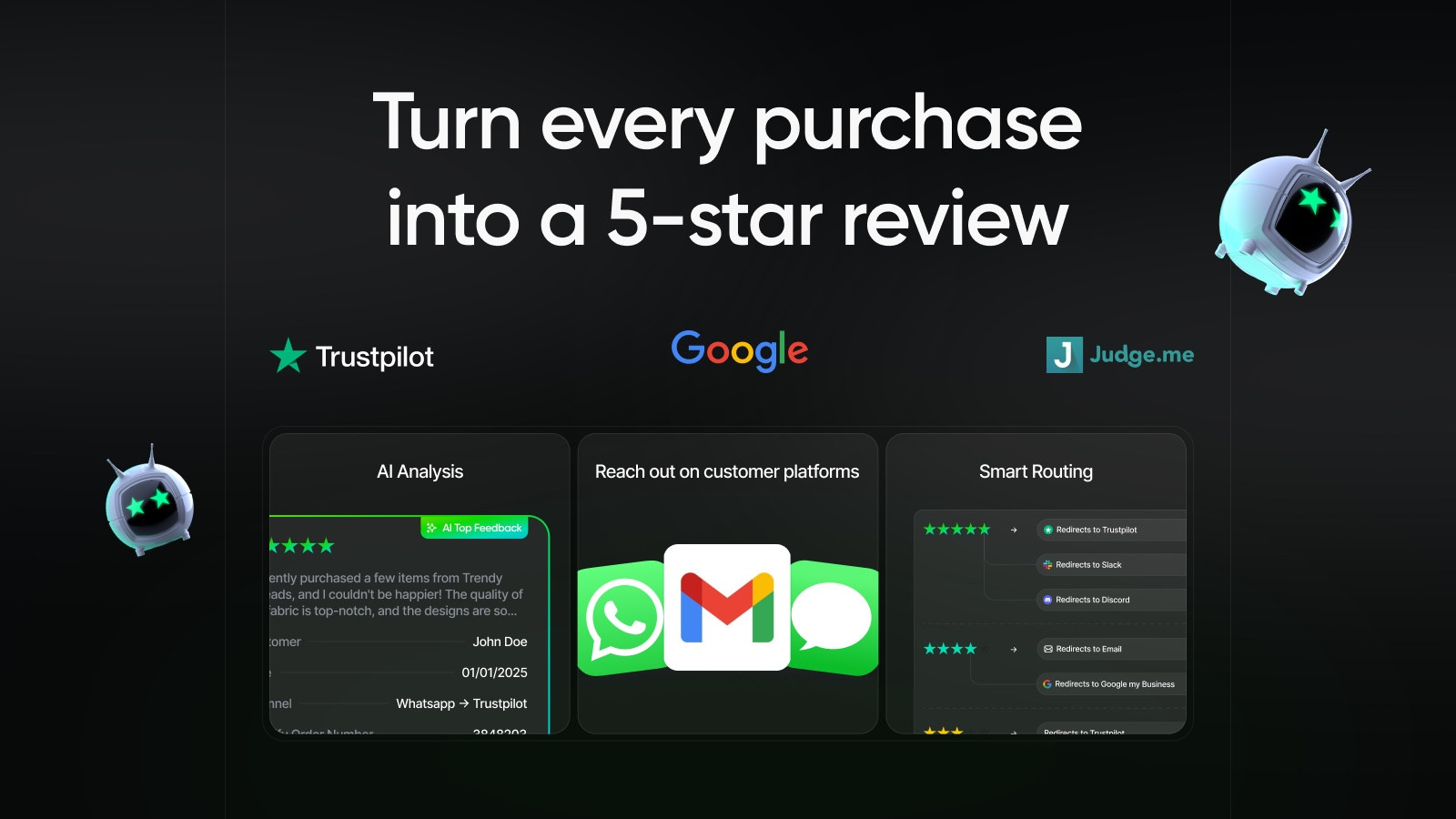 |
Reviewz.ai for Shopify automatically routes happy customers to leave reviews on Trustpilot, Google, and Judge.me, while privately catching unhappy ones in a feedback portal before they post a public 1-star. Re-engage every reviewer with upsell offers via WhatsApp, email, and SMS.
 Install Reviewz on Shopify
 |
5 levers to improve your TrustScore
Lever 1: Volume (biggest impact)
Going from 100 to 500 reviews of the same average rating raises your TrustScore by ~0.15 points (because the Bayesian prior weight gets diluted). This is the single highest-leverage move. Active collection beats passive collection by 5-8x in volume.
For the playbook on collecting more, see our 9-tactic guide, and how to get more 5-star reviews on Trustpilot for keeping that incoming volume weighted toward the top of the scale.
Lever 2: Recency
Reviews from the last 12 months get full weight. Reviews older than 24 months get 50% or less. If you collected most reviews 2 years ago and stopped, your TrustScore is silently fading. Resume collection to refresh the recency weighting.
Lever 3: Response rate
Trustpilot doesn't directly factor your response rate into TrustScore (officially), but Proserpio & Zervas (2017) documented a 12% lift in positive reviews for businesses that respond to negative ones. Higher response rate → more positive reviews → higher TrustScore over time.
For the framework, see our L.A.S.T. response guide.
Lever 4: Verified ratio
Reviews that come from Trustpilot's automatic invitations carry a "Verified" label. While Trustpilot doesn't disclose if Verified reviews carry more weight in TrustScore, they're more resistant to flagging by other users (reducing the chance of false-positive removals that hurt your score).
If you want more reviews than Trustpilot's invitation caps allow (50 a month on the free plan, 100 to 1,000 on paid plans), send invites from your own infrastructure pointing to your Trustpilot review URL (wiring this into your store is covered in the complete Trustpilot Shopify integration guide); reviews collected this way don't get the badge but still count.
Lever 5: Removing flagged content
Genuinely fake reviews on your profile drag your TrustScore down. Flag them following our step-by-step removal guide. Trustpilot removes around 65% of valid flagged reviews; the rest stay but at least you've done your part.
The realistic timeline to improve a TrustScore
Trustpilot's algorithm rewards consistency, not bursts. From real Shopify merchants we've worked with:
- 4.0 to 4.5: typically 6-9 months of consistent collection (100+ new reviews/month)
- 4.5 to 4.7: 9-12 months
- 4.7 to 4.9: 18+ months and almost no negative reviews (which means actually fixing the underlying issues, not just collection volume)
The 4.9+ tier is rare and slow to reach. Customers reading reviews understand this; 4.5 with 1,000 reviews is more credible than 4.9 with 50 reviews. Volume + consistency over chasing perfection.
|
| Reviewz.ai for Shopify automatically routes happy customers to leave reviews on Trustpilot, Google, and Judge.me, while privately catching unhappy ones in a feedback portal before they post a public 1-star. Re-engage every reviewer with upsell offers via WhatsApp, email, and SMS. Install Reviewz on Shopify |
Common myths about TrustScore
"Paying Trustpilot improves your score"
False, with a caveat. The TrustScore formula is the same on free and paid plans. However, paid plans give you more invitations (100 to 1,000 a month, against 50 on the free plan), which means more reviews, faster, and that indirectly helps your score. The score itself isn't directly bought.
"You can ask Trustpilot to manually adjust your score"
False. Trustpilot's policy is clear: scores are algorithmic. They will remove specific reviews under valid grounds, but they won't manually boost or reset a score.
"Old reviews don't count anymore"
Partially true. Reviews never disappear, but their weight decays significantly after 12 months. After three years they contribute a fraction of their original impact. So old reviews still matter, just less.
The bottom line
TrustScore is designed to be hard to manipulate, which is also a big part of why Trustpilot is a legitimate trust signal and why it can feel slow to move. The five levers that actually work are: collect more (volume), collect recently (recency), respond to all (engagement), use verified invites where possible (badge), and remove genuine fakes (cleaning). There are no shortcuts; the Bayesian average exists precisely so that a handful of reviews cannot swing the score.
If your TrustScore feels stuck below 4.5, the answer is almost always one of two things: not enough recent reviews (collection bottleneck) or unaddressed underlying customer experience issues (which no amount of new reviews will fully fix). Diagnose which one you have, then act, and if you're recovering from a genuinely low number, our guide to fixing a low Trustpilot score covers the full recovery playbook.
Worked example: how a 4.3 score becomes a 4.7 over 6 months
Here is the arithmetic on a typical small Shopify profile, so you can redo it with your own numbers. To keep it checkable, it ignores time decay (which would help a little more, since new reviews weigh more than old ones).
Starting point. 60 reviews: 45 five-star, 5 four-star, 3 three-star, 2 two-star, 5 one-star. The plain average is 263 / 60 = 4.38. With the 7 built-in reviews at 3.5, the TrustScore is (263 + 24.5) / 67 = 4.29, displayed as 4.3.
Scenario 1: more volume, same mix. The store collects 240 more reviews over six months, with the same proportions as before. The plain average stays at 4.38 and the TrustScore becomes (1,315 + 24.5) / 307 = 4.36, displayed as 4.4. Volume alone only dilutes the built-in reviews. It does not change who is reviewing you.
Scenario 2: more volume, representative mix. Unprompted reviews over-represent unhappy customers. When the same store asks every customer after each order, the 240 new reviews look more like its real customer base: say 216 five-star, 14 four-star, 5 three-star and 5 one-star, an average of 4.82. The TrustScore becomes (263 + 1,156 + 24.5) / 307 = 4.70, displayed as 4.7, one tenth short of the 4.8 where Trustpilot starts showing five full stars.
The lesson is in the gap between the two scenarios: 0.3 points come from changing who gets asked, not from the number of reviews. That is the part a collection tool controls. On Shopify, Reviewz asks every customer after each order over WhatsApp, SMS and email, sends the ones who rate 4 or 5 stars to Trustpilot, Google or Judge.me, and sends the others to a private feedback form. It is free to start.
To build the invitation link for your own profile, use the Trustpilot review link generator. And if your score is being held down by reviews that should not be there, deleting or flagging a Trustpilot review covers what can and cannot be removed.
Frequently asked questions
Is the TrustScore just an average of the star ratings?
No. It is a weighted score that gives more weight to recent reviews and includes the value of 7 reviews at 3.5 stars, so profiles with few reviews sit closer to 3.5 than their plain average.
What is a good TrustScore on Trustpilot?
4.3 and above is labeled "Excellent" and 3.8 to 4.2 is labeled "Great". For an ecommerce store, 4.3 or more with a few hundred recent reviews is a solid position.
How often is the TrustScore updated?
It is recalculated every time a new review is added, and it also moves when reviews are removed or as older reviews lose weight.
Does replying to reviews change the TrustScore?
Not directly. Replies are not part of the calculation. They matter because shoppers read them, and because businesses that reply tend to receive more positive reviews afterwards.
References:
- Trustpilot. TrustScore and star rating explained. Link
- Proserpio & Zervas (2017). Online Reputation Management. Marketing Science.
- Bayesian average rating systems (general background). Wikipedia
- Trustpilot. Trust Report 2025. Link

About the author
Nicolas Provost · Founder of Reviewz.ai
Nicolas built Reviewz.ai after auditing 500+ Shopify review setups while running Kanal (WhatsApp marketing for Shopify). He has spent four years inside the Shopify ecosystem and writes about review collection, brand trust SEO, and the actual economics of running customer-feedback flows on ecommerce sites.
