

Fake Amazon reviews leave a fingerprint, and once you know the nine patterns they almost always share, you can spot them in seconds. The fastest path is to run the listing through a free review checker, then eyeball the reviews yourself for the tells we break down below.
Fake Amazon reviews cluster around a handful of giveaways: generic praise with no product specifics, superlative stacking ("life-changing," "best ever"), all-caps urgency, suspicious review velocity (50 reviews in two days), a wall of unverified purchases, and near-identical wording across multiple accounts. Free tools like our fake review checker score a listing for you, but a 30-second manual scan catches most fakes. For Shopify merchants, the lesson is simple: collect verified-buyer reviews from your own customers so you never have to fake anything.
Why fake Amazon reviews are everywhere
Reviews move money. The Spiegel Research Center at Northwestern found that displaying reviews can lift conversion by up to 270 percent, and that the jump from zero to five reviews does the heaviest lifting. When a single five-star average can mean thousands of dollars a day, a black market for fake reviews is inevitable.
Amazon itself sued more than 10,000 Facebook group administrators in 2022 for brokering fake reviews, and the Federal Trade Commission's 2024 rule on fake reviews now makes buying, selling, or writing them a finable offense in the United States. That has not killed the practice. It has just pushed it into harder-to-detect forms: incentivized reviews disguised as organic, AI-generated text, and "review hijacking" where a seller swaps an old product listing for a new one to inherit its rating.
Knowing the red flags protects you as a shopper and, if you sell online, teaches you exactly what authentic reviews look like so yours never get flagged.
The 9 red flags of a fake Amazon review
1. Generic praise with zero product specifics
A real reviewer mentions the thing. "The strap broke after three washes" or "the blue is darker than the photo." A fake review praises in the abstract: "Great product, works perfectly, highly recommend, will buy again." If you could paste the review under any product in any category and it would still make sense, it is a red flag.
2. Superlative stacking
"Absolutely life-changing. The BEST purchase I have ever made. 100% the greatest product on Amazon." Real customers are rarely this breathless about a phone case. Stacked superlatives are the verbal signature of someone who was paid per word and never used the item.
3. All-caps and manufactured urgency
ALL-CAPS bursts, exclamation-point clusters, and "BUY THIS NOW before it sells out" read like ad copy because they are. Genuine reviewers are not trying to close the sale for the seller.
4. Suspicious review velocity
A product that collected 4 reviews in its first six months and then 80 reviews in a single week did not suddenly go viral. It bought a batch. Sort reviews by "most recent" and watch for clusters of five-star reviews posted within a day or two of each other. Tools like Fakespot and ReviewMeta were built specifically to surface these velocity spikes.
5. A wall of unverified purchases
Amazon labels reviews from confirmed buyers as "Verified Purchase." When most of a product's five-star reviews lack that badge, the reviewers likely never paid for the item, which is the textbook structure of a seeded review campaign. Verified-purchase rate is the single most useful signal a layperson can check.
6. Identical or templated wording across reviews
Open three or four of the glowing reviews side by side. If they share the same sentence structure, the same odd phrasing, or literally the same lines, they came from one script handed to many accounts. Copy a distinctive phrase into Google in quotes and you will often find it pasted across competing listings.
7. Reviewer profiles with no history
Click the reviewer name. A real account has a mix of ratings across different categories over months or years. A fake account often has a handful of five-star reviews all posted in the same week, all for unrelated products, frequently with a generic username and no profile photo.
8. Sentiment that does not match the star rating
A "five-star" review whose text actually describes problems ("a bit flimsy and arrived late, but okay") is a sign of a reviewer rushing through a quota, or of a translation pipeline that pasted the wrong rating. Mismatched sentiment is also exactly what AI-written reviews produce, a pattern we dug into in our study on detecting AI-generated reviews.
9. The classic "I received this product for free" disclosure buried mid-paragraph
Incentivized reviews are not always fake, but they skew positive and the FTC requires the disclosure to be clear and conspicuous. When the disclosure is hidden at the end of a glowing paragraph, treat the rating with suspicion.
Free tools that score a listing for you
A manual scan catches most fakes, but tools quantify what your eye senses. Here is how the main options compare.
| Tool | What it does | Best for |
|---|---|---|
| Our fake review checker | Paste a review or listing text and get an authenticity read on the language patterns above | Quick gut-check on any platform, not just Amazon |
| Fakespot | Grades a full Amazon listing A to F based on review patterns | Whole-listing analysis before you buy |
| ReviewMeta | Recalculates an "adjusted" rating after filtering suspicious reviews | Seeing what the score would be without the fakes |
| The TheReviewIndex | Aggregates review sentiment by product feature | Spotting which complaints are real |
The honest caveat: no tool is perfect, and Amazon's own changes to how reviews are displayed have broken some third-party scanners over time. Use them as a first filter, then apply the nine red flags yourself. Run a single review through our fake review checker and you will see exactly which language patterns it flags.
How Amazon and Trustpilot detect fakes behind the scenes
Platforms catch far more than shoppers ever see. Amazon says it stopped more than 200 million suspected fake reviews in 2022 before a single customer read them, using machine-learning models that weigh signals you cannot check by hand: device fingerprints, IP clustering, the relationship between the reviewing account and the seller, and timing patterns across thousands of listings at once.
Trustpilot publishes an annual Transparency Report describing similar defenses: automated fraud detection that removed millions of fake reviews, plus a public flagging system and legal action against sellers of fake reviews. The common thread is that both platforms lean on metadata, not just text. A review can read perfectly and still get nuked because the account that wrote it shares an IP block with fifty others that all reviewed the same five products.
For shoppers, the takeaway is reassuring: the obvious fakes you can spot are the ones that slipped through. For sellers, it is a warning. Get caught buying reviews and you risk delisting, not just deletion.
What this means for Shopify merchants
If you sell on Shopify, the entire fake-review economy is a trap you do not need to step into. The FTC rule applies to you too, and a suppressed or purchased review is a brand-risk you cannot insure against. We audited this exact exposure across 50 real stores in our FTC review rule Shopify audit, and the stores that got burned were almost always the ones gaming volume instead of earning it.
The durable alternative is to collect verified-buyer reviews from people who actually bought from you, made frictionless with a direct link from our Amazon review link generator. That is the whole reason verified-purchase reviews exist as a signal: they cannot be faked at scale without committing the fraud platforms are built to catch. A genuine review pipeline gives you the specifics, the mixed ratings, and the buyer verification that make reviews believable in the first place.
A few principles keep your reviews on the right side of authentic:
- Ask every buyer, not just the happy ones. Selectively requesting reviews only from customers you think will rave is itself an FTC gray area. Send the request to everyone and let sentiment routing handle the rest.
- Never gate or pay for reviews. No "leave a five-star review for a discount." That is the line the FTC rule draws.
- Collect across channels. Email open rates keep falling. Adding WhatsApp and SMS to your review requests lifts response rates substantially, which we cover in our guide to the best time to send a review request.
- Show the real distribution. A perfect 5.0 with a thousand reviews looks faker than a 4.6. Authentic stores have a few three-star reviews, and shoppers trust them more for it. See how many reviews a product actually needs.
This is exactly the workflow we built Reviewz for. It collects verified reviews from your real Shopify customers across WhatsApp, SMS, and email, routes happy buyers to public sites like Trustpilot and Google, and catches unhappy ones in a private feedback form before they vent in public. No incentives, no seeding, no risk. If you want the deeper playbook on building trustworthy volume, start with the best Shopify review apps and our breakdown of why customer reviews matter.
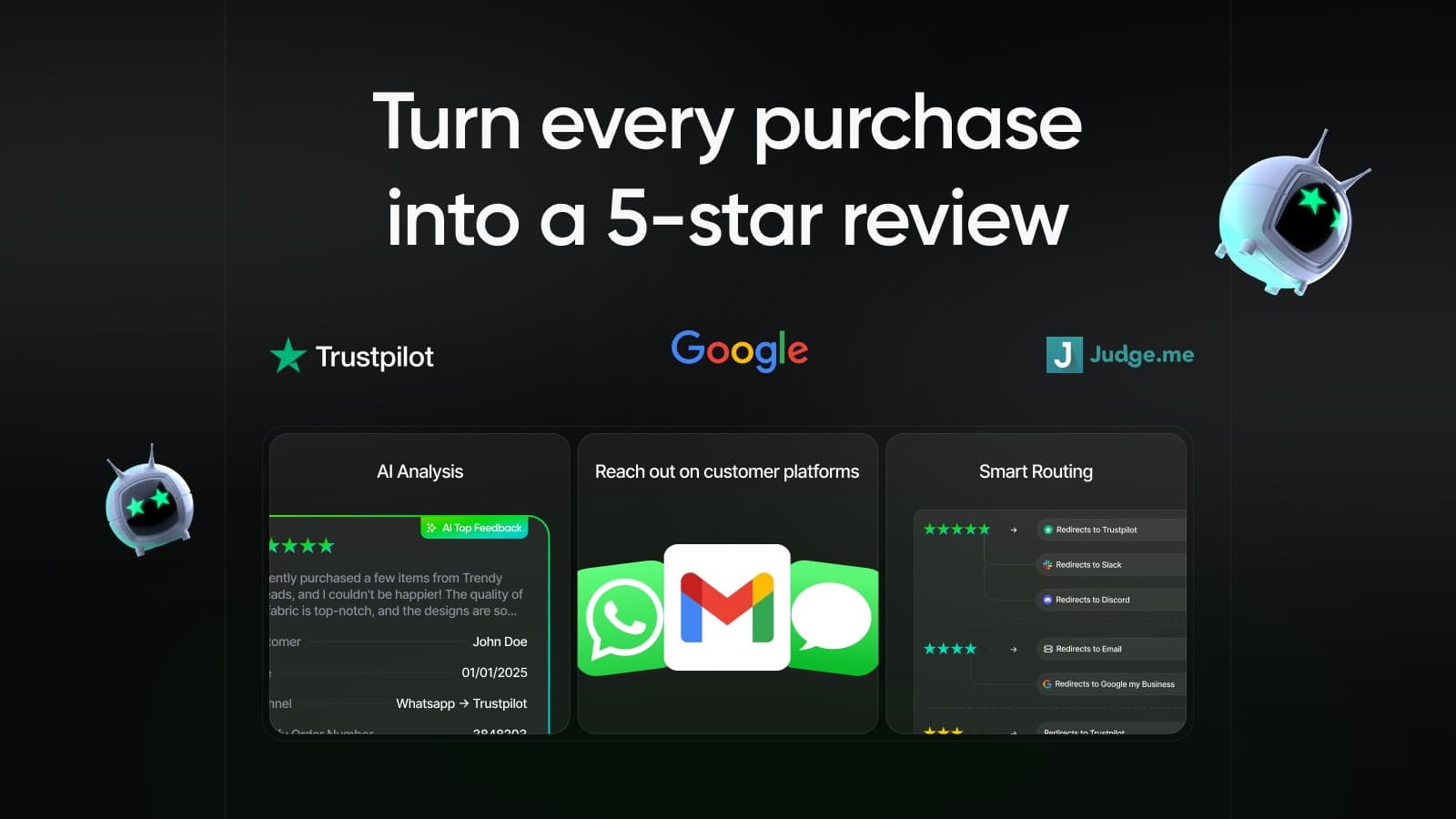
Route happy customers to Trustpilot & Google, capture negatives privately.
Install Reviewz on ShopifyA 30-second fake-review checklist
Before you trust a star rating, run this:
- Sort by most recent and scan for a velocity spike.
- Check the verified-purchase ratio on the five-star reviews.
- Read three glowing reviews for product specifics versus generic praise.
- Click two reviewer profiles for account history.
- Paste a suspicious review into our fake review checker.
If three or more flags fire, treat the rating as inflated and weigh the verified, specific reviews far more heavily than the breathless ones.
References:
- FTC, Final Rule Banning Fake Reviews and Testimonials (2024). Link
- Spiegel Research Center, How Online Reviews Influence Sales. Link
- Trustpilot Transparency Report. Link
- FTC Endorsement Guides: What People Are Asking. Link

About the author
Nicolas Provost · Founder of Reviewz.ai
Nicolas built Reviewz.ai after auditing 500+ Shopify review setups while running Kanal (WhatsApp marketing for Shopify). He has spent four years inside the Shopify ecosystem and writes about review collection, brand trust SEO, and the actual economics of running customer-feedback flows on ecommerce sites.
