
Buying Trustpilot reviews is illegal in the US under the FTC rule that took effect in October 2024, and it almost never works: fake Trustpilot reviews get detected and removed, and your profile can end up with a public consumer warning. Don't buy them. Under the FTC's Rule on the Use of Consumer Reviews and Testimonials, civil penalties run up to $53,088 per violation, and Trustpilot's own Trust Report 2025 shows 4.5 million fake reviews removed in 2024, 90% of them automatically. Detection combines machine learning, graph analysis of reviewer networks and device signals. The legitimate alternative that achieves the same goal, more positive reviews, is automated review collection from real customers via NPS-routed invitations, which Shopify merchants can start for free with Reviewz. If you want the full picture on the platform first, read what Trustpilot is and how it works.
Reviewed by Nicolas Provost, founder of Reviewz.ai. Insights based on auditing 500+ Shopify review setups and analyzing public pricing, schema, and conversion data across the leading review platforms. LinkedIn
Quick answer: should you buy Trustpilot reviews?
No. Since October 21, 2024, buying or selling fake online reviews is a federal violation in the US under the FTC's Rule on the Use of Consumer Reviews and Testimonials, with civil penalties up to $53,088 per fake review (the figure was $51,744 when the rule was announced and is adjusted for inflation each year). In the EU, fake reviews have been a banned commercial practice since May 2022 under the Omnibus Directive.
Beyond the legal risk: Trustpilot's automated fraud detection screens every review that is submitted, bought reviews tend to get removed, and the business profile can be flagged with a public consumer warning that destroys whatever credibility the fake reviews were meant to build. If your goal was simply to look more trustworthy, it's worth understanding whether Trustpilot itself is legit before assuming injected reviews will fool buyers who increasingly know how to spot them.
This article covers the legal reality, why the services still exist, what actually happens when you buy reviews, and the legitimate path that achieves the same goal (more positive reviews) without the risk.
Trustpilot fake reviews: how big is the problem?
Fake reviews on Trustpilot are real, and Trustpilot publishes the numbers itself. Three figures from its own reporting give the scale:
- 4.5 million fake reviews removed in 2024, around 7% of the 61 million reviews written on the platform that year (Trust Report 2025).
- 90% of those fakes were removed automatically, by machine learning, neural networks and graph-based models, before or shortly after they went live.
- 7.8 million fake reviews detected and removed in 2025, according to Trustpilot's trust page, which also states that every submitted review passes through automated fake-review detection.
Two things follow for a merchant. First, a meaningful share of what gets submitted is fake, which is why shoppers ask whether Trustpilot is legit and why a profile full of generic five-star praise convinces nobody. Second, the fakes are mostly caught, and the businesses behind them are pursued: in 2024 Trustpilot issued about 19,000 warnings and 5,000 cease and desist letters to businesses misusing the platform, and around 9,000 public Consumer Warnings were active on profiles. Buying reviews means paying to join the 7% that Trustpilot is built to find.
Fake Trustpilot reviews also run in the other direction. Competitors and people who never bought from you can post fake negatives too. If you are on the receiving end, you do not need to fight fire with fire: here is how to remove a fake Trustpilot review through the official flagging process, and you can run any suspicious text through the free fake review checker before you flag it.
The legal reality in 2026
The FTC's Rule on the Use of Consumer Reviews and Testimonials (effective October 21, 2024) prohibits five specific practices, each carrying civil penalties:
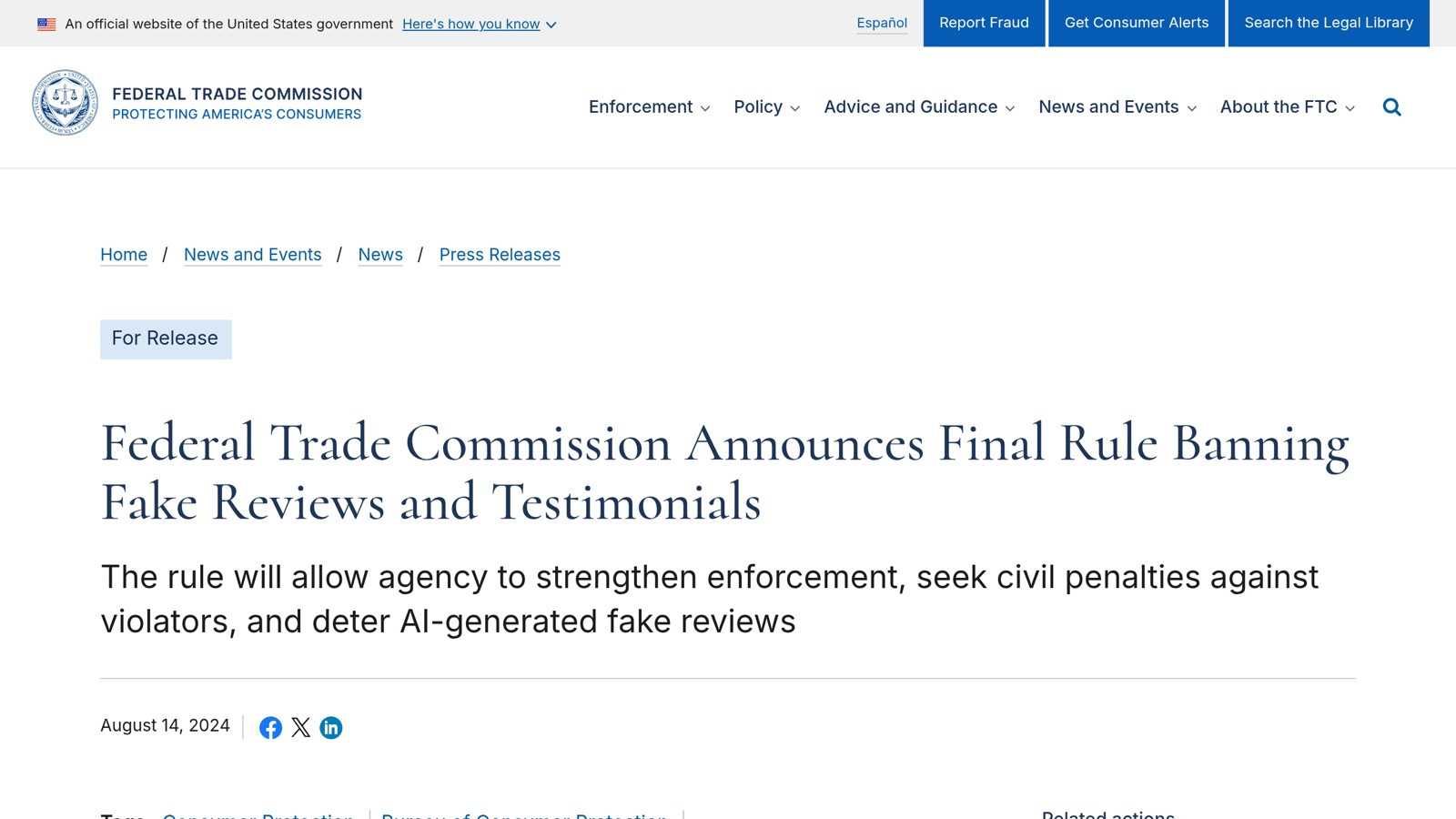
The FTC's August 2024 announcement of the final rule banning fake reviews and testimonials. Civil penalties, now up to $53,088 per violation, have been enforceable since October 21, 2024.
- Fake reviews and testimonials: created by AI, written by people who never used the product, written about non-existent people
- Buying positive or negative reviews: from any reviewer, including paying for "honest reviews" that are tied to compensation
- Insider reviews not clearly disclosed: employees, executives, agents, or close family members posting reviews without disclosure
- Company-controlled review sites: where the company creates the review platform and presents it as independent
- Suppression of negative reviews: through threats, intimidation, or unfounded legal action
The penalty structure: up to $53,088 per violation, and the FTC can treat each fake review or paid testimonial as a separate violation. The rule gives the FTC something it did not have before for reviews: the ability to seek civil penalties against knowing violators.
This isn't theoretical anymore. On December 22, 2025, the FTC sent warning letters to 10 companies about possible violations of the rule, its first public enforcement step under it. The agency did not name the companies, but the letters cite the same $53,088 figure.
Why fake-review services still exist (and what they actually deliver)
If buying reviews is illegal and detection is good, why does Googling "buy Trustpilot reviews" return dozens of "agencies" claiming to provide them? Three structural reasons:
The demand is real
Trustpilot's organic review system disadvantages small and new businesses. A 0-review profile loses against a competitor's 4.5/300 profile. The temptation to skip the 12-month buildup with a quick injection is rational, even if illegal. Demand creates supply.
The services aren't operating in the US
Most fake-review sellers are based in jurisdictions that don't enforce the FTC rule (Bangladesh, Pakistan, Eastern Europe). They sell to US clients knowing the legal risk falls on the buyer, not the seller. Most US buyers don't know this.
The services often don't deliver what they promise
Reading the actual customer experiences on Reddit threads about buying Trustpilot reviews, a clear pattern emerges:
- You pay $200-$500 for "10 verified reviews"
- 5-7 reviews appear within 48 hours
- Trustpilot's detection software spots the cluster (similar account ages, posting patterns, language fingerprints) and removes most within 2-4 weeks
- Your business profile gets flagged with a consumer warning about misleading reviews that's visible to all visitors
- The agency disappears or refuses refunds
So you spent money, got temporary fake reviews, ended up with a public warning, and have no recourse against the seller. The worst-case outcome (FTC investigation) compounds this.
What buying Trustpilot reviews actually costs in 2026
If you've already priced out a few "agencies," you've seen the going rates. Here is what the market actually looks like in 2026, based on the public price lists of sellers still operating and the Reddit/forum reports of buyers who used them:
| What's advertised | Typical 2026 price | What you actually get |
|---|---|---|
| 10 "verified" Trustpilot reviews | $150 to $400 | 5 to 7 post within 48h; most removed in 2 to 4 weeks |
| 50-review "starter package" | $600 to $1,200 | Cluster triggers Trustpilot's fraud detection, profile gets flagged |
| Monthly "review retainer" | $300 to $800 / month | Detection rate climbs each month as graph data accumulates |
| "Aged account" reviews (premium) | $25 to $60 / review | Slightly slower detection, still removed; highest legal exposure |
The hidden cost is what economists call the all-in cost: the cash you pay, plus the FTC exposure (up to $53,088 per review if pursued), plus the public warning flag, plus the eventual cost of rebuilding once the fakes are stripped out. A $300 purchase of 10 reviews has a realistic expected cost in the thousands once you weight the downside. Compare that to legitimate collection: Reviewz is free to start on Shopify, then $59 a month for up to 250 orders, and it produces real, permanent reviews. The math isn't close.
Can you buy verified Trustpilot reviews?
No. "Buy verified Trustpilot reviews" is the most common variation of this search, and it rests on a misunderstanding of what the label means. On Trustpilot, a review is marked Verified when Trustpilot can tie it to a genuine experience, typically because the business invited that customer through one of Trustpilot's automatic invitation methods connected to a real order. A seller has no way to attach that to a purchase that never happened.
When a review seller writes "verified", it is describing its own reviewer accounts, not Trustpilot's label. The only way to get Verified reviews is the boring one: invite real buyers after real orders. That is exactly what a Trustpilot and Shopify integration does, and if you just need the invitation link itself, the Trustpilot review link generator builds it in a few seconds.
What about buying negative Trustpilot reviews for a competitor?
Same rule, same penalties. The FTC rule covers fake negative reviews as much as fake positive ones, and a review written by someone who never bought from the business breaks Trustpilot's guidelines whichever way it points. Competitor attacks also tend to be easy to document, because the "customers" have no order on file. If it is happening to you, flag each review with the order lookup showing no matching purchase.
The 5 red flags that you're buying from a fake-review seller
If a vendor pitches any of these, you're buying reviews that will be detected and removed:
- They promise a specific star rating ("guaranteed 4.8+") rather than honest reviews from real customers.
- They guarantee reviews "stay up" or offer "replacement" reviews if some get removed, which only happens because removal is expected.
- They can't connect the reviews to a real, verifiable transaction or order ID on your store.
- They ask only for your business URL and a count, never for a customer list to invite.
- They operate offshore and accept only crypto or irreversible payment, so there's no recourse when reviews vanish.
The legitimate equivalent of every one of these is an automated collection flow that invites your actual buyers, the people whose orders Trustpilot can verify.
How Trustpilot detects fake reviews
Trustpilot's Trust Report describes the detection stack (machine learning, neural networks, graph-based models and generative AI), and the company is explicit in its guidelines for businesses that buying reviews or selectively soliciting only happy customers is prohibited. The detection signals include:
- Posting velocity: 10 new 5-star reviews in 48 hours after a profile averaged 1/month for years
- Account fingerprints: similar IP ranges, account creation patterns, browser configurations
- Language patterns: generic praise ("great service, highly recommend"), missing first-person details, low specificity
- Reviewer history: accounts that only review specific verticals or only review businesses that paid the same fake-review service
- Cross-platform signals: many fake reviewers also leave fake reviews on Yelp, Google, etc., creating a pattern that aggregator data exposes
You can see the same patterns yourself: paste any suspect review into our free fake review checker and it scores 8 of these signals automatically. Trustpilot's internal version is more sophisticated and runs on every new review at posting time. The same tells apply across platforms, so if you want to train your eye, our breakdown of how to spot fake Amazon reviews walks through the exact language and timing patterns detection engines weight most heavily. And if a competitor has already planted fakes on your profile, here is how to remove a fake Trustpilot review the legitimate way.
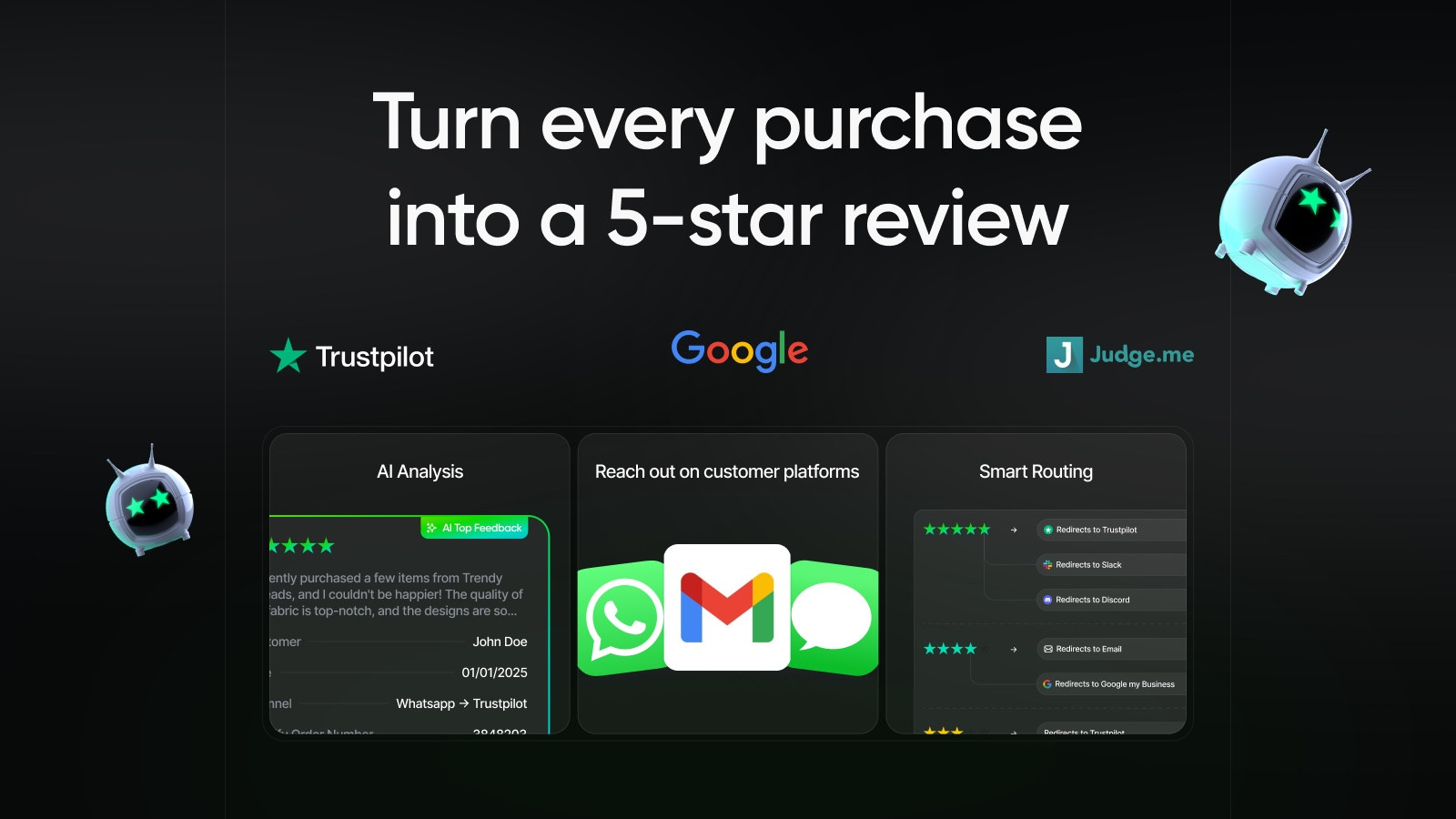 |
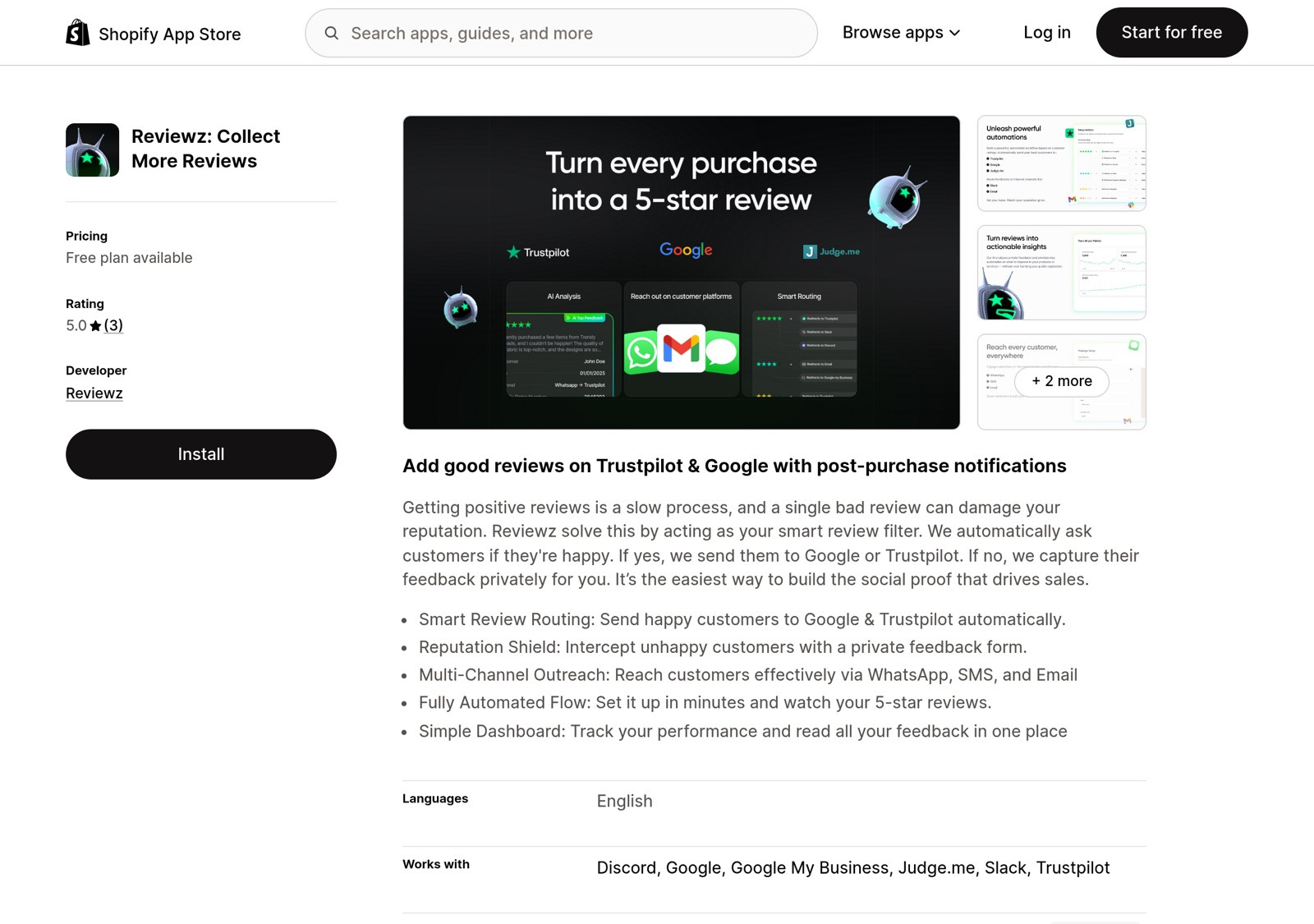
Reviewz.ai for Shopify automatically routes happy customers to leave reviews on Trustpilot, Google, and Judge.me, while privately catching unhappy ones in a feedback portal before they post a public 1-star. Re-engage every reviewer with upsell offers via WhatsApp, email, and SMS.
 Install Reviewz on Shopify
 |
Can you "pay for" Trustpilot reviews legitimately?
Yes, but with strict rules. Trustpilot offers an Invitation Service on paid plans (Standard and above) that lets you systematically invite real customers to leave reviews. This isn't paying for reviews. It's paying for the infrastructure that asks real customers to share their honest opinion.
The distinction the FTC and Trustpilot draw:
- ✅ Legal: ask every customer (or a representative sample) to leave an honest review, regardless of expected sentiment
- ✅ Legal: incentivize reviews with a small token (discount, points), as long as the incentive is offered regardless of review content and disclosed (see our guide on offering a discount for reviews the compliant way)
- ❌ Illegal: only ask happy customers ("review gating" if you also block unhappy customers from posting)
- ❌ Illegal: tie incentives to review content ("$10 off if you leave 5 stars")
- ❌ Illegal: pay third parties to post reviews
The key is: real customers, honest reviews, no content-based gating.
What actually works (and is legal)
If you're searching "buy Trustpilot reviews" because your store has a thin review profile, the legitimate playbook achieves the same outcome (more positive reviews) without the risk:
1. Proactive collection from real customers
Most Shopify stores collect reviews passively (a generic "leave us a review" footer). This yields 1-2% of orders converting to reviews. Active collection (timed invites with the right subject line, sent at the right moment) yields 8-15%, all from real verified customers. Multiplying review volume by 8-10x using legal methods is faster than buying 10 fake reviews that get removed.
For the full 9-tactic playbook, see our guide to getting more Trustpilot reviews on Shopify, and to wire that collection into your store end to end, the complete Trustpilot Shopify integration guide covers the full setup. On Shopify, this is the job Reviewz does: every order triggers a review request over WhatsApp, SMS and email, with no manual sending. If you are weighing it against Trustpilot's own paid invitation plans, the Reviewz vs Trustpilot comparison lays out the differences.
2. Pre-filtering with NPS
Send an NPS survey first, then only ask the 9-10 promoters to post a Trustpilot review. This is legal (you're not blocking detractors from posting on their own) and dramatically lifts your average rating because you're not actively recruiting your unhappy customers, the same approach our guide on how to get more 5-star reviews on Trustpilot builds on. Use our free NPS calculator to see the math.
3. Multi-channel invites
Email alone gets 15-25% click-through. Adding WhatsApp and SMS at staggered intervals lifts total review volume by 35-50%, because different customers respond to different channels.
4. Display existing reviews to lift collection rate
Stores that display Trustpilot reviews on product pages and footer collect more new reviews because customers see the reciprocity. Trustpilot's free TrustBox widgets let you embed reviews in your Shopify theme, and a printed review QR code in the parcel gives buyers a second, offline path to the same review page. Real, specific reviews convert far better than generic 5-star clusters anyway, our roundup of testimonial advertising examples shows why authentic, detailed customer stories outperform manufactured praise in ads and on product pages.
A 30-day legal playbook to match what fake reviews promised
The reason people buy reviews is impatience: they want to skip the slow buildup. Here's a 30-day plan that produces a comparable volume of real Trustpilot reviews, with none of the risk:
- Days 1-2: Audit your baseline. Note your current review count and rating, and your current passive collection rate. Most stores sit at 1-2% of orders. The average review submission rate data shows where you should be after optimization.
- Days 3-5: Turn on automated invitations. Connect Reviewz (or Trustpilot's paid Invitation Service) to your Shopify orders so every fulfilled order triggers a review request automatically.
- Days 6-7: Fix your timing. Send the invite when the product has actually arrived and been used, not at checkout. Our analysis of the best time to send a review request puts the sweet spot at 5-10 days post-delivery for most categories.
- Days 8-14: Add an NPS pre-filter. Survey first, then route promoters (9-10 scores) to your public Trustpilot link and detractors to a private feedback form. This is fully legal and lifts your average rating without gating anyone out of the public review.
- Days 15-21: Layer channels. Add SMS and WhatsApp follow-ups to your email invite. Different customers respond on different channels, and the staggered sequence typically lifts total volume 35-50%.
- Days 22-30: Backfill from past orders. Trustpilot lets you invite customers from the last 12 months. A single backfill campaign to 6-12 months of past buyers often produces more legitimate reviews in two weeks than any fake-review package promised, permanently.
Run this and a thin profile typically goes from a handful of reviews to dozens of verified ones inside a month, all of which stay up and all of which Trustpilot will happily display.
Reviewed by Nicolas Provost, founder of Reviewz.ai. Insights based on auditing 500+ Shopify review setups and analyzing public pricing, schema, and conversion data across the leading review platforms. LinkedIn
The bottom line
Buying Trustpilot reviews in 2026 is illegal under federal law, detected by automated systems, financially wasteful (the reviews get removed), reputationally damaging (the warning flag stays public), and increasingly being prosecuted. There's no scenario where it makes business sense.
The reason the services still appear in Google results is the same reason payday lenders still exist: there's a pool of desperate buyers who haven't done the math. If your review profile is thin, the answer isn't to buy reviews; it's to collect more from real customers, faster, with the right tools.
|
| Reviewz.ai for Shopify automatically routes happy customers to leave reviews on Trustpilot, Google, and Judge.me, while privately catching unhappy ones in a feedback portal before they post a public 1-star. Re-engage every reviewer with upsell offers via WhatsApp, email, and SMS. Install Reviewz on Shopify |
What FTC enforcement actually looks like in 2025-2026
The public record so far is short, and it is worth stating precisely rather than dramatically:
- January 2022 (before the rule): Fashion Nova agreed to pay $4.2 million to settle FTC allegations that it suppressed reviews below four stars on its own site. It was the FTC's first case over hiding negative reviews, and it shows the agency was pursuing ecommerce brands over review practices before it had a dedicated rule.
- October 21, 2024: The Rule on the Use of Consumer Reviews and Testimonials took effect, giving the FTC direct civil-penalty authority over fake reviews, undisclosed insider reviews, sentiment-conditioned incentives and review suppression.
- December 22, 2025: The FTC warned 10 companies about possible violations, based on consumer complaints and information from the companies themselves, and reminded them that penalties reach $53,088 per violation.
The pattern: the FTC moved from one-off cases under general deception law to a dedicated rule, then to warning letters under that rule. Warning letters are how the agency usually opens an enforcement cycle. Separately, the FTC's own Q&A on the rule is worth ten minutes of any merchant's time.
For merchants tempted by the math ("buying $300 of fake reviews lifts conversion by X%"), the calculus has changed. The expected-value math now includes platform removal, a public warning on your profile and a real possibility of regulatory attention.
Frequently asked questions
Are there fake reviews on Trustpilot?
Yes. Trustpilot reports removing 4.5 million fake reviews in 2024, about 7% of everything submitted that year, with 90% of them removed automatically. Fakes exist in both directions: bought positives and malicious negatives.
Is it illegal to buy Trustpilot reviews?
In the US, yes. The FTC's Rule on the Use of Consumer Reviews and Testimonials has prohibited buying, selling or writing fake reviews since October 21, 2024, with civil penalties of up to $53,088 per violation. In the EU, fake reviews have been a banned commercial practice since May 2022.
Can you buy verified Trustpilot reviews?
No. Trustpilot's Verified label is tied to a real invitation sent after a real order, so nobody can sell it. Sellers who advertise "verified" reviews are describing their own accounts, not Trustpilot's label.
What happens if Trustpilot catches fake reviews on my profile?
The reviews are removed, and Trustpilot escalates: an educational message, then a warning, then a cease and desist letter. If those are ignored, it places a public Consumer Warning on your profile, hides your TrustScore and closes the profile to new reviews. Around 9,000 Consumer Warnings were active in 2024.
How do I get more Trustpilot reviews without buying them?
Ask every real customer, automatically, a few days after delivery, on the channel they actually read. On Shopify, Reviewz sends that request over WhatsApp, SMS and email after each order, and it is free to start.
References:
- FTC. Rule on the Use of Consumer Reviews and Testimonials (2024). Link
- Trustpilot. Trust Report 2025. Link
- FTC. FTC Warns 10 Companies About Possible Violations of the Agency's New Consumer Review Rule (December 2025). Link
- EU Directive 2019/2161 (Omnibus Directive). Link
- Trustpilot. Guidelines for businesses. Link
- FTC. Soliciting and Paying for Online Reviews: A Guide for Marketers. Link

About the author
Nicolas Provost · Founder of Reviewz.ai
Nicolas built Reviewz.ai after auditing 500+ Shopify review setups while running Kanal (WhatsApp marketing for Shopify). He has spent four years inside the Shopify ecosystem and writes about review collection, brand trust SEO, and the actual economics of running customer-feedback flows on ecommerce sites.
