

For Shopify ecommerce stores, Trustpilot wins your branded SERP. Google Reviews wins only if you have a physical address. Trustpilot ranks its own domain in your brand search results and shows star ratings in Google sitelinks. Google Reviews live inside Google Business Profile, which Shopify-only stores often can't qualify for. Most stores benefit far more from Trustpilot than Google Reviews. The exception: hybrid retail-and-ecom brands with a real storefront.
Reviewed by Nicolas Provost, founder of Reviewz.ai. Insights based on auditing 500+ Shopify review setups and analyzing public pricing, schema, and conversion data across the leading review platforms. LinkedIn
The honest verdict for Shopify merchants
Most comparisons of Trustpilot vs Google Reviews are written for local businesses (plumbers, dentists, restaurants). For those, Google Reviews wins by a landslide because Google Business Profile dominates local-pack rankings. But you're running a Shopify store, which is a completely different game.
For ecommerce, the SERP that matters is your branded search (people typing your brand name into Google). Whoever owns that SERP owns your trust signal. Trustpilot ranks its own subdomain on that page, often in position 2 or 3. Google Reviews can show in your sitelinks too, but only if you have a verified Google Business Profile, which pure-online stores often can't get.
That's why the smart play for most Shopify stores is Trustpilot first, Google Reviews second (or skipped entirely). For Trustpilot specifically on Shopify, our guide on getting Trustpilot reviews on Shopify covers the integration mechanics.
What each platform actually is
Trustpilot is an independent review platform headquartered in Copenhagen, founded in 2007. It hosts reviews on its own domain (trustpilot.com/review/yourstore.com), separate from Google. Reviews are tied to your verified business profile, accessible to anyone who searches Trustpilot directly or finds your branded page through Google. Trustpilot also feeds star ratings into Google search snippets through approved schema.
Google Reviews are reviews hosted inside Google Business Profile (GBP, formerly Google My Business). They appear in the Google Maps panel, the Knowledge Panel for your brand, and the local 3-pack for nearby searches. They are tied to a verified physical address. Without an address, you can't run a GBP (per Google's own eligibility guidelines), which means no Google Reviews for pure Shopify dropshippers and digital-first DTC.
The two systems don't compete for the same SERP real estate the way most marketers assume. They occupy different positions, and a sophisticated trust strategy uses both deliberately.
Where each one shows on Google search
When someone searches your brand name, the SERP has predictable real estate:
- Position 1: your own store homepage.
- Knowledge Panel (right side, desktop): pulls from Google Business Profile if you have one. This is where Google Reviews appear, with the gold star average.
- Sitelinks under position 1: includes "Reviews" link if Google detects review pages on your domain.
- Positions 2-5: third-party trust platforms ranking on your brand keywords. Trustpilot frequently sits here.
- Positions 6-10: news, social profiles, competitor pages.
Trustpilot owns positions 2-5 because it has stronger domain authority than your store and Google rewards independent third-party verification. If you don't have a Google Business Profile, your Knowledge Panel either won't appear or will be sparse, and Trustpilot's third-party listing becomes your dominant trust signal. See our guide on whether Trustpilot is legit for the wider context on Trustpilot's perceived authority.
Cost comparison: Trustpilot vs Google Reviews
This is where the gap is brutal.
| Cost factor | Trustpilot | Google Reviews |
|---|---|---|
| Free tier | Yes (basic profile, manual replies, no automation) | 100% free, no paid tier exists |
| Paid plans | $259-$899/mo (Plus, Premium, Advanced) | None |
| Setup time | 2 hours (domain claim + Shopify app) | 1-6 weeks (address verification by mail) |
| Eligibility | Any domain, no address needed | Verified physical address required |
Google Reviews is free, full stop. Trustpilot's free tier exists but throttles features. Most Shopify stores using Trustpilot seriously are on the $259+ Plus plan. For the full Trustpilot pricing breakdown, see our Trustpilot pricing on Shopify guide.
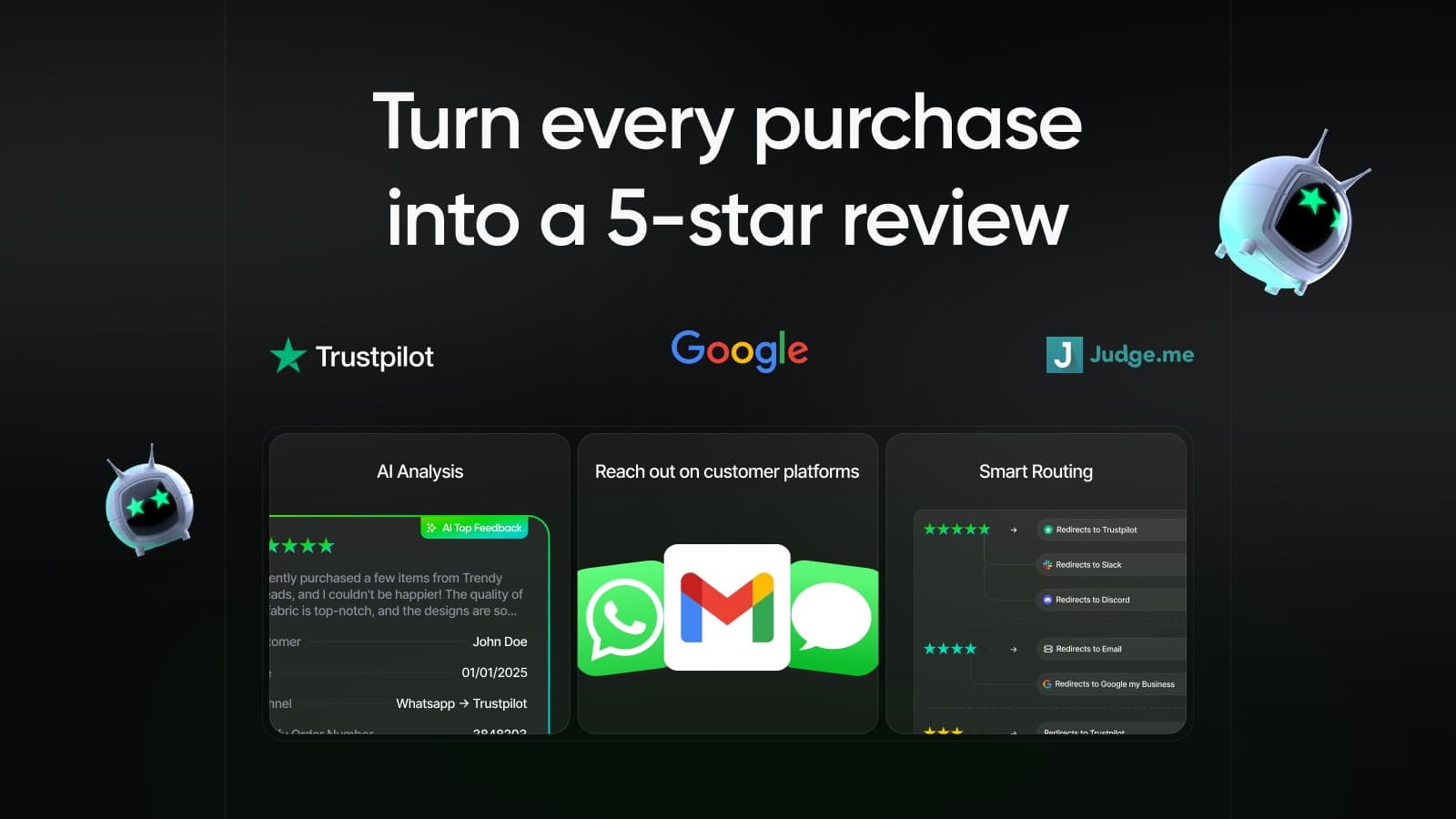
Route happy customers to Trustpilot & Google, capture negatives privately.
Install Reviewz on ShopifyFeature-by-feature comparison
| Feature | Trustpilot | Google Reviews |
|---|---|---|
| Brand-level reviews | Yes (one profile per domain) | Yes (one profile per location) |
| Product-level reviews | Paid plans only | No, only business-level |
| Shows in Google SERP | Yes (organic ranking + sitelinks) | Yes (Knowledge Panel, Maps) |
| Shopify integration | Official app + Reviewz routing | No native, third-party only |
| Review moderation | Flag for review, appeal process | Flag only, slow takedown |
| Reply to reviews | Yes, free tier included | Yes, free |
| Influence on local SEO | Low | High (local pack) |
Which one wins for ecommerce specifically
For a Shopify store without a physical retail location, Trustpilot wins on five dimensions: brand-level domain authority on Google, product-review support, dispute-resolution process, Shopify-native integrations, and being viewable on the Trustpilot domain directly (which builds independent trust). Google Reviews is a strong supplement when you qualify, but it shouldn't be your foundation.
That said, Trustpilot has its own integrity issues. Stores buy fake reviews, Trustpilot flags some and misses others. The FTC's 2024 fake review rule makes both platforms liable for failing to police fraud. See our piece on why buying Trustpilot reviews is now a federal violation.
For high-AOV brands with paid plans, Trustpilot also unlocks product-level reviews that feed Google Shopping rich results, which Google Reviews cannot do without a separate Merchant Center integration. If product-level reviews are your priority, our roundup of the best Shopify review apps compares the dedicated tools.
Using both: the dual-platform play
If you qualify for both, run both. Trustpilot covers brand search trust, Google Reviews cover Maps and local-pack visibility. The challenge is collection: most stores can ask each customer for one review, not two. That's where review routing matters.
The clean setup: after a customer rates their experience privately (the Reviewz NPS-style trigger), route 4-5 star ratings to Trustpilot if AOV is over $100, to Google Reviews if you have a strong local-pack play, or to both alternately. Negative ratings go to support, never public, and once a Google review lands you should know how to respond to it. This stays within FTC compliance because no review is suppressed, only redirected before publication. If you do route to Google, our Google review link generator builds the one-tap "leave a review" URL so customers land directly on the write-a-review box, and the Trustpilot review URL generator does the same for Trustpilot.
Try our NPS calculator to model how many promoters your current customer base produces, and our review request email generator for the actual collection mechanics.
Common mistakes when comparing the two
The first mistake is assuming Google Reviews is universally available. For pure-online Shopify stores, you need a Google Business Profile, which requires a verifiable physical address. PO boxes don't count. Coworking spaces fail Google's review queue. Many DTC brands try and silently get rejected.
The second mistake is treating them as substitutes when they're complements. Trustpilot rates your brand at the domain level, Google Reviews rates your physical location. They serve different intent in different parts of the SERP.
The third mistake is sending the same review request to both. Google explicitly forbids review-gating (asking only happy customers to leave Google Reviews). Trustpilot is more permissive. If you route the same request to both, you risk violating Google's policy. Use platform-specific flows.
FAQ
Can I have Google Reviews without a physical address?
Officially no. Google Business Profile requires a verifiable physical location where you serve customers. Pure online retailers with no office, warehouse-only operations, or P.O. box addresses don't qualify. Google has been progressively tightening this since 2021. Some online-only brands list a Service Area Business profile, which hides the address but still needs a real one for verification. If you can't pass GBP verification, Google Reviews is off the table and Trustpilot becomes your only major third-party brand-review channel.
Does Trustpilot rank higher than Google Reviews in branded SERPs?
They rank in different positions. Google Reviews fills the Knowledge Panel and Maps panel (right side of desktop SERP) and never appears in the organic ranking. Trustpilot frequently ranks in organic positions 2-5 on branded queries with its trustpilot.com/review/yourdomain URL. They don't compete head-to-head. If you have both, you occupy more SERP real estate. If you have only one, Trustpilot has stronger search-result visibility for ecommerce-style queries while Google dominates Maps-style queries.
Are Google Reviews more trusted than Trustpilot?
It depends on customer demographics. Google Reviews tend to carry more weight with older shoppers and local consumers. Trustpilot is more recognized for online-only purchases, especially in Europe where it originated. The BrightLocal Consumer Review Survey consistently finds Google as the most-used review platform overall, used by roughly 81% of consumers to evaluate local businesses, far ahead of any single competitor, but Trustpilot leads for ecommerce-specific evaluations. For Shopify merchants targeting digitally-native shoppers, Trustpilot trust signals usually outperform Google's.
Can I import Google Reviews into Trustpilot or vice versa?
No. Both platforms forbid importing reviews from third parties. Each review must be left directly on the platform by a verified customer. Trustpilot allows you to upload customer email lists for review invitations, but the resulting review must be written natively on Trustpilot. Google has the same rule. Trying to bulk-create reviews on either platform from imported data is a violation of both their terms and the FTC's 2024 fake-review rule. You cannot shortcut this. You have to ask customers and let them write their own reviews on each platform.
Which is harder to remove fake reviews from?
Both are difficult, but Trustpilot is faster and more transparent. Trustpilot lets you flag a review for an evidence-based dispute, and decisions usually come within 7-10 days. Google's review-takedown process is largely automated and slow, with most flagged reviews staying live for months. Our guide on removing fake Trustpilot reviews covers the dispute process in detail. For Google, the only reliable path is showing the reviewer was never a customer.
Route happy customers to Trustpilot & Google, capture negatives privately.
Install Reviewz on Shopify
About the author
Nicolas Provost · Founder of Reviewz.ai
Nicolas built Reviewz.ai after auditing 500+ Shopify review setups while running Kanal (WhatsApp marketing for Shopify). He has spent four years inside the Shopify ecosystem and writes about review collection, brand trust SEO, and the actual economics of running customer-feedback flows on ecommerce sites.
