

Most Shopify stores need both, not either: Judge.me for product-page reviews (free tier covers most stores under $500K ARR), Trustpilot for brand-level credibility on the SERP. Judge.me costs $0-$15/month; Trustpilot is free to claim with 50 invitations a month, and its paid plans run from $99 to $799 a month, billed annually. The cheapest effective combination: Judge.me free + Trustpilot free + Reviewz to ask every customer once and send them to the right place. This stack covers most of what an all-in-one suite such as Yotpo does, at a fraction of the price.
Reviewed by Nicolas Provost, founder of Reviewz.ai. Insights based on auditing 500+ Shopify review setups and analyzing public pricing, schema, and conversion data across the leading review platforms. LinkedIn
The short answer
Trustpilot and Judge.me solve different problems. Trustpilot is a brand-trust platform: a public, third-party profile customers Google to validate you before buying. Judge.me is a product-page conversion tool: verified reviews and star ratings displayed inline on your Shopify product pages, optimized for Google rich snippets (see the FTC final rule banning fake reviews and testimonials).
For most Shopify stores doing $100K+ in revenue, the right answer is both, used for different parts of the buyer journey. This article breaks down where each one wins, what they cost in 2026, and how to run them together without doubling your work (see the EU Omnibus Directive 2019/2161). If you want the wider field first, our roundup of the best Shopify review apps compares eight platforms.
What each platform actually does
Trustpilot
Trustpilot is an independent third-party review site. Customers leave reviews on Trustpilot's domain about your business overall (not specific products). Reviews appear on your public Trustpilot profile (e.g. trustpilot.com/review/yourstore.com), in Google search results when people Google your brand, and via embeddable TrustBox widgets you can place on your store.
Best for: building brand trust. When a new customer Googles your brand name, your Trustpilot profile shows up in the top 3 results, with the star rating visible in the SERP. This is the validation step before they decide to visit your site. That validation step is not optional: BrightLocal's Local Consumer Review Survey finds the overwhelming majority of consumers read reviews before trusting a business.
Concerns: Trustpilot's review verification is weak by default (we covered this in our honest analysis), most reviews are unverified, and the freemium model creates pay-to-defend asymmetries. If you want to drive invited reviews to your profile, our Trustpilot review URL generator builds the exact link to share in post-purchase emails.
Judge.me
Judge.me is a Shopify-native review app. Customers leave reviews tied to specific Shopify orders (verified-purchase by default), displayed on your product pages (not on a third-party site), with star-rating widgets and Google's structured data markup for rich snippets.
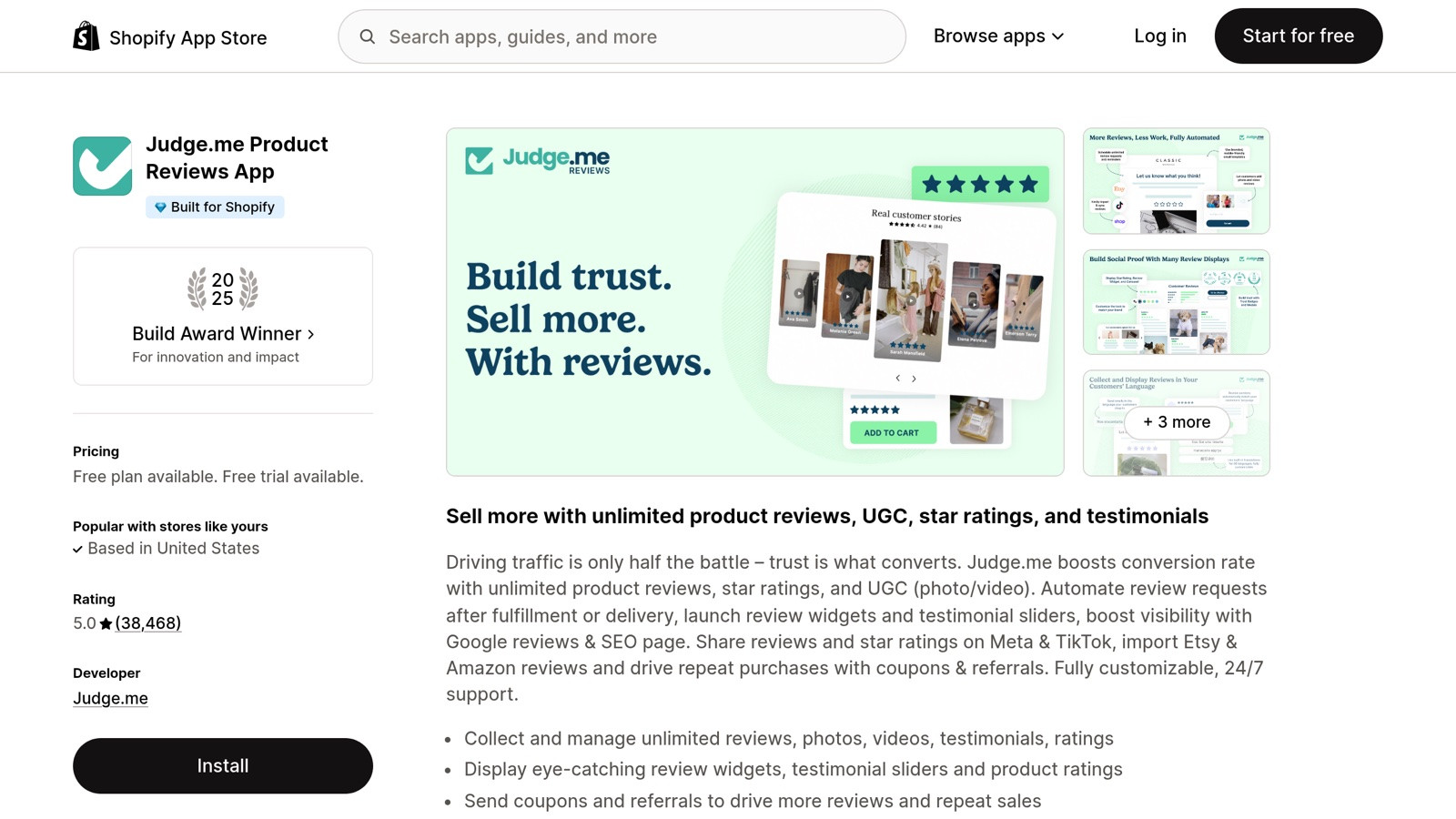
Judge.me on the Shopify App Store, rated 5.0 from 47,950 merchant reviews in October 2026.
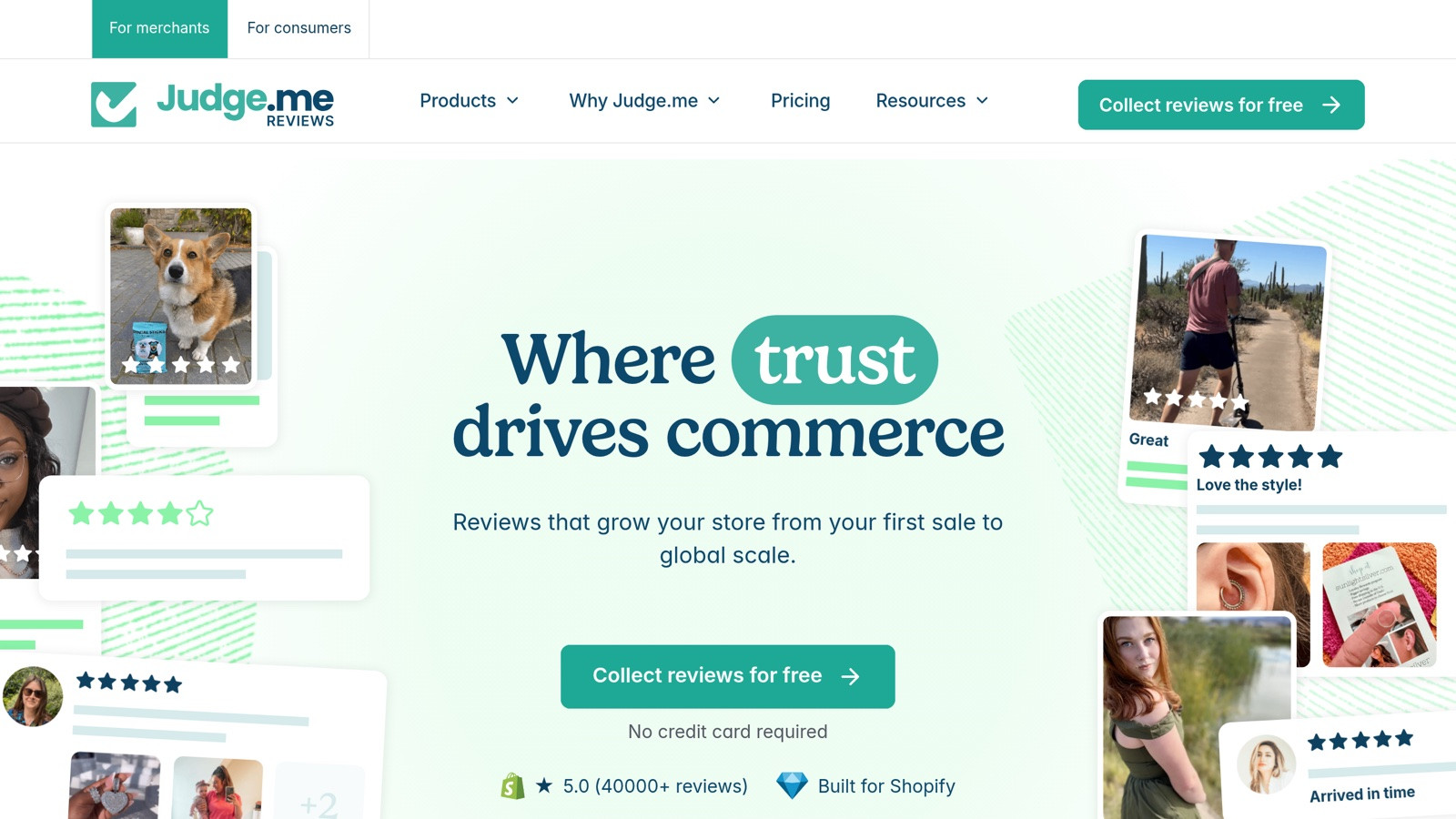
Best for: product-page conversion. When a buyer is on your product page deciding whether to add to cart, seeing 47 verified-purchase reviews with photos lifts conversion meaningfully: the Spiegel Research Center at Northwestern found displaying reviews can increase conversion rates by up to 270%, with the largest lift on higher-priced products. If you want those stars to render in Google for free, our review schema generator outputs the AggregateRating markup Judge.me produces automatically.
Concerns: Judge.me reviews are mostly invisible outside your store. Customers don't search "[brand name] judge.me", so it does nothing for brand-level trust. The trade-off is reach: while Trustpilot reviews surface on a public domain that shoppers find through branded search, Google's own documentation on review snippets confirms that the AggregateRating markup Judge.me injects is what makes the star ratings eligible to appear directly in organic product results, where they can lift click-through.
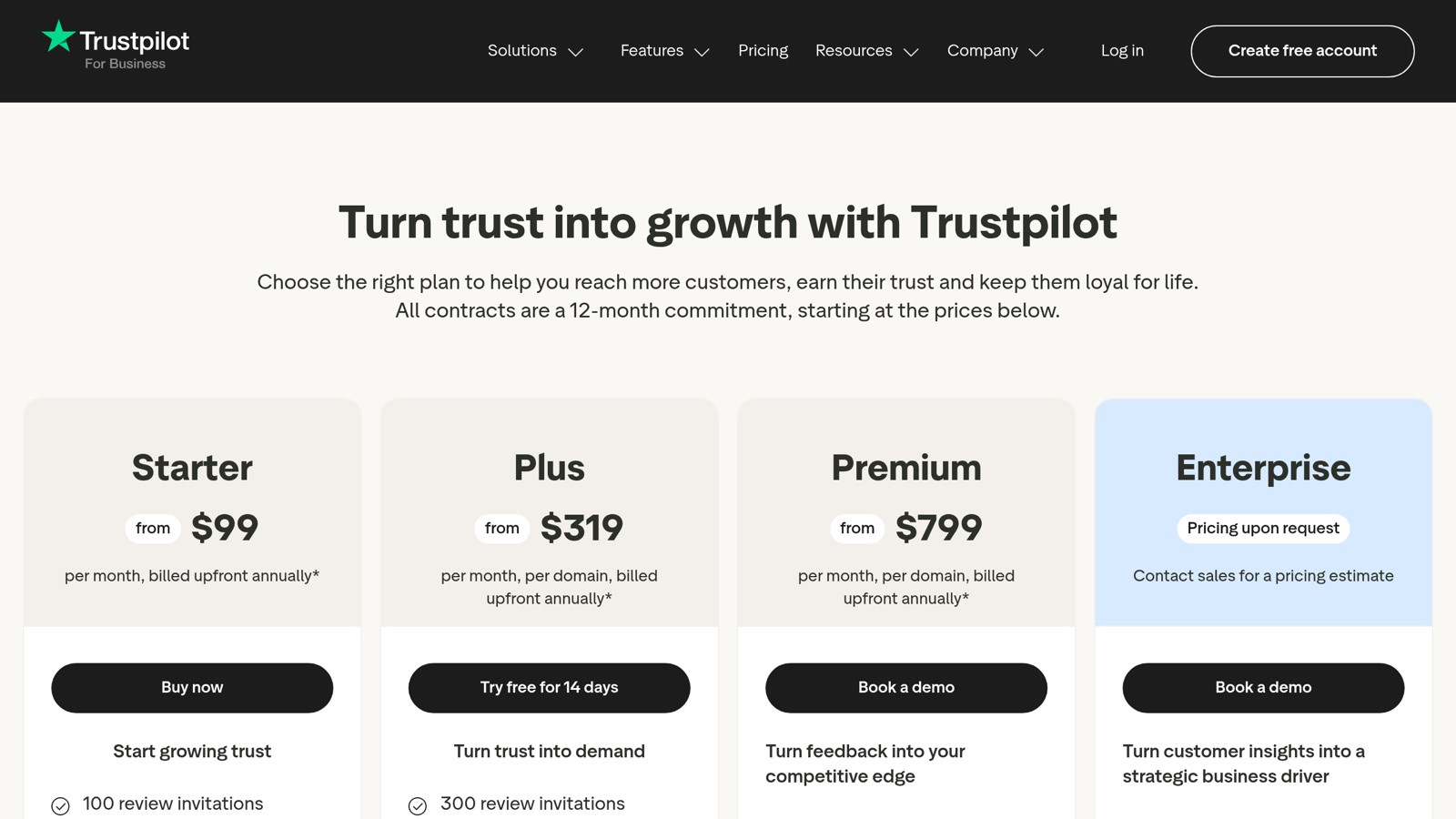
Trustpilot's paid plans start at $99/month (Starter), billed annually; the free plan includes 50 invitations a month.
Side-by-side comparison
| Feature | Trustpilot | Judge.me |
|---|---|---|
| Where reviews live | Public Trustpilot.com profile | Your Shopify product pages |
| Verification | Mostly unverified (paid-plan invitation system fixes this) | Verified by Shopify order ID by default |
| Free plan limits | 1 widget, 50 invitations/month, 1 user | Unlimited product and store reviews, photo and video reviews, review widget, star badge, carousels |
| Paid plans (2026) | $99 (Starter), $319 (Plus) or $799 (Premium) per month; Enterprise by quote | $15/month (Awesome plan, all features unlocked) |
| Contract | 12-month commitment, prepaid | Monthly |
| Shopify App Store rating | 2.7 (18 reviews) for the Trustpilot app | 5.0 (47,950 reviews) |
| SEO impact | Brand-name SERP authority | Product-page rich snippets (★ in Google) |
| Photos & videos | No (paid plans only) | Yes, on free plan |
| Q&A on product pages | No | Yes (Awesome plan) |
| Review syndication to Google | Available (paid plan) | Available (Awesome plan) |
| Best for | Brand trust, services, established e-commerce | Product conversion, dropshipping, small Shopify stores |
Prices and ratings are from Trustpilot's pricing page and the two Shopify App Store listings, checked on October 4, 2026. For the plan-by-plan detail, see our Trustpilot pricing breakdown.
Which one wins for which type of Shopify store?
Pre-revenue / pre-launch Shopify stores
Judge.me only. Trustpilot's value comes from review volume, which you don't have yet. Judge.me's free plan gives you product-page reviews from day one, with star ratings showing in Google search. Add Trustpilot once you've passed 100 orders/month.
Small Shopify stores ($10K-$100K/month)
Judge.me primarily, Trustpilot optionally. Focus your energy where conversion happens: product pages. Trustpilot is nice-to-have but not the bottleneck. If you do add Trustpilot, stay on the free plan and don't stress about the 50/month invitation cap.
Mid-sized Shopify stores ($100K-$1M/month)
Both. At this scale, customers research your brand before buying (especially repeat purchases or higher AOV), so Trustpilot becomes a real moat. Judge.me handles product-level trust on the page itself. Run both, with a unified collection process so you don't ask the same customer twice.
Large Shopify Plus stores ($1M+/month)
Both, with paid plans on each. At this scale, the pay-to-defend asymmetries on Trustpilot start mattering (you need flagging tools, review syndication, custom widgets). Judge.me's Awesome plan unlocks Q&A and Google integration. Budget roughly $335 a month for Trustpilot Plus and Judge.me Awesome, and more if your volume pushes you to Trustpilot Premium.
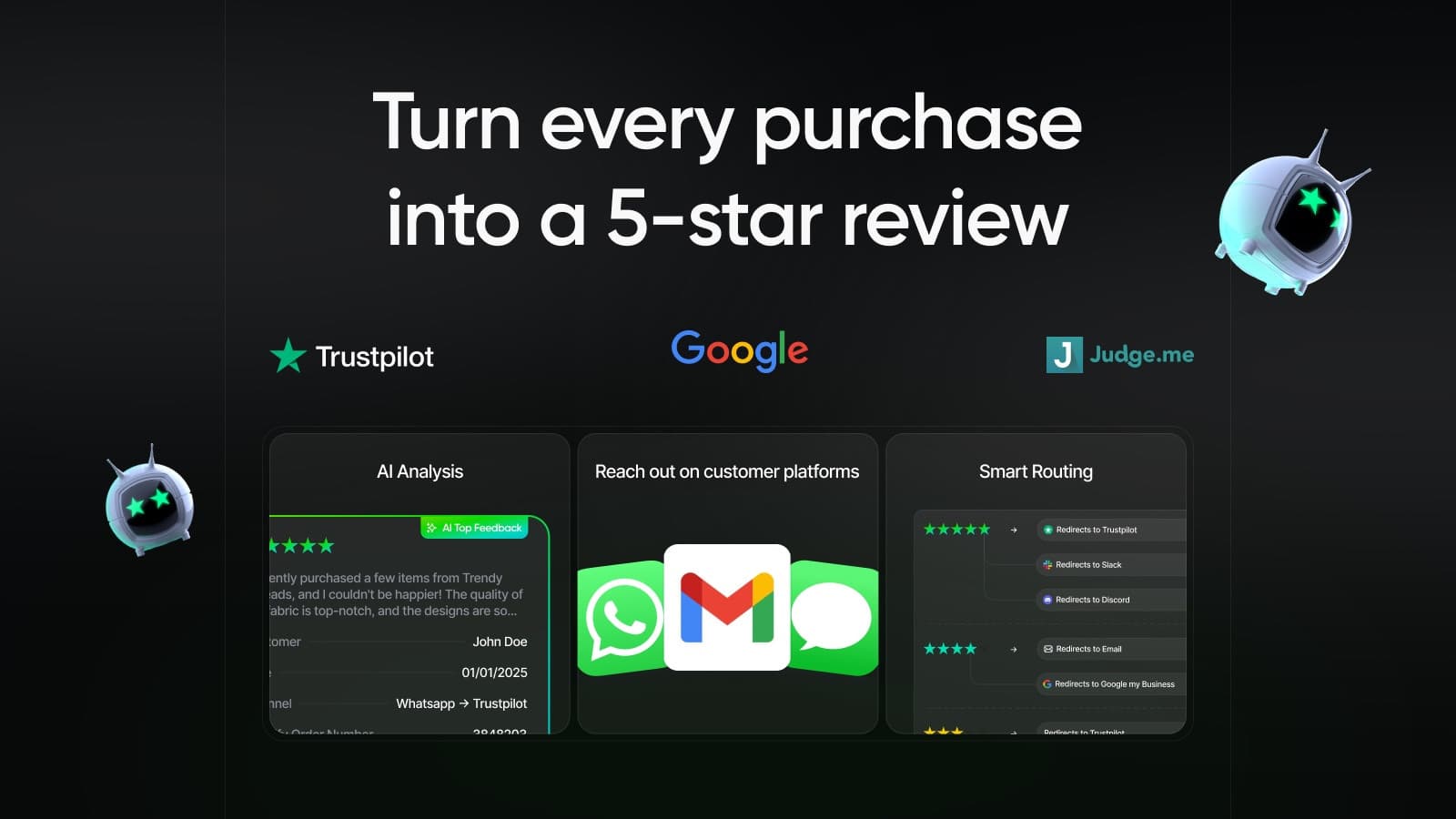
Route happy customers to Trustpilot & Google, capture negatives privately.
Install Reviewz on ShopifyThe real cost of running both
The dirty secret of "use both" advice: it doubles your work if you don't have a unified collection layer. Without one, you end up:
- Asking customers twice (annoying, lowers response rates)
- Tracking two separate dashboards
- Manually copying reviews between platforms (against TOS for both)
- Not knowing which channel is performing
The fix is a single collection layer that asks each customer once, then routes them to the right platform based on signals. Promoters who shop frequently → Trustpilot for brand trust. First-time product buyers → Judge.me for product-level proof. Everyone gets a single ask, you get reviews on both platforms.
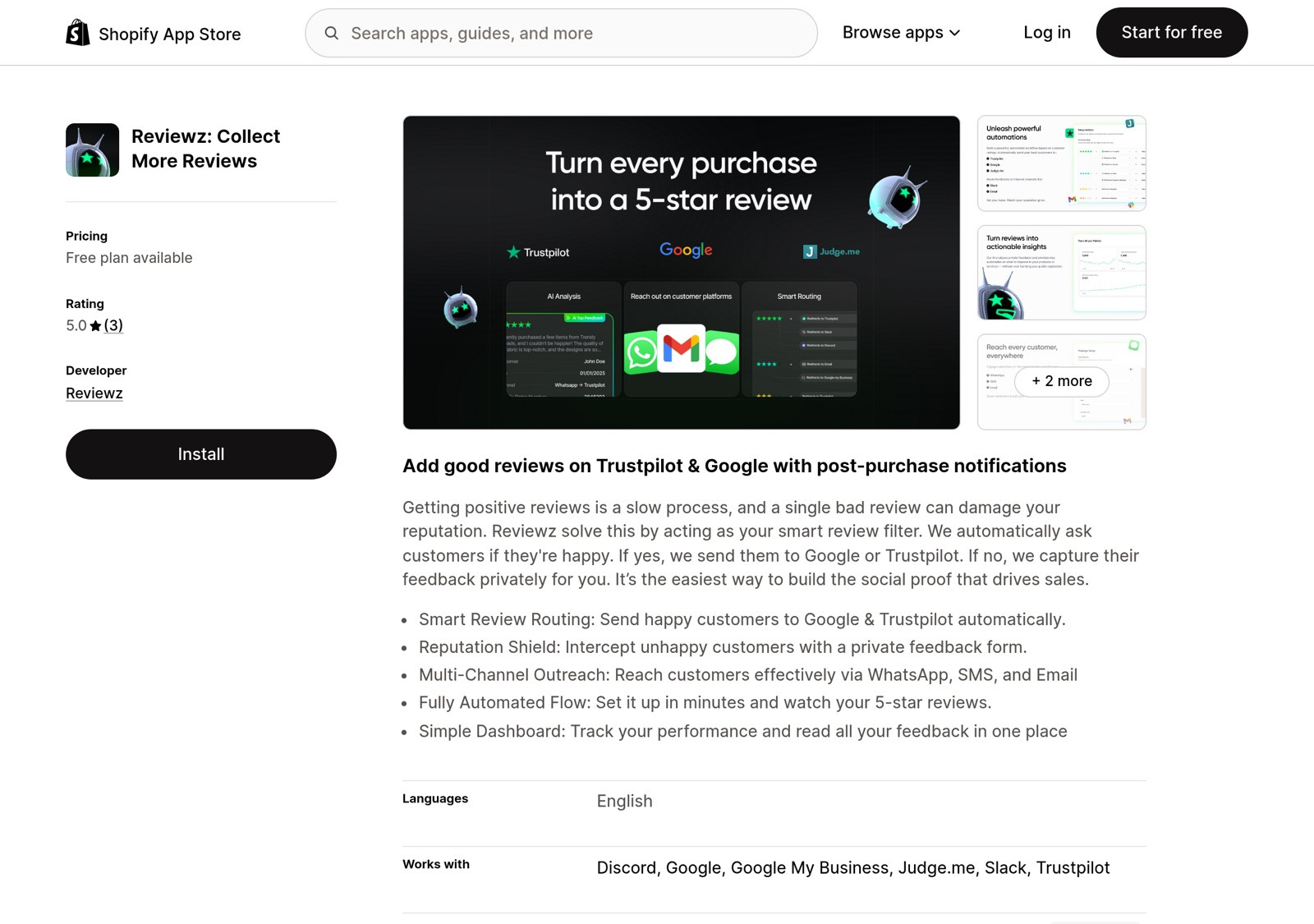
This is what Reviewz automates on Shopify: one request per customer after each order, over WhatsApp, SMS and email. Customers who rate the order 4 or 5 stars are sent to Trustpilot, Judge.me or Google, and the others go to a private feedback form. It is free to start, and the NPS calculator helps you track how satisfaction moves once the flow is running.
Does Judge.me integrate with Trustpilot?
Not directly. There is no built-in sync that copies Judge.me reviews to your Trustpilot profile or the other way round, and both platforms want each review written by the customer on their own system. Running the two together therefore comes down to who you ask, and where you send them:
- Judge.me keeps collecting product reviews on your store through its own request emails.
- Trustpilot gets the customers you point at your Trustpilot review link.
- A routing layer decides which customer gets which link, so nobody is asked twice. Reviewz lists Trustpilot, Google and Judge.me as destinations for exactly this reason.
If you are leaning toward one platform only, the two alternative pages go deeper on each: Reviewz as a Judge.me alternative and Reviewz as a Trustpilot alternative.
What about Yotpo, Loox, Reviews.io?
Quick takes for completeness:
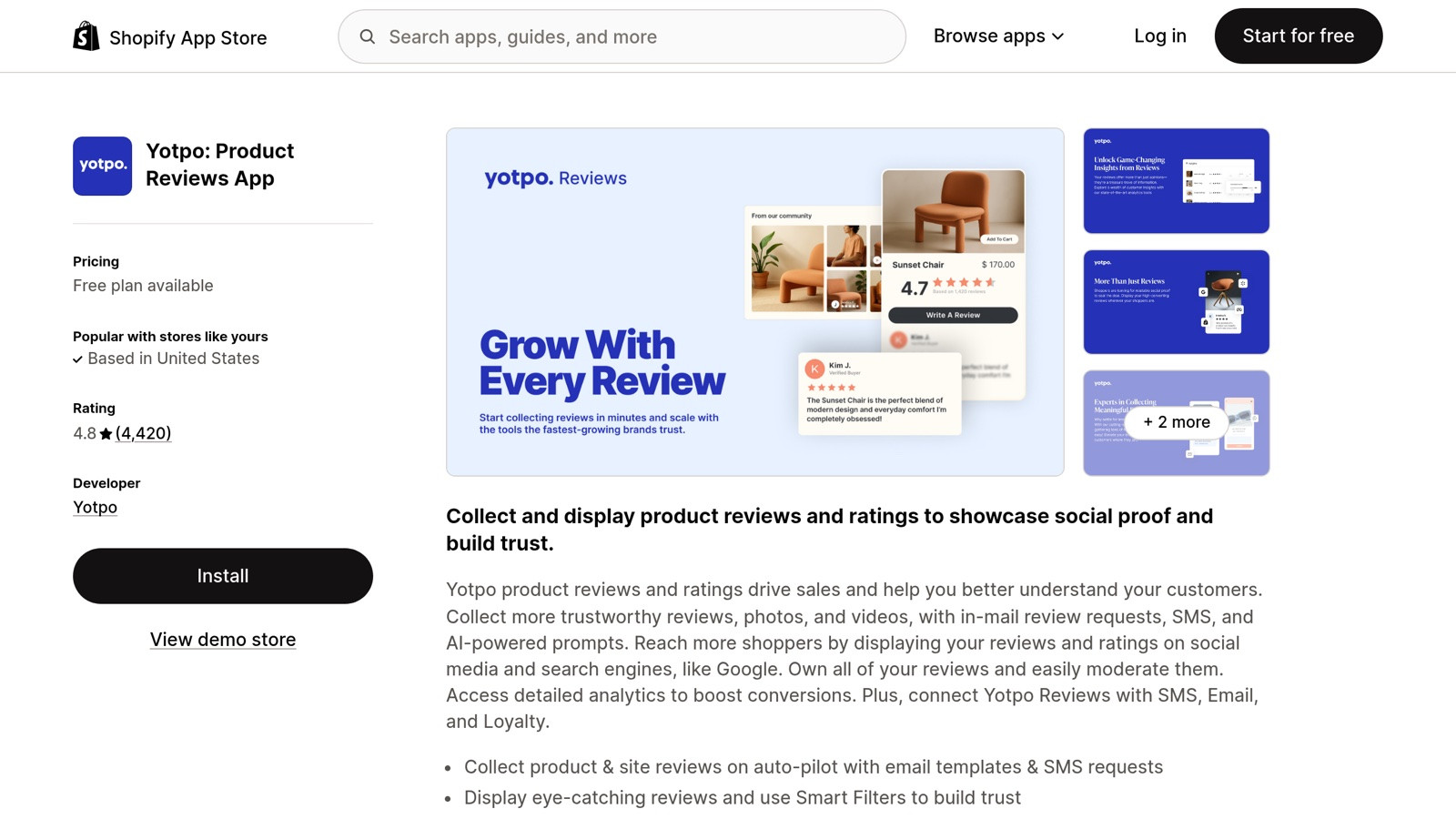
- Yotpo: free up to 50 orders a month, then $15 (Starter) and $119 (Pro) a month on the Shopify App Store, with prices that rise with order volume. Powerful, but the bill grows with you. Best for brands that want reviews, Google Shopping and seller ratings from one vendor.
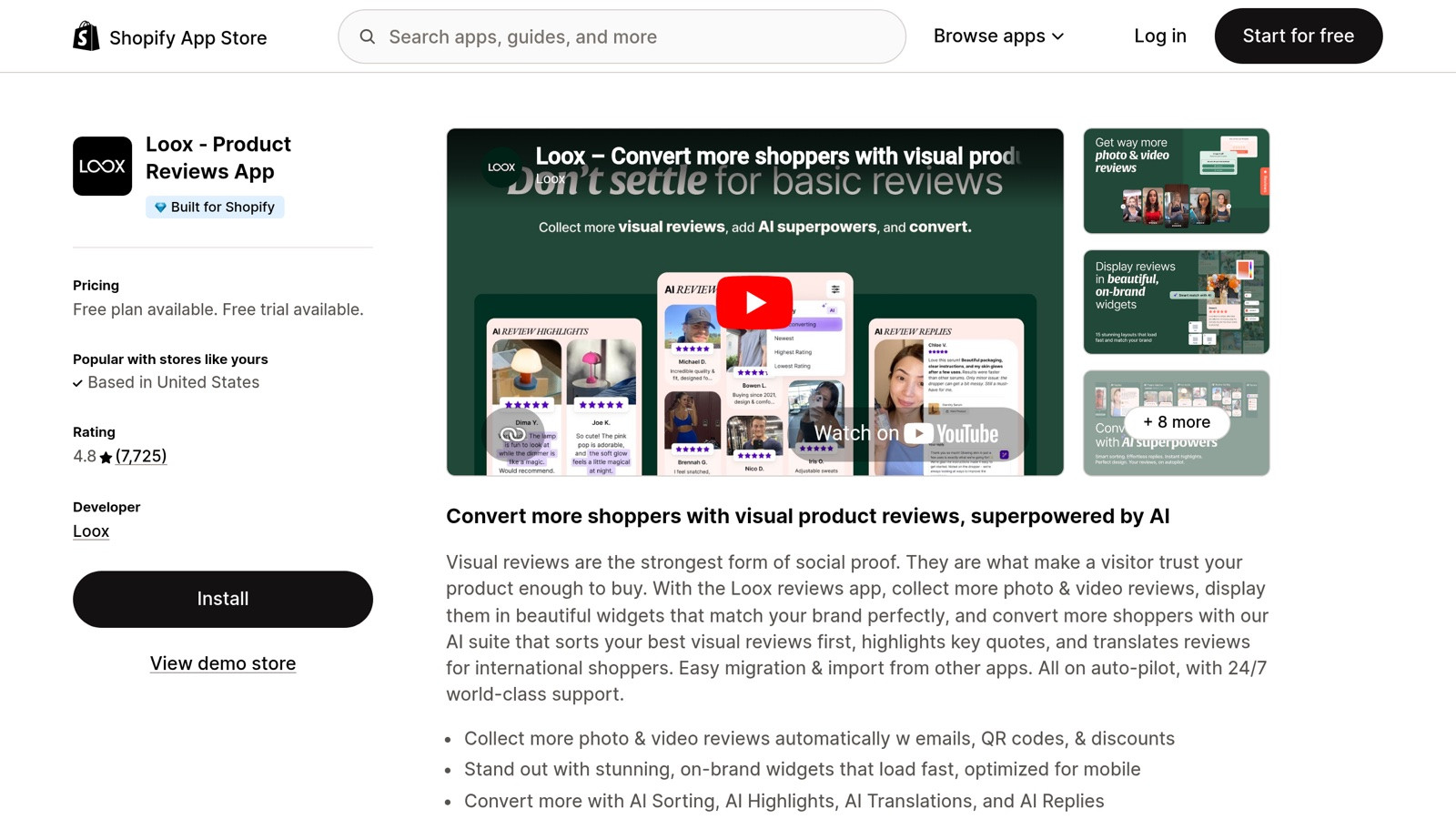
- Loox: Judge.me competitor with stronger photo-review focus. More expensive: $49.99 a month (Convert) or $299.99 (Unlimited), with a free plan capped at 500 orders. Pick over Judge.me if photo reviews are central to your conversion (apparel, home goods, beauty), and see our dedicated Loox vs Judge.me breakdown.
- Reviews.io: Trustpilot competitor with better Shopify integration but lower brand-name SEO authority. Worth considering if you're price-sensitive on Trustpilot's paid plans: its Shopify plans run from free (25 invites a month) to $19 and $45 a month.
Direct cost comparison: Trustpilot vs Judge.me at three Shopify scales
The pricing logic of these two platforms is fundamentally different. Judge.me's $15/month Awesome plan is flat regardless of orders. Trustpilot scales with invites sent. At small scale, Judge.me is wildly cheaper. At enterprise scale, Trustpilot Premium delivers brand-level review SEO that no product reviews app can match. Here is the annualized cost at three real Shopify scales.
| Shopify scale | Judge.me (Awesome) | Trustpilot (to invite every customer) | Cost delta (annual) | What Trustpilot adds for the delta |
|---|---|---|---|---|
| 100 orders/mo | $180/yr | $1,188/yr (Starter) | about $1,000 | Public brand profile with invited, verified reviews |
| 300 orders/mo | $180/yr | $3,828/yr (Plus) | about $3,650 | 10 widgets, all integrations, up to 3 domains |
| 1,000 orders/mo | $180/yr | $9,588/yr (Premium) | about $9,400 | Sentiment analysis, dedicated success manager, 21 widgets |
Trustpilot's free plan stays at $0 at every scale, with 50 invitations a month.
The math gets interesting at the third row. If you do $1M/year on Shopify, paying $9,588 a year for Trustpilot Premium only makes sense if the profile earns more than that back in margin. The Spiegel Research Center finding (visible reviews lift conversion most on higher-priced products) means it can. But run the math for your AOV before committing to a 12-month contract. Below $500k/year revenue, a paid Trustpilot plan is rarely worth it: the free Trustpilot plan, Judge.me and a collection layer such as Reviewz cover the same ground.
The bottom line
Don't pick one in 2026, pick both. Trustpilot for brand-level trust (people Googling your name), Judge.me for product-page conversion (people deciding to add-to-cart). Use the free plans on each until you outgrow the limits. Use a unified collection layer to avoid asking customers twice and to route reviews intelligently.
The bigger lesson: review platforms are interchangeable infrastructure. The strategy (timing, channel, segmentation, response) matters more than the platform, starting with when you send the review request. Get the strategy right and any combination of Trustpilot + Judge.me + Google works. Get it wrong and the best paid plan won't save you.
Real merchant story: when one fits, when both fit
To make the abstract comparison concrete, here are three real Shopify merchant scenarios from our network (anonymized).
Brand A: $200K ARR DTC apparel, Judge.me alone is enough
This brand uses Judge.me's free tier. Currently at 320 product reviews accumulated over 14 months. Trustpilot wouldn't add anything because their customer acquisition is 100% paid social, buyers don't research the brand on Google, they buy directly from Instagram ads. Judge.me reviews on the product page are the only social proof that matters. Cost: $0/month.
Brand B: $1.2M ARR home goods, both, with Reviewz routing
This brand sells higher-AOV items ($150-$400). Customers comparison-shop. The buyer journey involves Googling the brand name, finding Trustpilot, reading reviews, then returning to product pages. Brand B uses Trustpilot for brand-level + Judge.me for product-level + Reviewz to route post-purchase NPS to the right platform per customer. Total cost: two free plans plus a Reviewz plan sized to their order volume, replacing a Yotpo bundle they had outgrown.
Brand C: $5M ARR consumer electronics, Trustpilot alone, but with custom workflow
Higher-AOV technical products. Customers research Trustpilot heavily before buying. Brand C invested in Trustpilot Premium for the larger invitation volume and the wider widget library. They don't use Judge.me because product-page reviews matter less than brand-level credibility for considered purchases. They built their own NPS workflow to feed Trustpilot.
The pattern: store size + customer journey type determines the right answer, not feature count. Most $200K-$2M Shopify merchants land in Brand B's zone, both platforms, layered with smart routing.
Related reading: Judge.me review.
Frequently asked questions
Is Judge.me cheaper than Trustpilot?
Yes, by a wide margin on paid plans. Judge.me Awesome costs $180 a year whatever your order volume. Inviting every customer through Trustpilot costs $1,188 a year at 100 orders a month, $3,828 at 300 and $9,588 at 1,000. Both have a free plan.
Are Judge.me reviews verified?
Yes, Judge.me reviews are tied to a Shopify order and verified by purchase by default. On Trustpilot, reviews that come from automatic invitations carry a Verified label, while organic reviews can be posted by anyone.
Which is better for SEO, Trustpilot or Judge.me?
They help different parts of SEO. Judge.me produces AggregateRating schema that pulls star ratings into Google rich snippets on your product pages, lifting CTR. Trustpilot gives you brand-name SERP authority, so its profile (with stars) ranks on page one when someone searches your brand. Use both: Judge.me for product-page snippets, Trustpilot for branded-search control.

About the author
Nicolas Provost · Founder of Reviewz.ai
Nicolas built Reviewz.ai after auditing 500+ Shopify review setups while running Kanal (WhatsApp marketing for Shopify). He has spent four years inside the Shopify ecosystem and writes about review collection, brand trust SEO, and the actual economics of running customer-feedback flows on ecommerce sites.
