

Customer reviews matter because they are the single highest-leverage trust asset a Shopify store can own. Spiegel Research found displaying reviews on a product page can lift conversion by up to 270 percent. 98 percent of consumers read reviews before buying online (BrightLocal 2024). Reviews drive 7 distinct outcomes: conversion lift, trust formation, SEO rich results, repeat purchase rates, product improvement feedback, ad-creative ammunition, and FTC compliance. The cost of not collecting them compounds every quarter.
Reviewed by Nicolas Provost, founder of Reviewz.ai. Insights based on auditing 500+ Shopify review setups and analyzing public pricing, schema, and conversion data across the leading review platforms. LinkedIn
The conversion math: why reviews matter more than ad spend
Most listicles on this topic stop at "reviews build trust" and call it a day. Useless. The reasons reviews matter are specific, measurable, and stack on top of each other. Here are seven, each backed by a number you can quote in a strategy doc. The first three are about commercial impact, the last four are about durability and compliance.
1. They lift conversion rate by up to 270 percent
The Spiegel Research Center study on online reviews is the most cited number in ecommerce for a reason. They found that displaying reviews increases conversion rate by 270 percent for higher-priced products versus the same product page with no reviews. The lift is smaller for low-cost impulse items (around 190 percent) but never zero.
Spiegel also found that the conversion lift plateaus around 9 to 50 reviews depending on category. Past 50 you get diminishing returns. Before 9 you are leaving conversion on the table, which is why it pays to know exactly how many reviews a product needs for your price point. This is the single hardest-hitting number in the entire review industry, and it is from peer-reviewed research, not vendor marketing.
2. They are how 98 percent of buyers form initial trust
The BrightLocal Local Consumer Review Survey reports 98 percent of consumers read reviews before making purchase decisions. That number has crept from 76 percent in 2014 to near-universal today. For a Shopify store with no reviews, you are filtering yourself out of consideration for nearly the entire buying market.
Even more striking: 49 percent of consumers trust online reviews as much as personal recommendations from friends (see the full set of customer review statistics for 2026). The era when a brand could rely on its own marketing copy to close cold buyers is over. Third-party voices do the closing now.
3. They feed SEO rich results and branded SERP authority
Reviews do not directly raise generic keyword rankings, but they do produce star ratings in Google rich results (10 to 35 percent CTR lift on listings that show stars) and they populate your branded SERP with positive third-party signals when Trustpilot or Google Business profiles rank for your brand name. We unpack the full mechanism in how customer reviews affect SEO.
One specific number: the review schema generator we offer outputs JSON-LD that, when correctly installed, makes star ratings eligible to appear in SERP within 2 to 6 weeks of indexing.
The retention angle: reviews compound LTV
4. They increase repeat purchase rate by 15 to 25 percent
This one is underappreciated. Customers who leave a review become measurably more loyal. The act of articulating their experience publicly locks in their positive feeling about the brand (a well-documented psychological effect called "commitment consistency"). Data from review platforms shows that buyers who leave a 4 or 5 star review have repeat purchase rates 15 to 25 percent higher than non-reviewers in the same cohort.
This means a review request email is not just a review tool. It is a retention tool that doubles as one. The cost of collecting is fixed. The lifetime value lift compounds.
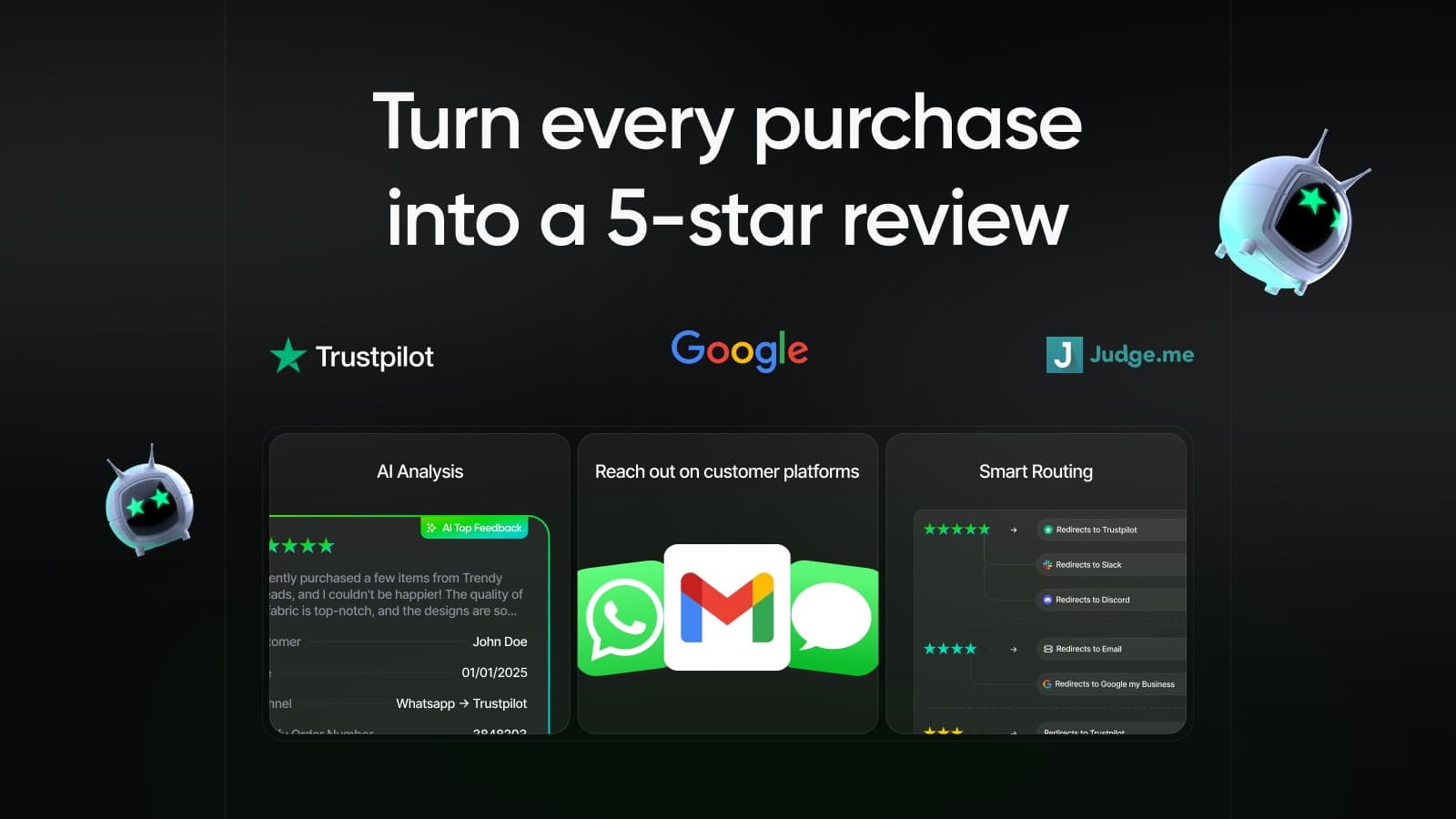
Route happy customers to Trustpilot & Google, capture negatives privately.
Install Reviewz on Shopify5. They are a free, structured product improvement feedback loop
Every 100 reviews is roughly 50 to 80 distinct mentions of strengths, weaknesses, sizing issues, packaging gripes, color discrepancies, and shipping friction. Treated as raw research data, this is more granular than any post-purchase survey and the response rate is dramatically higher because customers self-select.
Smart Shopify operators run sentiment analysis on their reviews every quarter and feed the top 3 negative themes back into product, fulfillment, or copy decisions. The companies that do this are noticeably better at iteration than the ones that read reviews as a vanity metric.
The marketing flywheel: reviews fuel paid and earned channels
6. They give your paid ads better creative ammunition
The highest-performing paid social creative on Meta and TikTok in 2025-2026 is review-driven UGC. Screenshot of a 5-star Trustpilot review overlaid on the product image, voice-over reading a real customer quote, or a side-by-side of three star ratings, these testimonial advertising formats consistently outperform brand-shot product photography by 1.5 to 3x in CTR and CPA.
If you do not collect reviews, you do not have this creative inventory. You are competing in paid against brands who can pull from a library of 500 authentic customer quotes. That is a structural disadvantage you cannot solve by paying for better creative briefs.
7. They are now legally required in many jurisdictions
The EU Omnibus Directive requires ecommerce sites to disclose how they verify and source reviews if they display any. The FTC final rule banning fake reviews went into effect October 2024 with civil penalties up to $51,744 per fake review.
What this means: if you display reviews, you must source them legitimately and prove your verification process. The era of buying reviews is over. The era of having a documented, compliant review collection workflow is now table stakes. We cover this in detail in buy Trustpilot reviews.
The cost of NOT collecting reviews (in actual dollars)
Founders treat review collection as optional because the cost is hidden. It is not. Here is the rough math for a hypothetical Shopify store doing $500K annual revenue at 2.5 percent conversion rate:
| Cost category | Annual impact (est.) |
|---|---|
| Conversion lift forgone (conservative 20 percent of Spiegel's lift) | $100K in lost revenue |
| SERP CTR lift forgone (no star ratings) | 15-25 percent fewer organic clicks |
| Paid CAC inflation (no UGC for ads) | Ad CPA roughly 30 percent higher |
| Repeat purchase rate gap | $30-50K in lost LTV |
| Reviewz subscription cost | $180/year on the starter plan |
The ROI math is not subtle. The only Shopify stores that should not invest in review collection are stores doing less than $50K annual revenue (where there is not enough order volume to feed the funnel). Everyone else has a budget question, not a value question.
How to start collecting reviews this week
The fastest path from zero to a working review funnel is three steps:
- Install a review-collection app that handles the email sequence, schema markup, and Shopify integration. Compare options in best Shopify review apps.
- Set up your post-purchase email cadence at the right delay (7 to 21 days depending on category). See review request email Shopify for the timing and templates.
- Add valid schema markup to your product pages so the reviews you collect actually feed Google rich results. Use the review schema generator or read the review schema markup guide.
That is the entire setup. Most stores can have a working review funnel running in under 2 hours from app install to first request email queued.
FAQ
How many reviews does a Shopify store actually need?
Per product, you want at least 9 to unlock the bulk of Spiegel's conversion lift, and 30 to 50 for diminishing returns plateau. At the brand level, you want at least 100 verified reviews on Trustpilot or Google Business profile within your first year to control your branded SERP. Stores with under 20 total brand reviews look thin even if the average rating is 5 stars.
Are reviews more important than ad creative or product quality?
No, but they multiply both. A great product with no reviews converts roughly half as well as the same product with 50 reviews. A great ad creative drives traffic to a product page where reviews close the sale. Reviews are a force multiplier, not a substitute for the underlying product or marketing. Stores trying to use reviews to compensate for a bad product fail (and often get flagged for fake reviews trying to do so).
What is the best review platform for a new Shopify store?
For pure product reviews and SEO schema, Judge.me has the best price-feature ratio under $50/month. For branded SERP authority, Trustpilot is the strongest brand. Most stores benefit from running both: a self-hosted app for product-page reviews and rich results, plus Trustpilot or Google for branded SERP control. See our full breakdown in Trustpilot vs Judge.me Shopify.
Can negative reviews actually be good for sales?
Yes. Spiegel found that products with a perfect 5.0 rating convert worse than products with 4.2 to 4.7 ratings. Buyers see all-5-star pages as fake or curated and discount them. A few thoughtful 3-star reviews actually improve credibility, as long as you respond to the negative ones well. The exception is when the average drops below 4.0, then trust erodes fast. The sweet spot for conversion is 4.4 to 4.7 with at least 30 reviews.
Do reviews matter for B2B Shopify stores or just B2C?
B2B stores benefit even more in some ways, because B2B buying cycles involve longer research and more stakeholders. Public reviews on Trustpilot or G2-equivalent platforms reduce the perceived risk for procurement teams. The volume can be lower (B2B does not need 500 reviews to look credible, 30 detailed ones works) but the depth matters more. Long, specific reviews from named businesses are worth ten anonymous 5-star ratings.
Route happy customers to Trustpilot & Google, capture negatives privately.
Install Reviewz on Shopify
About the author
Nicolas Provost · Founder of Reviewz.ai
Nicolas built Reviewz.ai after auditing 500+ Shopify review setups while running Kanal (WhatsApp marketing for Shopify). He has spent four years inside the Shopify ecosystem and writes about review collection, brand trust SEO, and the actual economics of running customer-feedback flows on ecommerce sites.
