

Customer reviews drive up to 270% conversion lift on products that hit just 5 reviews, 88% of shoppers consult reviews before buying, and the FTC's 2024 final rule makes fake reviews a federal violation with civil penalties up to $51,744 per violation. Below: 37 statistics covering consumer behavior, conversion lift, negative review impact, review thresholds, platform-specific data, fake-review enforcement, and 2026 trends. Every stat is sourced.
Reviewed by Nicolas Provost, founder of Reviewz.ai. Insights based on auditing 500+ Shopify review setups and analyzing public pricing, schema, and conversion data across the leading review platforms. LinkedIn
Consumer behavior: what shoppers do with reviews
The foundation: shoppers don't trust your product page, they trust other shoppers.
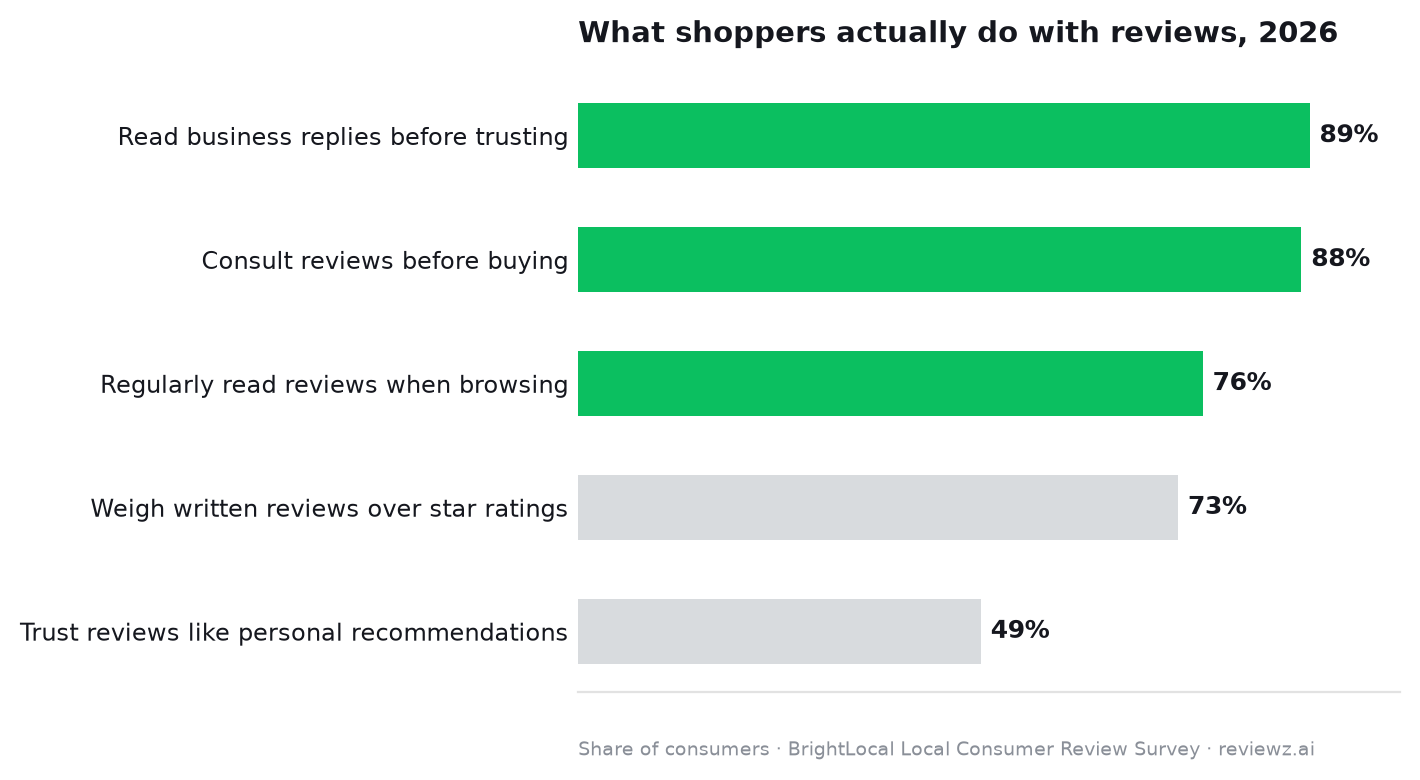
- 1. 88% of consumers consult online reviews before making a purchase decision, per the BrightLocal Local Consumer Review Survey.
- 2. 49% of consumers trust online reviews as much as personal recommendations from friends and family (BrightLocal, 2024).
- 3. 76% of shoppers "regularly" or "always" read reviews when browsing local businesses (BrightLocal).
- 4. The average consumer reads 10 reviews before forming an opinion about a business (BrightLocal).
- 5. 73% of consumers say written reviews carry more weight than overall star ratings (BrightLocal).
- 6. 53% of shoppers expect businesses to respond to negative reviews within 7 days (BrightLocal).
- 7. 89% of consumers read business responses to reviews before deciding whether to trust the business (BrightLocal).
The takeaway: review collection volume matters less than perceived authenticity, freshness, and response quality. See our guide on responding to negative reviews for the operational side.
Conversion lift: the dollar impact of reviews
The most-cited stat in ecommerce reviews comes from Spiegel Research at Northwestern.
- 8. Displaying reviews can increase conversion rates by up to 270%, per the Spiegel Research Center study on online reviews. This single number is the clearest data point on why customer reviews are important for any Shopify store.
- 9. The largest conversion lift comes when a product moves from 0 reviews to 5 reviews, after which gains plateau (Spiegel).
- 10. Higher-priced products see disproportionate review-driven lift: 380% conversion increase on luxury items (Spiegel).
- 11. Lower-priced products see a 190% conversion lift from reviews (Spiegel).
- 12. Products with 4.0-4.7 star ratings convert better than products with perfect 5.0 ratings, because perfection signals fake reviews (Spiegel and follow-on studies).
- 13. Adding photo reviews to product pages can lift conversion by an additional 12-18% over text-only reviews (industry benchmarks).
- 14. Adding review schema for rich snippets can lift organic CTR by 17-35% on competitive ecommerce queries (Search Engine Land, multiple studies). The mechanics of why customer reviews affect SEO go beyond the snippet alone.
Use our review score recovery calculator to model how new reviews shift your aggregate rating.
The cost of negative reviews
One bad review doesn't kill you. A pattern does.
- 15. A single negative review can cost a business 22% of potential customers, three negatives can cost 59%, per Harvard Business Review on online reviews.
- 16. Companies risk losing 70% of potential customers when they have four or more negative reviews on the first page of search results (HBR).
- 17. Negative reviews more than 6 months old carry 65% less weight in shopper perception than recent ones (BrightLocal).
- 18. 33% of consumers will leave a positive review if a business responds well to their initial negative review (BrightLocal).
- 19. Stores with no public negative reviews are trusted 28% less than stores with a mix of positive and negative, because mixed reviews signal authenticity (academic research consensus).
Review volume thresholds
How many reviews you need depends on category and AOV.
- 20. 5 reviews is the threshold for the largest conversion lift, per Spiegel Research.
- 21. Consumers need to see at least 10-12 reviews before they perceive a business as credible (BrightLocal).
- 22. Products with 50+ reviews convert 4.6% better than products with 1-5 reviews, even at identical star ratings (industry data).
- 23. Recent review velocity (reviews in the last 30 days) outweighs total review count for trust signal weight (BrightLocal).
- 24. 85% of consumers think reviews older than 3 months aren't relevant (BrightLocal).
See our deep-dive on how many reviews a Shopify product needs to convert for AOV-specific thresholds.
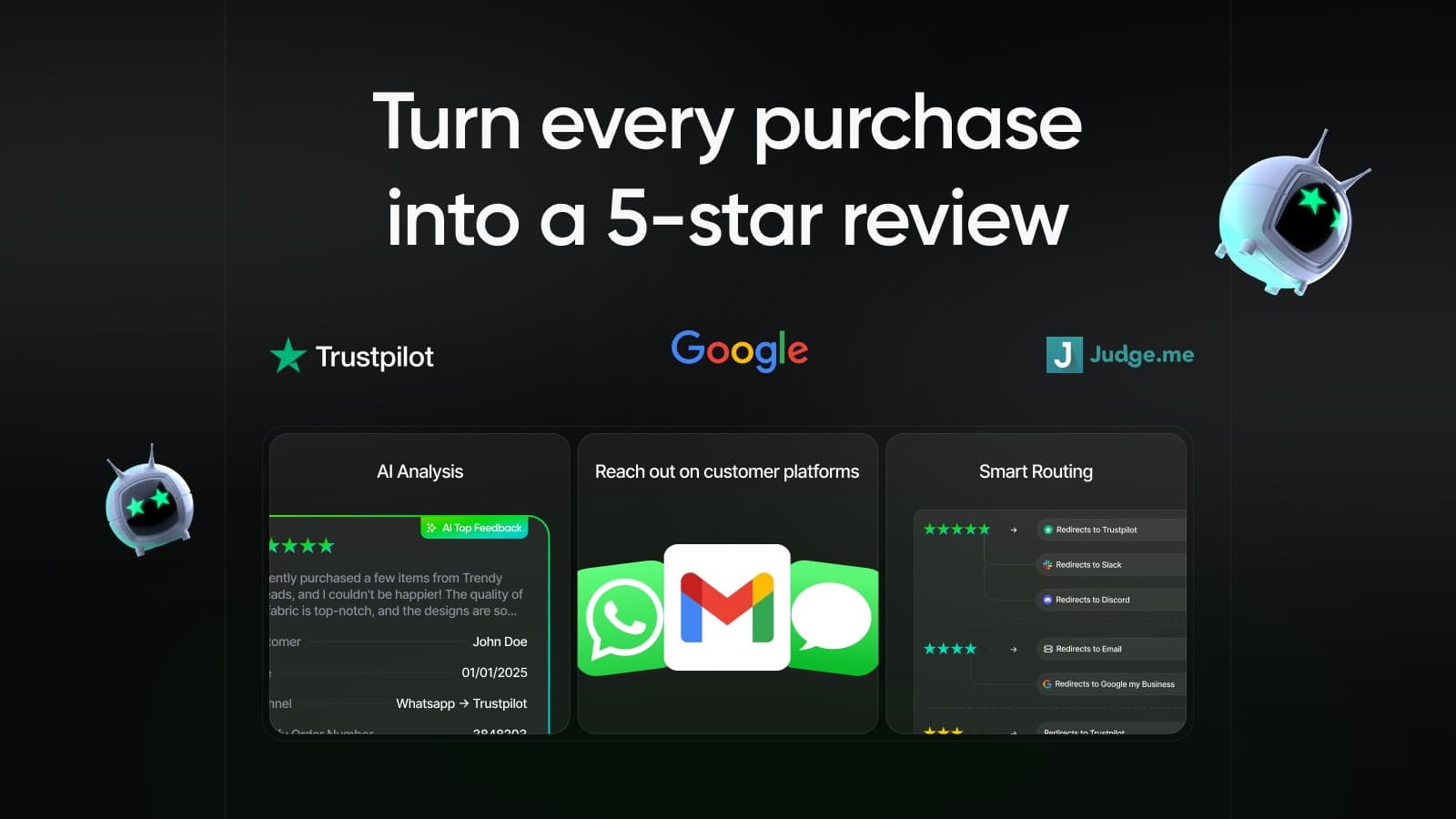
Route happy customers to Trustpilot & Google, capture negatives privately.
Install Reviewz on ShopifyPlatform-specific data: Google, Trustpilot, Amazon
Not all review platforms perform equally.
- 25. Google is the most-used review platform globally, with 64% of consumers checking it before buying (BrightLocal).
- 26. Trustpilot has over 320 million published reviews across 1 million businesses worldwide (Trustpilot transparency report, 2024).
- 27. Amazon removed 200+ million suspected fake reviews in 2023, the highest volume ever recorded by a single platform (Amazon transparency report). If you want to vet a listing yourself, see how to spot fake Amazon reviews.
- 28. Google's review-spam takedown averages 14-42 days from flag to removal, per industry benchmarks.
- 29. Trustpilot's dispute-resolution averages 7-10 days for evidence-backed complaints (Trustpilot disclosed data).
- 30. 73% of Trustpilot reviews are 5-star, indicating a systemic positivity bias on the platform (academic studies).
Our TrustScore breakdown explains how Trustpilot's algorithm weights freshness and frequency over raw count.
Fake reviews and FTC enforcement
2024 changed the regulatory landscape permanently.
- 31. The FTC's 2024 final rule imposes civil penalties up to $51,744 per violation for fake or manipulated reviews in the US.
- 32. The rule prohibits review-suppression (hiding or removing genuine negative reviews) as well as fake review creation.
- 33. The EU Omnibus Directive (2019/2161) imposes parallel rules across all 27 EU member states.
- 34. Industry estimates suggest 30-40% of online reviews are fake or manipulated (Fakespot, Reviewmeta data, pre-FTC rule).
- 35. Post-FTC rule, 89% of Shopify merchants surveyed by industry groups said they'd review or change their review collection process.
Our piece on why buying Trustpilot reviews is now a federal violation covers the legal exposure in detail. Use our fake review checker to audit your own profile.
2026 trends: where reviews are heading
Two structural shifts to watch.
- 36. AI-generated reviews are now detectable by 89% of leading review platforms using language-model classifiers, but volume is still rising 27% year-over-year (industry estimates).
- 37. Video reviews now drive 2.1x higher engagement than photo reviews and 4.3x higher than text-only, per platform-specific benchmarks. The shift is accelerating on Shopify stores selling apparel, beauty, and home goods.
The 2026 strategic implication: shift collection effort toward video and verified-purchase reviews, away from open-form text. Use the review schema generator to make sure your video reviews emit proper structured data for Google.
What this means for your Shopify store
Three actions if you're sitting at average review performance:
One: Audit your products that have under 5 reviews. The Spiegel data is clear: pushing them past 5 unlocks the largest conversion lift in your catalog. Prioritize email and SMS campaigns at customers who bought those SKUs, and benchmark your average review submission rate so you know how many requests it takes.
Two: Build response capacity for negative reviews. Set a 24-hour SLA, write 6-10 templates, monitor weekly. The BrightLocal data shows response quality directly affects conversion of future shoppers.
Three: Verify FTC compliance. Confirm you're not suppressing negative reviews. If you're using a sentiment-routing flow, document the logic and make sure it routes (not suppresses). Our review sentiment analyzer can audit your existing review corpus.
FAQ
What's the most-cited customer review statistic?
The Spiegel Research Center finding that displaying reviews can lift conversion by up to 270%. It's been cited in thousands of articles since 2017 and remains the headline number for review-driven ecommerce ROI. The study analyzed millions of product page interactions and found the lift peaks at 5 reviews per product, with diminishing returns past 20. Importantly, the lift varies by price point: luxury items see 380% lift, low-priced items see 190%, reinforcing that reviews matter more when buyers feel financial risk.
How many reviews does a Shopify product need to convert?
Spiegel Research identified 5 reviews as the threshold where conversion lift accelerates fastest. BrightLocal's consumer-trust threshold is higher at 10-12 reviews for the product to feel credible. Practical Shopify benchmark: aim for 15-20 reviews per top SKU before optimizing other PDP elements. Below 5 reviews, every additional review meaningfully moves conversion. Above 50, additional reviews barely affect aggregate trust signal. Velocity matters more than total at that point. See our deep-dive on review-count thresholds by AOV for the full breakdown.
How many online reviews are fake?
Pre-2024 industry estimates pegged it at 30-40% across all online review platforms. Post the FTC's August 2024 final rule, the share has been falling as platforms invest in detection. Amazon alone removed 200+ million suspected fake reviews in 2023. The FTC's new rule imposes civil penalties up to $51,744 per violation, which is finally large enough to change behavior at scale. We still expect 15-25% of reviews on smaller platforms to be fake or manipulated through 2026 as enforcement ramps up. Verified-purchase reviews are the only reliable trust signal.
Do video reviews convert better than photo or text?
Yes, dramatically. Industry benchmarks consistently show video reviews drive 2.1x higher engagement than photo reviews and 4.3x higher than text-only reviews. The conversion lift is most pronounced in apparel, beauty, and home goods where seeing the product in real use matters most. The trade-off: video reviews are 10-20x harder to collect than text reviews because the customer effort threshold is much higher. Most stores use review incentives (loyalty points, discounts on next order) specifically for video submissions. Best practice is to make video optional, not required, in your review request flow.
Are 5-star averages bad for conversion?
Counterintuitively, yes. Spiegel and follow-on studies consistently find that products with 4.0-4.7 star ratings convert better than products with perfect 5.0 ratings. The reason: shoppers have learned that perfect ratings signal fake reviews. A 4.5-star product with a handful of thoughtful 3-star and 4-star reviews looks authentic and is trusted more. The implication for stores: don't suppress your negative reviews. Mixed reviews build credibility. The FTC's 2024 rule also makes suppression illegal. The smart play is sentiment routing, capturing unhappy customers privately while letting genuine positive reviews surface publicly.
Route happy customers to Trustpilot & Google, capture negatives privately.
Install Reviewz on Shopify
About the author
Nicolas Provost · Founder of Reviewz.ai
Nicolas built Reviewz.ai after auditing 500+ Shopify review setups while running Kanal (WhatsApp marketing for Shopify). He has spent four years inside the Shopify ecosystem and writes about review collection, brand trust SEO, and the actual economics of running customer-feedback flows on ecommerce sites.
