

Most Shopify Plus and enterprise stores over-buy on review platforms, paying $15k to $50k per year for features they don't use. What enterprises actually need: multi-store consolidation under one brand, headless review schema injection, governance (who can respond, who can delete, audit logs), SSO, and API rate limits that won't choke at peak hours. What they get sold: a thousand integrations they'll never enable. Buy on the four enterprise-specific needs, not on the feature checklist.
Reviewed by Nicolas Provost, founder of Reviewz.ai. Insights based on auditing 500+ Shopify review setups and analyzing public pricing, schema, and conversion data across the leading review platforms. LinkedIn
What actually changes at Plus and enterprise scale
At Plus and enterprise scale, the review problem shifts from "how do we collect more" to "how do we govern what we already have across complex setups." The underlying reasons reviews matter don't change; the operational complexity does. Four changes drive the buying decision.
One, multi-store. A Plus org might run 3 to 10 stores under one brand (regional storefronts, sub-brands, B2B vs DTC). Reviews on the Canadian store should sometimes display on the US store and sometimes not. Most review apps weren't built with this in mind.
Two, headless commerce. With Hydrogen or custom Next.js, the widget injection model doesn't apply. You need a clean API and responsibility for rendering review components and schema markup yourself.
Three, governance. Multiple teams will respond to reviews. Marketing wants control of public responses. CX wants to escalate. Legal wants delete authority. Without role-based access control and audit logs, a junior CS rep will delete a review that should have escalated.
Four, SLA and reporting. Response-time SLAs, NPS trends, sentiment by SKU, category-level reporting flowing to the data warehouse. Most app-level reporting falls short here.
Multi-store review consolidation
This is the single most common pain point we see at the Plus level. You have a US, UK, EU, and APAC storefront for the same brand. The same product SKU exists on all four. A US customer leaves a great review on the US store. Should it appear on the UK product page? On the EU product page? In what language?
The pragmatic answer for most multi-region brands: yes, reviews should be consolidated at the brand-product level, with optional language tagging and optional region tagging for buyers who want to filter. Buyers in different regions read each other's reviews, and an empty review section on the EU store while the US store has 200 reviews on the same SKU is a conversion killer.
Apps that handle this well: Yotpo Enterprise has a multi-store sync feature, Okendo supports cross-store review syndication on its higher tiers, Reviews.io has a multi-store mode that needs more configuration but works. Trustpilot's brand-level reviews are inherently cross-store because they live on Trustpilot's domain, which is one of the underrated advantages of using Trustpilot as the trust layer. Our guide on Trustpilot reviews for Shopify covers the integration patterns.
The trap: vendor-side sync that requires every product to be SKU-matched across stores. If your product catalog isn't clean (and at enterprise scale, it usually isn't), the sync will silently miss matches. Audit the SKU mapping before signing the contract.
Headless Shopify and review schema
If your front-end is Hydrogen, Next.js, Remix, or any custom stack, the standard review app widget approach is mostly off the table. You need three things: an API that returns review data for a given product, a JSON-LD schema generator that emits valid schema.org/Review markup (our review schema markup guide walks through the exact nesting), and ideally a webhook so your front-end can revalidate when new reviews are submitted.
Most enterprise review apps now offer a GraphQL or REST API, but the quality varies. Things to verify before committing:
Does the API return aggregateRating data in a format that maps directly to schema.org/AggregateRating fields? You'll need this for Google rich results, and you can validate output with our review schema generator or with Google's Rich Results Test.
Are there per-page rate limits? Some review APIs choke at 50 requests per second, which is fine for a moderate Shopify store but disastrous for a headless storefront with ISR cache misses during a flash sale.
Is there a CDN-cached read endpoint? If every product page render hits the review API live, you've added unnecessary latency to your TTFB.
Can you submit reviews via API too, or is collection still email-driven? For headless setups, you often want a custom in-page review form, not the app's hosted page. Apps that lock you into their hosted review form will limit your front-end design.
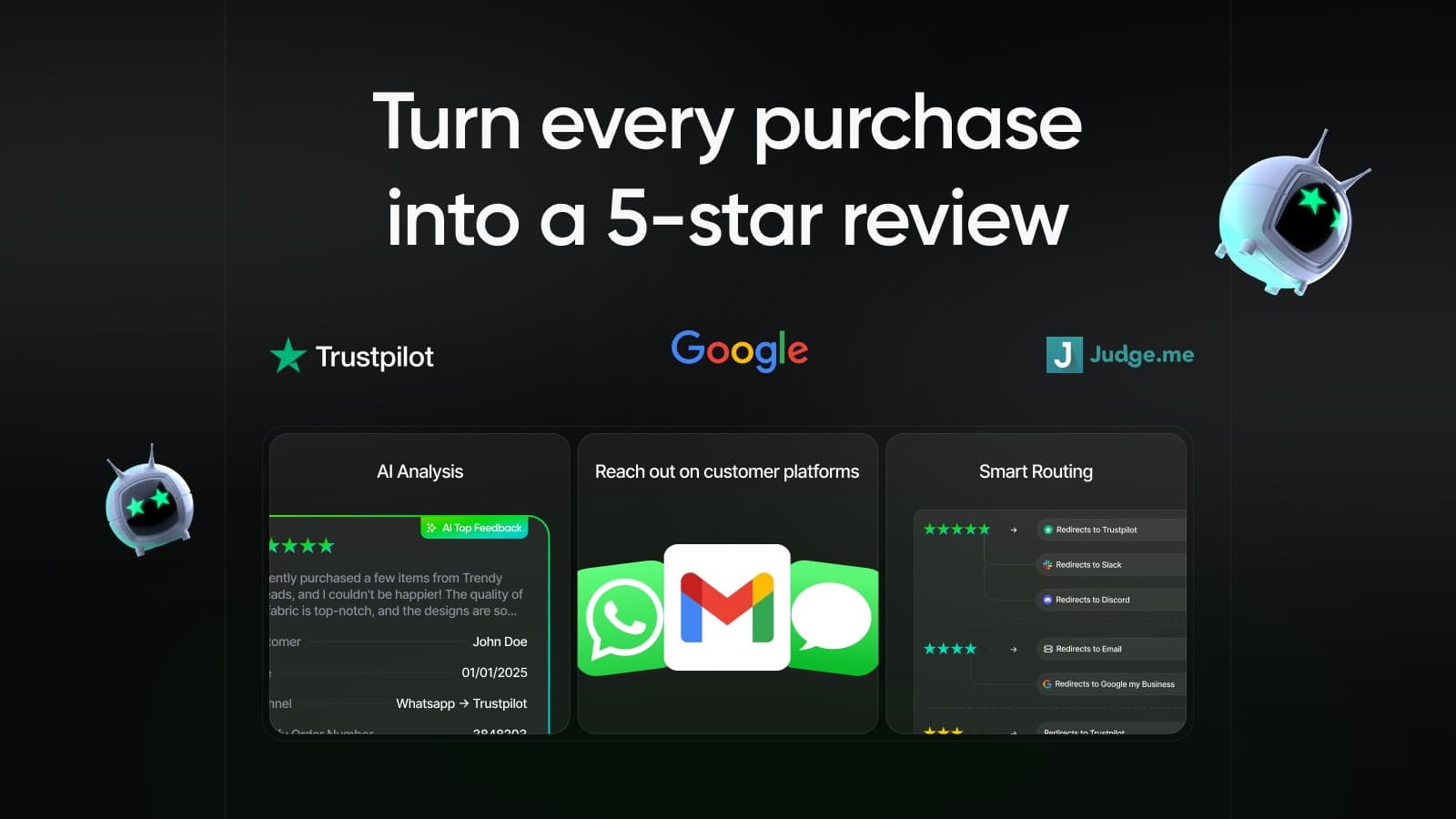
Route happy customers to Trustpilot & Google, capture negatives privately.
Install Reviewz on ShopifyGovernance: response permissions, SLA tracking, audit logs
At a 5-person Shopify store, one person responds to reviews. At a Plus org with 50 stores and 200 employees, the answer is messier. Here's the governance setup that actually works:
Role-based access control with at least three roles. Reviewer (read-only, can see all reviews and reports). Responder (can post public responses on assigned product categories or stores). Admin (can flag for removal, delete user-generated content, manage roles). Most enterprise review platforms support this; many smaller apps don't.
Response SLA tracking. Define an internal SLA (24 hours for negative reviews, 72 hours for neutral, optional for positive) and have the platform track whether responses meet the SLA. Pull this into a weekly report for the CX team.
Audit logs. Every deletion, every response edit, every flag-for-removal action needs to be logged with timestamp, user, and reason. This matters for legal review of brand handling, and it matters even more if you're in a regulated industry (financial, healthcare, alcohol) where review content can have compliance implications.
SSO. If you're on Okta or Azure AD, the review platform needs to support SSO with provisioning. Manually managing 50 user accounts in the review platform when you have a directory service is operationally wasteful and creates security holes.
For responding at enterprise scale, our guide on responding to negative reviews sets the language baseline, but enterprise teams should also have a response playbook with pre-approved tone, escalation criteria, and lawyer-reviewed templates for edge cases (defamation claims, regulatory complaints).
Enterprise pricing tiers (and where the over-buy happens)
Honest pricing reality for Plus and enterprise review platforms in 2026:
| Platform | Annual range | Best for |
|---|---|---|
| Yotpo Enterprise | $30k to $80k | Multi-region brands needing one vendor across reviews, loyalty, SMS |
| Trustpilot Premium | $10k to $40k | Brand-level trust signal, multi-store consolidated on Trustpilot domain |
| Okendo Pro | $15k to $40k | DTC enterprises with strong product attributes and design needs |
| Reviews.io Enterprise | $10k to $30k | Cost-conscious enterprises wanting multi-store and Google integration |
| Bazaarvoice | $50k to $200k+ | Large retailers syndicating reviews across retail networks |
Where the over-buy happens: enterprises commonly pay for features they will never enable (our Reviewz vs Yotpo comparison breaks down exactly which of those bundled modules you are actually paying for). Loyalty modules they don't use. SMS marketing they handle elsewhere. UGC galleries that need design time their team doesn't have. AI-powered moderation when their actual moderation issue is the response SLA, not the moderation rules.
Before signing an enterprise review contract, list the 5 specific outcomes you want from the platform in year one. If the platform you're considering delivers on 5 out of 5 with the base tier and you're being upsold to the top tier for outcomes 6 through 10, push back. Most enterprise sales motions assume you'll buy the top tier; you usually don't need to.
API and integration needs at enterprise scale
The integration list that matters at enterprise scale, in priority order.
One, the data warehouse. Reviews and ratings need to land in Snowflake or BigQuery. Most enterprise apps offer Segment or direct webhook; verify latency (real-time vs hourly batch).
Two, the CDP. If you're running mParticle, Segment, or Twilio Engage, review events should flow in as customer events. A 5-star is engagement; a 1-star should trigger CX outreach.
Three, the helpdesk. Negative reviews auto-create tickets in Zendesk, Gorgias, or Front. One of the cleanest ROI integrations you can do.
Four, Klaviyo or your ESP. Our Klaviyo reviews integration guide covers triggers; at enterprise scale you also want submitter-vs-non-submitter segmentation for retention.
Five, the PIM. The review platform needs to match reviews to the correct product across store instances. Either pull SKUs from the PIM or treat Shopify as canonical and manage the mapping there.
Common enterprise review mistakes (and how to avoid them)
Five patterns we see repeatedly. One, buying for features instead of outcomes. Two, treating reviews as a marketing problem when they're a CX + brand + legal problem at enterprise scale. Three, no clear ownership: marketing, CX, and legal all touch reviews, and without a single accountable owner, nothing improves. Four, ignoring the FTC final rule on fake reviews compliance at scale, the same gaps we found when we audited 50 Shopify stores for FTC compliance. Five, paying for syndication features you don't enable.
For enterprises operating in the EU, the EU Omnibus Directive imposes specific disclosure requirements on review verification. Larger brands have been fined for not making it clear how reviews are verified. This is a legal review item, not a marketing one.
The right framing for enterprise review platform selection: treat it as an enterprise software purchase with three buyer personas (CX, marketing, legal) and an IT integration sponsor. Run it like a CRM or CDP procurement, not an app store purchase.
FAQ
Can a single review platform handle multiple Shopify Plus stores?
Yes, but the implementation varies. Yotpo Enterprise, Okendo Pro, and Reviews.io Enterprise all support multi-store setups under one parent account, with configurable cross-store review syndication. Trustpilot handles this differently: because reviews live on Trustpilot's domain at the brand level, they're inherently cross-store. The cleanest implementations require a well-maintained SKU mapping across stores; without that, reviews silently fail to syndicate. Audit your product catalog hygiene before assuming the platform will solve the problem.
Does Shopify Plus include any native review functionality?
Shopify Plus does not include a native review product. Every store on Plus pulls reviews from a third-party app on the Shopify App Store or from a dedicated enterprise platform. The Shopify Product Reviews app (which was the legacy native option) was sunset in 2024. For enterprise stores, the typical setup is either Yotpo, Okendo, Reviews.io, or Trustpilot for the heavy lifting, sometimes paired with Reviewz.ai for the routing layer that filters happy customers to public platforms and captures negatives privately.
How do reviews work on a headless Shopify Plus storefront?
On a headless storefront (Hydrogen, Next.js, custom), you call the review platform's API to fetch reviews, render the display yourself, and inject the schema.org/Review JSON-LD into the page head. The widget injection model that comes out of the box with most apps does not apply. Verify the platform's API supports your render pattern (ISR, SSR, edge), check the rate limits, and confirm there's a CDN-cached read endpoint. Also verify you can submit reviews via API if you want a custom in-page form rather than the platform's hosted page.
What governance features should an enterprise look for in a review platform?
Five specific features. Role-based access control (reviewer, responder, admin at minimum). Response SLA tracking with reporting. Audit logs for every delete, edit, flag, and response action. SSO support with your identity provider (Okta, Azure AD, Google). Per-store or per-category permissions so a regional team can manage their own reviews without touching others. Without these, you'll either over-restrict access (slow responses) or under-restrict (a junior employee deletes a review that should have escalated). Most app-store-tier review apps don't ship these features; enterprise-tier ones do, but pricing varies widely.
Is Bazaarvoice worth it for a Shopify Plus enterprise?
Only if you're syndicating reviews across major retail networks (Amazon, Walmart, Target, Best Buy product detail pages). Bazaarvoice's core value is the retail syndication network, not its on-Shopify display features. If your product is sold through retail partners and you want your reviews to populate on the retailer's product pages too, the price tag can pay for itself. If you sell exclusively DTC on Shopify, you're paying for capabilities you'll never use. The other enterprise platforms (Yotpo, Okendo) handle DTC-only Shopify Plus setups at a fraction of the cost.
Route happy customers to Trustpilot & Google, capture negatives privately.
Install Reviewz on Shopify
About the author
Nicolas Provost · Founder of Reviewz.ai
Nicolas built Reviewz.ai after auditing 500+ Shopify review setups while running Kanal (WhatsApp marketing for Shopify). He has spent four years inside the Shopify ecosystem and writes about review collection, brand trust SEO, and the actual economics of running customer-feedback flows on ecommerce sites.
