

Yes, customer reviews affect SEO, but not the way most blog posts claim. The real wins for Shopify stores are three: valid AggregateRating schema that pulls star ratings into Google's rich results (a measurable CTR lift), branded SERP authority when Trustpilot or Google Business profiles rank for your brand searches, and UGC volume as a Google quality signal. Reviews do not directly boost generic keyword rankings. Stop chasing that myth, start chasing the rich snippet.
Reviewed by Nicolas Provost, founder of Reviewz.ai. Insights based on auditing 500+ Shopify review setups and analyzing public pricing, schema, and conversion data across the leading review platforms. LinkedIn
Reviews influence SEO indirectly, through 5 specific mechanisms
The phrase "reviews boost SEO" is doing a lot of heavy lifting on the average ecommerce blog. The truth is more boring and more useful: reviews never directly raise your ranking for "buy red sneakers online". What they do is feed five distinct signals that Google does weigh, and only one of them (schema-driven rich results) produces an immediate, measurable lift.
Here are the five mechanisms, ranked by how much they actually move the needle on a Shopify store:
- AggregateRating schema producing star ratings inside the SERP, lifting CTR on existing rankings.
- Branded SERP authority, where Trustpilot or Google Business listings rank for your brand name and frame the buyer's first impression.
- Dwell time and engagement signals on product pages, longer sessions, lower bounce.
- Fresh user-generated content, which Google treats as a quality and freshness signal.
- E-E-A-T signals for the brand entity, especially the "Experience" pillar Google added in 2022.
Most blog posts blur all five together and call it "SEO boost". That is why founders install a review app, wait three months, see no ranking change, and assume the app is broken. The app is fine. The expectation was wrong. The deeper case for collecting reviews at all is in why customer reviews are important, which goes well beyond search.
Star ratings in rich results: the only direct CTR lift you can measure
This is the one mechanism with a clean cause-and-effect chain. You add valid Product and AggregateRating schema to your product pages, Google parses it, and a yellow star bar appears beside your search result. The same listing, same position, suddenly takes a larger share of clicks.
The CTR lift is real but modest. Industry data points to 10 to 35 percent CTR increases on product-result rows that show star ratings versus identical rows without them (one of many figures in our customer review statistics for 2026). The variance is huge because it depends on whether competing listings also show stars (when everyone has stars, the lift collapses).
Two things to know:
- Google's policy is that schema must reflect reviews displayed visibly on the same URL. Hiding the review widget while keeping the JSON-LD is a guaranteed manual action eventually.
- You need at least one review per product. AggregateRating with
reviewCount: 0is technically valid but Google routinely strips zero-count results from rich snippets.
If you want to set this up correctly, our review schema markup guide walks through the JSON-LD code and the review schema generator outputs valid markup you can paste into your Shopify theme.
Branded SERP authority: when Trustpilot ranks for your brand name
Type your brand name into Google. You should rank first. But position two, three, or four usually belongs to Trustpilot, Google Business, Reddit, or a comparison site. That branded SERP is the first impression every researched buyer gets. It is also the highest-stakes piece of SEO real estate you own.
This is where collecting reviews actively matters, not for ranking lift but for narrative control. A Trustpilot page with 4.6 stars and 800 reviews tells a different story than the same page with 3.2 stars and 14 reviews. Same brand, very different SERP.

Reviewz routes happy buyers to Trustpilot and Google so your branded SERP fills with positive third-party validation instead of one angry customer who happened to leave a review unprompted. We dig deeper into this in how to get more Trustpilot reviews on Shopify and unpack platform legitimacy in is Trustpilot legit.
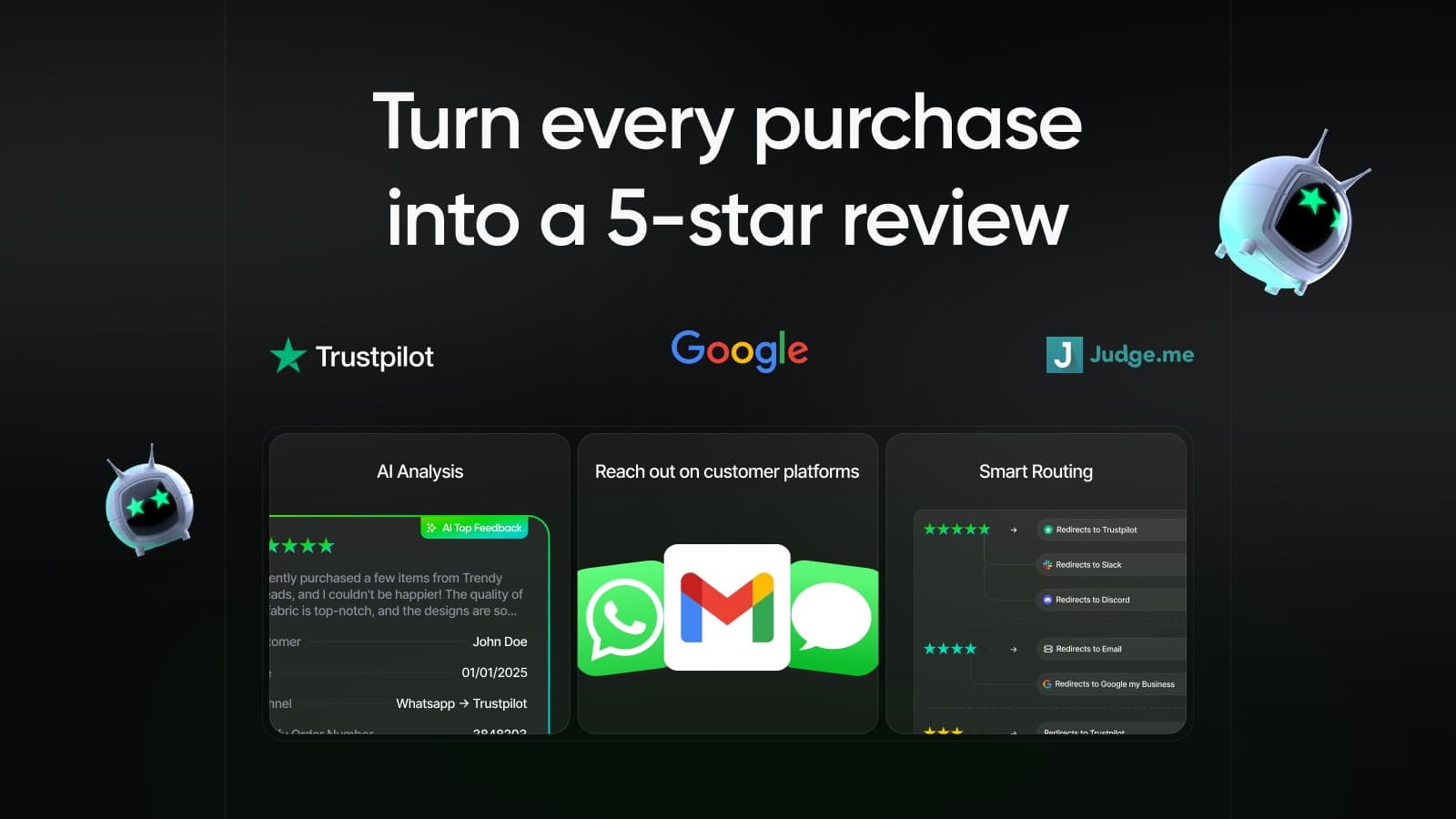
Route happy customers to Trustpilot & Google, capture negatives privately.
Install Reviewz on ShopifyCTR and dwell time: the second-order SEO signal
Google has publicly said it does not use Chrome data or click-through rate as a direct ranking factor. Then in 2024 the DOJ antitrust case unsealed internal Google documents showing a system called Navboost that uses clicks heavily. So the official line and the internal reality diverged. Operate accordingly.
What this means for review-heavy product pages: when buyers land on your page, scroll through reviews, read photos and Q&A, and stay 90 seconds instead of 8 seconds, that engagement is part of the user signal stack Google uses. Reviews give buyers something to do on the page. Dwell time goes up. The signal compounds.
This is not a switch you flip and see in Search Console next week. It is a 6 to 12 month drip that shows up as gradual rank stability and improved positions on commercial-intent queries. It is also why low-review-count product pages get outranked by 50-review pages even when on-page content is identical, which loops back to how many reviews a product needs before these signals kick in.
UGC volume and E-E-A-T: why Google trusts pages with real reviews
Google's Harvard Business Review on online reviews reporting and its own E-E-A-T documentation both push the same idea: pages backed by real customer experience get treated as more trustworthy than pages with only brand-authored copy. Adding "Experience" to E-A-T in December 2022 was not a cosmetic change. It was Google publicly endorsing user-generated content as a quality moat.
Practically, a Shopify product page with 40 unique reviews (each a few unique sentences) is dramatically richer text than the product page alone. You get long-tail keyword coverage you never planned for: "runs small", "perfect for travel", "fits my XL frame". Those phrases match how real shoppers search. They are not keywords you would ever stuff into product copy.
This is also why review syndication services that paste identical reviews across multiple sites do not help SEO. Google deduplicates. Only unique on-page UGC adds value. The same unique review text increasingly feeds AI answer engines too, which is the focus of our guide to AEO for ecommerce reviews.
Common SEO mistakes with reviews (the ones that actually hurt)
Most of the "review SEO" damage we see on audits comes from a small set of recurring mistakes:
| Mistake | SEO consequence |
|---|---|
| Schema markup not matching visible reviews | Manual action, stars stripped sitewide |
| Reviews loaded via JavaScript only | Googlebot may miss UGC text, no long-tail benefit |
| Buying fake reviews | FTC fines plus platform bans, see buy Trustpilot reviews |
| Syndicating identical reviews across sites | Duplicate content, zero UGC value |
| Ignoring branded SERP (no Trustpilot, no GBP) | Reddit and complaints sites rank for your brand |
The fake-review one is now backed by enforcement. The FTC final rule banning fake reviews went into effect in October 2024 with civil penalties up to $51,744 per violation. Google de-indexes sites caught syndicating fake UGC. The risk-reward is laughably bad.
FAQ
Do customer reviews directly improve Google rankings?
No, not directly. Reviews are not a ranking factor in the way that backlinks or page speed are. What they do is feed several indirect signals: rich result eligibility (which lifts CTR on existing rankings), longer dwell time on product pages, unique long-tail content, and E-E-A-T trust signals. The compounded effect over 6 to 12 months can be substantial, but no Shopify store has ever jumped from page three to page one solely because they collected more reviews.
How many reviews do I need before star ratings show in Google search?
Technically you need one. In practice, Google's rich results algorithm prefers products with at least 5 unique reviews and a non-zero AggregateRating. Below that threshold, stars often fail to appear even with valid schema. Aim for at least 10 reviews per SKU on your top-traffic product pages before expecting consistent rich snippet display.
Is third-party review schema (Trustpilot widget) better than self-hosted?
For product pages, self-hosted schema with your own review collection app wins. Trustpilot widgets primarily drive Trustpilot's own SEO, not yours. For brand-level trust (the branded SERP), Trustpilot helps because their domain authority puts them on page one for your brand. Use both: self-hosted product reviews for rich snippets, Trustpilot for branded SERP authority.
Do bad reviews hurt SEO?
Not directly. A 3.2-star average will still show stars in rich results (Google does not filter low ratings). What bad reviews hurt is CTR (buyers see the stars and skip the listing) and conversion rate. Both compound into worse user signals over time. The fix is not hiding bad reviews, it is collecting more good ones to dilute the average. See our guide on how to respond to negative reviews.
Should I worry about reviews if I run a small Shopify store?
Yes, but in a specific way. Small stores get the biggest CTR lift from rich-result stars because they typically rank lower (positions 4-10) where star-rated rows steal a disproportionate share of clicks. Small stores also benefit most from branded SERP control because they have fewer ranking pages overall. Start with rich-result schema on your top 5 products, then build branded SERP coverage with Trustpilot or Google reviews.
Route happy customers to Trustpilot & Google, capture negatives privately.
Install Reviewz on Shopify
About the author
Nicolas Provost · Founder of Reviewz.ai
Nicolas built Reviewz.ai after auditing 500+ Shopify review setups while running Kanal (WhatsApp marketing for Shopify). He has spent four years inside the Shopify ecosystem and writes about review collection, brand trust SEO, and the actual economics of running customer-feedback flows on ecommerce sites.
