
Send the first review request after the first actual use, not after delivery, and send a second one after the second cycle ships. Subscription products live or die on the second renewal, so your review flow needs to catch churn signals before they become cancellations. Most Shopify subscription stores under-collect reviews because they copy one-shot review timing (7 days after delivery) and then wonder why their public review count is half of what a comparable one-shot store has.
Reviewed by Nicolas Provost, founder of Reviewz.ai. Insights based on auditing 500+ Shopify review setups and analyzing public pricing, schema, and conversion data across the leading review platforms. LinkedIn
Why subscription product reviews are different
A one-shot Shopify order has a single moment of truth: the unboxing and first use. A subscription product has a different moment of truth: the second cycle. The first cycle tells the customer whether they like the product. The second cycle tells them whether they want to keep paying for it. Your review flow should mirror that, because for a subscription the reviews you collect are also retention signals, which raises the stakes on why reviews are so important in the first place.
Most subscription stores on Shopify run on Recharge, Bold Subscriptions, or the native Shopify Subscriptions app. The review side of the stack rarely gets the same attention. Stores will spend six months optimizing the bundle, the shipping cadence, and the cancellation flow, then bolt on Judge.me with a default 7-day-after-fulfillment trigger and call it done. That trigger fires before half of subscribers have even opened the box.
Consumables (coffee, supplements, pet food, skincare) need 7 to 21 days of actual use before a review prompt makes sense. Boxes (curated subscription boxes, meal kits) hit their peak satisfaction within the first week. Service subscriptions (memberships, software) need a full billing cycle. One trigger does not fit all three.
When to send the first review request (after use, not after delivery)
Stop triggering off the fulfillment webhook. Start triggering off estimated first use. For most consumable subscriptions, that means 10 to 14 days after delivery, not 7. For a coffee subscription, 14 days gets you past the first bag opening and into actual brewing. For supplements, 21 days is closer to the truth, because customers want to feel something before they vouch for it.
If you're running Recharge, use the order tags to differentiate first-order subscribers from recurring shipments. The first-order review prompt should ask about the onboarding experience and the product. Recurring shipments should never get the same prompt twice, that's how you end up with the same customer leaving the same 5-star review three times in a row, which is exactly the kind of pattern Trustpilot's fraud detection flags as suspicious.
For prompts, our review request email templates include subscription-specific variants that ask about the first use experience, not the delivery experience, and timing them well follows the same logic as the best time to send a review request. The wording matters: "How was your first week with [Product]?" outperforms "How was your order?" by a wide margin on subscription stores we've audited.
Review prompts that catch churn signals
This is where subscription review flows separate from one-shot flows. Your review request is also a churn-prevention survey, if you write it right. Three prompts that catch churn before it happens:
"What's the one thing you'd change about your delivery cadence?" Customers who want a slower cadence are 4x more likely to cancel in the next 60 days than customers who want it kept the same. Catch them, offer a pause or a frequency change, save the subscription.
"Is the quantity right for how often you use it?" This is the most common pre-cancellation signal we see. Customers stockpiling product will cancel. Customers running out before the next ship will downgrade or churn to a competitor.
"What else have you tried in this category recently?" If your subscriber names a competitor by name, they're shopping. Route that response to your retention team, not to your public review feed.
The standard review sentiment analyzer approach catches negative language, but subscription churn often shows up in neutral language with specific change requests. Train your team to read for change requests, not just for sentiment.
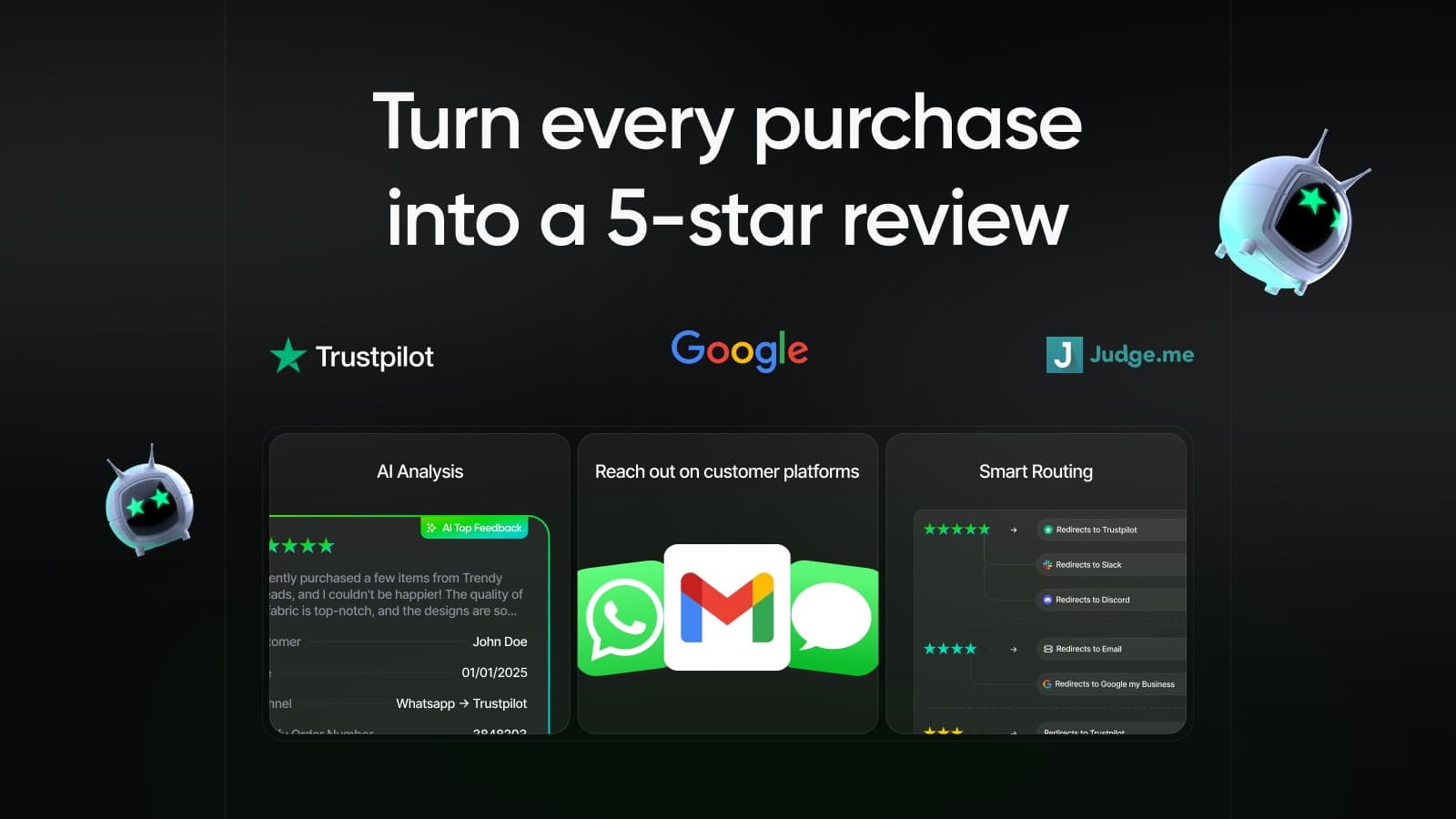
Route happy customers to Trustpilot & Google, capture negatives privately.
Install Reviewz on ShopifyThe second-cycle review request (do you still love it?)
The second review request, sent after the second shipment ships, is the most underused mechanic in subscription Shopify. It does three things at once: it gives you a fresh public review for the same product (with explicit subscriber context), it surfaces churn risk, and it shows the customer that you're paying attention to their longer-term experience.
The prompt should be different from the first one. "You've been a [Product] subscriber for [X] months now. What's working? What isn't?" That structure invites both positive and constructive feedback. A subscriber on month 4 who says "the product is great but I wish you offered a smaller size" is giving you a roadmap, not a complaint.
Stagger this trigger. If your billing cycle is 30 days, send the second review request between day 35 and day 45 of the customer lifecycle. Send it too early and they haven't experienced enough; too late and you've missed the renewal decision window.
Cancellation feedback as review fuel
Every subscription store has a cancellation flow. Most stores capture the cancellation reason and then do nothing with it. That's a missed input for your review strategy. Cancellation responses that are constructive ("I love it but I'm using too much") can be reframed as testimonials with permission. Cancellation responses that are negative deserve a private follow-up before they become a public 1-star review elsewhere.
Our guide on responding to negative reviews covers the response language. The shorter version: a cancelling subscriber who feels heard during the cancellation flow is far less likely to leave a public 1-star review later. That's a defensive use of feedback collection that most Shopify stores don't think about.
Tools like Recharge's cancellation flow let you trigger different paths based on cancellation reason. Pair that with a follow-up email 48 hours later asking if you can make anything right. Don't ask for a public review at this stage; the conversion will be terrible and the reviews will skew angry.
Platforms and apps that handle subscription review flows
Here's the honest state of the market for subscription-specific review handling on Shopify:
| Review platform | Subscription handling | Best for |
|---|---|---|
| Yotpo | Native Recharge integration, subscription-event triggers, smart timing | Larger subscription stores ($1M+ ARR) |
| Okendo | Subscription flow templates, attribute-based reviews | DTC subscription brands with strong product attributes |
| Judge.me | Basic time-based trigger, no native subscription awareness | Budget stores willing to use Klaviyo for smart triggers |
| Stamped | Recharge tag-based triggers, decent flow control | Mid-market subscription stores wanting flexibility |
| Reviewz.ai | Routes happy subscribers to Trustpilot/Google, captures negatives privately | Stores wanting public reputation without polluting their feed |
If you're on Klaviyo, the smartest move is to bypass the review app's native trigger and use Klaviyo's subscription-aware flows to fire the review request at the right moment. Our Klaviyo reviews integration guide walks through the trigger setup.
Common mistakes subscription stores make with reviews
The five mistakes we see most often when auditing subscription Shopify stores:
One, copying one-shot review timing. Seven days after fulfillment is wrong for almost every subscription product. Two, asking the same review question on every cycle. Three, treating cancellation as the end instead of a feedback moment. Four, ignoring the second-cycle review opportunity entirely. Five, displaying review counts that look low because the trigger is mistimed, then concluding "our customers don't review" when really the timing is just off.
The BrightLocal Local Consumer Review Survey consistently shows that 80%+ of customers will leave a review if asked at the right moment with a low-friction ask. Subscription stores hit closer to 5% to 10% submission rates because the moment and the friction are both wrong, well below the average review submission rate you should expect. Fix the moment first; friction is secondary.
One more thing: the FTC final rule banning fake reviews applies to subscription stores just as much as one-shot stores. Asking subscribers to update their old reviews positively in exchange for credit is the kind of thing that lands in the FTC's enforcement queue, which is exactly the line our guide to offering a discount for reviews helps you stay on the right side of. Ask for honest second-cycle feedback, not for review edits.
FAQ
When should I send the first review request to a Shopify subscriber?
10 to 14 days after delivery for most consumable subscriptions (coffee, food, skincare), 21 days for supplements or anything where the customer needs time to feel an effect, and 5 to 7 days for curated subscription boxes where peak satisfaction is the unboxing. Stop triggering off the fulfillment webhook; trigger off estimated first use. The whole point of a subscription product review is that the customer has lived with it long enough to mean it. A review collected the day after delivery is really a review of the packaging.
Should I send a review request after every cycle?
No. Send a review request after the first cycle, then a second one after the second cycle ships, then quarterly at most. Asking after every cycle leads to either review fatigue (customers tune out) or duplicate reviews (the same person leaves the same 5-star comment three times, which triggers fraud detection on platforms like Trustpilot). The second-cycle review is the highest-value one because it captures the retention decision in the customer's own words.
Does Recharge integrate with review apps?
Yes. Recharge has native integrations with Yotpo, Stamped, and a few others, and it tags subscription orders so any review app that reads order tags can differentiate first-order from recurring shipments. The cleaner approach is to drive review triggers from Klaviyo using Recharge subscription events, which gives you full control over timing per-product, per-cycle, and per-customer-segment without being locked into the review app's default logic.
Can I use cancellation feedback as a public review?
Only with explicit, written, informed consent. A cancelling customer who says "I love the product but I have too much of it" is giving you a testimonial in spirit, but you cannot publish it without asking. The cleaner play is to use cancellation feedback to improve the product and the flow, then re-engage the customer with a discounted resubscription offer 60 to 90 days later. If they come back, that's when you ask for the public review, with their experience of leaving and returning baked in.
Should subscription reviews go on Trustpilot, Google, or my product page?
All three, with different prompts. Product page reviews should focus on the product itself (taste, fit, results). Trustpilot reviews should focus on the overall subscription experience (delivery, customer service, value). Google reviews should focus on the brand. Most subscription stores try to send every review to the same place, which dilutes signal. A subscriber who leaves a Trustpilot review about "how easy it was to pause my subscription" is doing more for your acquisition than the tenth product-page review of the same SKU.
Route happy customers to Trustpilot & Google, capture negatives privately.
Install Reviewz on Shopify
About the author
Nicolas Provost · Founder of Reviewz.ai
Nicolas built Reviewz.ai after auditing 500+ Shopify review setups while running Kanal (WhatsApp marketing for Shopify). He has spent four years inside the Shopify ecosystem and writes about review collection, brand trust SEO, and the actual economics of running customer-feedback flows on ecommerce sites.
