
5 reviews is the magic threshold for the largest conversion lift, per Spiegel Research at Northwestern, but consumers say they need 10-12 reviews before they perceive a product as credible. Above $100 AOV, target 15-25 reviews per SKU. Above $300 AOV, target 30-50. Velocity (recent reviews) matters more than total once you cross 50. The lift from displaying any reviews is 270%, but the lift from going 0 to 5 reviews is the steepest curve in the data.
Reviewed by Nicolas Provost, founder of Reviewz.ai. Insights based on auditing 500+ Shopify review setups and analyzing public pricing, schema, and conversion data across the leading review platforms. LinkedIn
The magic numbers: 5, 12, and 50
Three thresholds matter, for three different reasons.
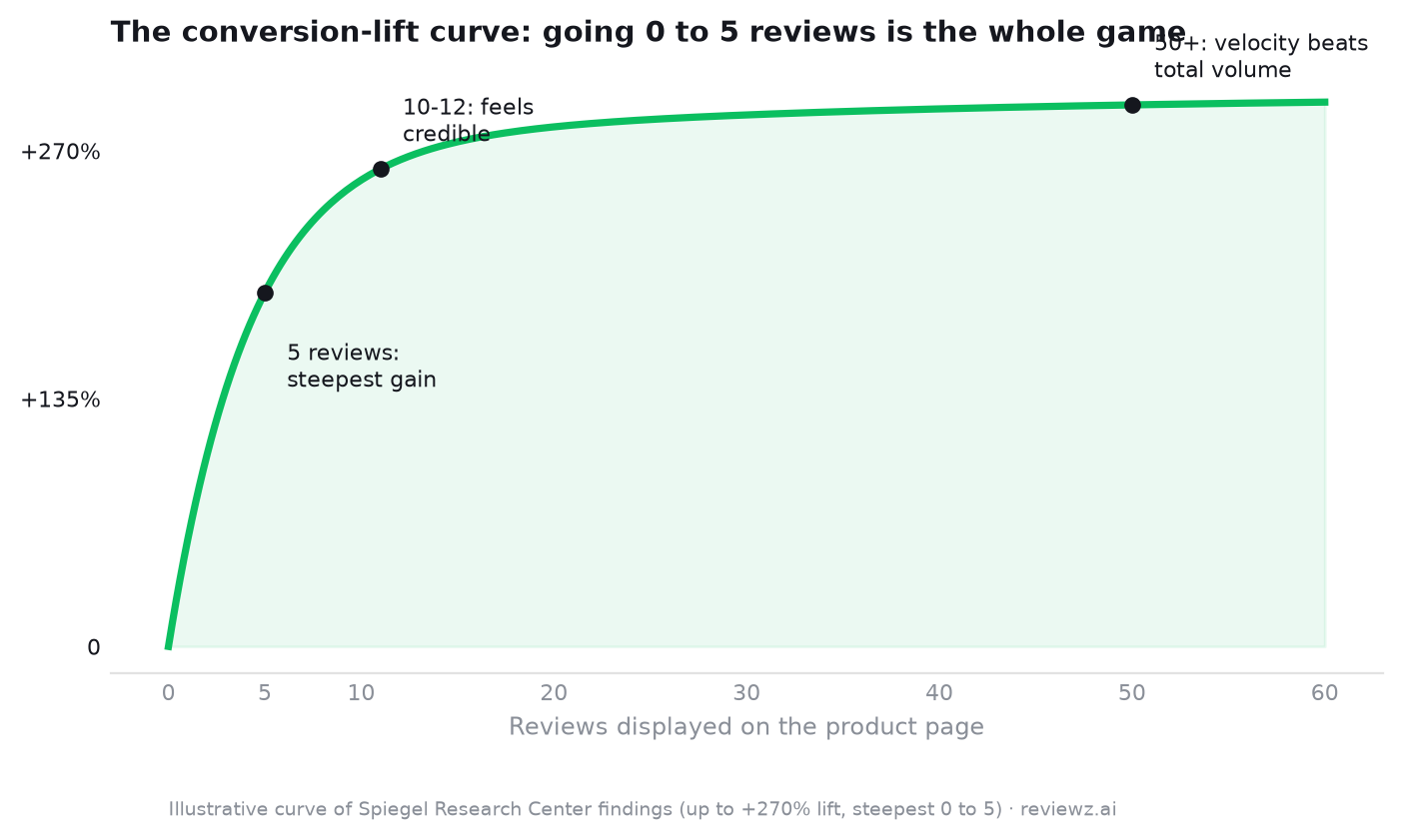
5 reviews: this is where the steepest part of the conversion-lift curve happens. Spiegel Research Center analyzed millions of product page interactions and found that going from 0 reviews to 5 reviews produces the largest single conversion gain. Past 5, gains continue but at a slower rate.
10-12 reviews: this is where consumers say a product feels "credible enough" to consider seriously. BrightLocal's Consumer Review Survey consistently finds shoppers read about 10 reviews before forming a clear opinion.
50 reviews: this is where total volume stops mattering and velocity takes over. After 50 reviews, having 5 fresh ones from the last 30 days outweighs the next 50 reviews from years ago.
These aren't arbitrary numbers. They're the most-replicated findings across review-research literature. For the wider statistical context, see our 37 customer review statistics for 2026.
The Spiegel Research breakdown
Spiegel's 2017 study (still the gold standard cited across industry) found four key effects from displaying reviews on product pages:
- Purchase likelihood increases 270% when reviews are displayed vs not displayed at all.
- The lift varies by price: 380% on luxury items, 190% on budget items.
- Five reviews is the threshold where the lift accelerates.
- Counterintuitively, 4.0-4.7 average ratings convert better than 5.0 averages because shoppers distrust perfection.
This is why most ecommerce content treats 5 reviews as the floor. Below 5, you're leaving conversion on the table on every product page view, which is the core of why customer reviews are important in the first place. Above 5, you're capturing most of the available lift. The diminishing returns kick in around 20-25 reviews per product for AOV under $100.
Review count thresholds by AOV
Higher prices mean higher buyer risk, which means more reviews needed for the same trust effect. For stores at the top of this range, our playbook on reviews for high-AOV Shopify stores goes deeper on the evidence shoppers expect.
| AOV range | Minimum reviews | Why |
|---|---|---|
| Under $25 | 5-8 | Low buyer risk, impulse purchase. 5 reviews satisfies most shoppers. |
| $25-$75 | 10-15 | Mid-range research. BrightLocal's 10-review credibility threshold applies. |
| $75-$200 | 15-25 | Moderate price risk. Need diversity of review experiences. |
| $200-$500 | 25-40 | High price risk. Shoppers read 15-20 reviews each. Need photos. |
| $500+ | 40-100+ | Luxury territory. Buyers want depth of evidence. Spiegel's 380% lift. |
These are minimums. More is generally better up to ~100 reviews, after which the marginal value drops sharply. Velocity becomes the dominant signal past that point.
Velocity matters more than total once you cross 50
Imagine two products. Product A has 200 lifetime reviews but only 1 from the past 60 days. Product B has 60 lifetime reviews but 12 from the past 60 days. Which converts better?
Product B, by a meaningful margin. Once a product crosses 50 reviews, shoppers stop counting and start scanning. They look at the top 5-10 reviews, check the dates, and assess freshness. A product with stale reviews signals "no one's bought this lately" even if the lifetime count is high.
The 2026 implication: review collection is not a one-time push. It's a continuous flow. Use post-purchase email triggers, SMS follow-up at delivery+7 days, and incentivize repeat customers to leave updated reviews. Whether you can sustain that flow comes down to your average review submission rate, so benchmark it before assuming the count is the bottleneck. Use the review request email generator to build the email cadence and NPS calculator to model promoter capture.
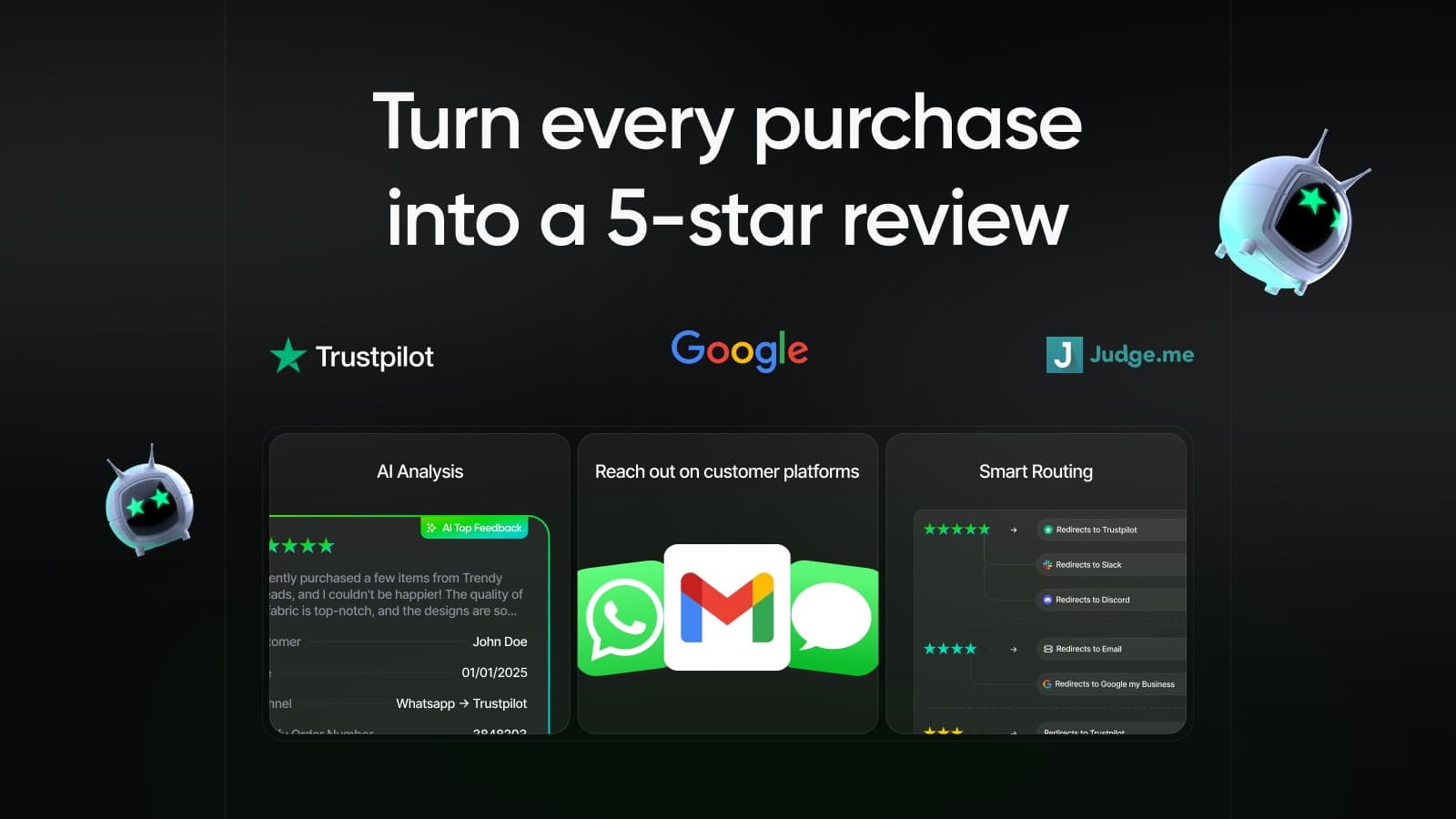
Route happy customers to Trustpilot & Google, capture negatives privately.
Install Reviewz on ShopifyWhat to do if you have fewer than 10 reviews
You're in the danger zone. Conversion is suppressed and you need to fix it fast. The compliant playbook:
Step 1: Set up a post-purchase email flow. Trigger at delivery+5-7 days when satisfaction peaks. Use the review request email generator for proven templates. Expect 5-12% reply rate, so 100 orders = 5-12 fresh reviews.
Step 2: Add an SMS layer for repeat customers. SMS review requests convert 2-3x better than email but cost more. Reserve for high-AOV products where each review meaningfully moves conversion.
Step 3: Make the review form 30 seconds long, not 3 minutes. Each extra field cuts completion rate by 10-15%. Star rating + one optional sentence + photo upload. That's it.
Step 4: Incentivize the first review batch with loyalty points or store credit (5-10% of purchase value). This is FTC-compliant as long as the incentive is offered regardless of star rating, and the reviewer discloses they received an incentive. Most apps handle disclosure automatically. See our piece on getting more Trustpilot reviews on Shopify for detailed mechanics.
Step 5: Route to multiple platforms. Don't put all your reviews on one platform. Spread across Judge.me (or Loox), Trustpilot, and Google Reviews based on customer profile. This expands SERP visibility and reduces concentration risk, which is part of how customer reviews affect SEO.
What to do if you have more than 100 reviews
You've crossed the volume threshold. Now your job shifts from collection to optimization:
Audit for freshness. Filter your reviews by date. If fewer than 15% are from the last 90 days, your displayed reviews are starting to feel stale to shoppers. Restart aggressive collection.
Add photo and video. If most reviews are text-only, push photo and video requests. Photo reviews lift conversion 12-18% over text. Video lifts engagement 2-4x further.

Surface the most useful reviews. Most review apps default to chronological display. Switch to a "most helpful" or "verified buyer first" sort. This shows shoppers the best content, not the most recent random one.
Cull review-suppression risk. With 100+ reviews, you almost certainly have some 1-star and 2-star reviews. Do not hide them. The FTC's 2024 rule prohibits selective suppression. Instead, respond to negatives publicly and route future low-rating customers to private feedback flows.
FAQ
Is 5 reviews really enough to start converting?
Yes, per Spiegel Research. Going from 0 to 5 reviews produces the steepest part of the conversion-lift curve. After 5, gains continue but at a slower rate. The catch: 5 reviews is the conversion threshold, not the credibility threshold. BrightLocal's data suggests shoppers want to see at least 10 reviews before they feel a product is established. The practical interpretation: 5 reviews unlocks meaningful conversion lift, but you should keep pushing toward 10-15 for full credibility. Below 5 you're leaving money on the table, between 5 and 15 you're capturing most of the available value.
Do I need more reviews for high-priced products?
Yes, significantly more. Spiegel Research found luxury items see 380% conversion lift from reviews, compared to 190% for budget items. The implication is that buyers of expensive products feel more risk, read more reviews, and need more evidence to convert. Practical thresholds: under $25 AOV, target 5-8 reviews. $25-75, target 10-15. $75-200, target 15-25. $200-500, target 25-40. $500+, target 40-100+. These are minimums. Going above is generally better up to ~100 reviews per SKU, after which marginal value drops and velocity becomes the dominant signal.
Does review velocity actually matter?
Yes, especially past 50 lifetime reviews. Shoppers stop counting at high volumes and start scanning. They look at the top 5-10 reviews displayed and check the dates. A product with 200 reviews but only 1 from the past 90 days converts worse than a product with 60 reviews and 12 fresh ones. The signal interpretation is: stale reviews = product is dying, fresh reviews = product is alive and selling. The strategic implication is that review collection is continuous, not one-time. Build email and SMS flows that trigger every purchase, not just initial launches.
Can I just import reviews to hit the threshold?
Only with clear FTC-compliant disclosure. Importing AliExpress or other-platform reviews and presenting them as native to your store violates the FTC's 2024 final rule, with civil penalties up to $51,744 per violation. Apps like Judge.me and Loox auto-label imported reviews. Even with proper labeling, imported reviews don't carry the same trust weight as fresh native verified-purchase reviews. Use imports as supplementary social proof while you build a fresh review base. The shortest path to 5 genuine reviews is an aggressive post-purchase email flow, not imports.
Should I worry about negative reviews diluting my count?
No, the opposite. Spiegel and follow-on research consistently shows that 4.0-4.7 star average ratings convert better than 5.0 averages. Some negative reviews signal authenticity. Buyers have learned that perfect ratings imply fake reviews. The smart play is to capture happy customers' reviews publicly and unhappy customers' feedback privately (via sentiment routing), then respond thoughtfully to any negative reviews that do post. Suppressing negative reviews violates the FTC's 2024 rule. Routing them privately before publication is compliant. Our piece on responding to negative reviews covers the operational mechanics.
Route happy customers to Trustpilot & Google, capture negatives privately.
Install Reviewz on Shopify
About the author
Nicolas Provost · Founder of Reviewz.ai
Nicolas built Reviewz.ai after auditing 500+ Shopify review setups while running Kanal (WhatsApp marketing for Shopify). He has spent four years inside the Shopify ecosystem and writes about review collection, brand trust SEO, and the actual economics of running customer-feedback flows on ecommerce sites.
