
At $500+ AOV, founder personal outreach beats automated review email at roughly 3x the submission rate. High-AOV Shopify stores (jewelry, furniture, watches, luxury fashion, art) have lower order volume and higher emotional stakes per order. Generic review apps assume volume and automate everything; that breaks the trust pattern that drove the purchase in the first place. The luxury buyer who just spent $2,000 expects a human follow-up, not a templated email with a 5-star widget.
Reviewed by Nicolas Provost, founder of Reviewz.ai. Insights based on auditing 500+ Shopify review setups and analyzing public pricing, schema, and conversion data across the leading review platforms. LinkedIn
Why high-AOV reviews are different (and why generic apps break)
A $30 t-shirt store ships 500 orders a week and needs scale. A $2,000 watch store ships 30 orders a week and needs depth. At low AOV, a 5% submission rate on automated email gets you 25 reviews a week, and the law of large numbers smooths out the bad ones. At $500+ AOV with 30 weekly orders, a 5% rate gets you 1.5 reviews a week, which is statistical noise. You need 15% to 30% submission rates to build a credible review base, and you only get those rates with human-to-human asks.
The emotional stakes per review change too. A 3-star review on a $30 product is annoying. A 3-star review on a $2,000 product is a category-defining signal that potential buyers will read 20 times before deciding. Each review carries more weight, both up and down. Your strategy needs to lean toward depth (longer reviews, photos, video) over count.
Most luxury Shopify stores we audit run Judge.me or Loox out of inertia. Both are fine apps. Neither is built for $500+ AOV mechanics. What luxury stores need is curated review collection: fewer reviews, more depth, more personal touch.
The founder-personal approach (and why it works at $500+)
Here's the play we've seen consistently win for high-AOV Shopify stores: 7 to 14 days after delivery, the founder sends a personal email from their own address, no review widget, no template, asking how the customer is enjoying the piece and whether they'd be willing to share a few words.
Submission rates on this approach run 30% to 50%, versus 8% to 15% for automated review emails. The reviews that come back are longer, more substantive, and read like testimonials instead of star ratings. They also disproportionately come with photos or video, because a personal ask invites a personal response.
The cost is founder time. At 30 orders a week, that's maybe an hour a week of personal email writing. At 100 orders a week, you can hand it off to a customer success lead who emails from a real name, not a no-reply address. Below 300 orders a week, do not automate this. The economic value of one substantive review at $500+ AOV (in terms of conversion lift on future buyers) easily justifies 15 minutes of human time.
The Spiegel Research Center study on online reviews found that conversion rates for higher-priced products lift more dramatically when reviews are present than for lower-priced products. The implication: every individual review you collect on a $2,000 product is worth more to your conversion rate than 10 reviews on a $30 product, which is a sharper version of why customer reviews matter at all. Treat them accordingly.
Video reviews matter more at high AOV
For luxury and high-consideration purchases, video reviews carry weight that photo and text reviews simply don't. A 30-second video of a buyer unboxing a $3,000 piece of furniture or trying on a $1,500 watch is the single best social proof asset you can have on a product page. Static photos compete with brand-shot imagery; video competes with nothing because the brand can't fake the lighting and the room.
The challenge is collection. Most automated review flows fumble video collection because the friction is high (record, edit, upload). The founder-personal email solves this too: ask for a quick video specifically, frame it as "a quick clip showing how it looks in your space" or "a 30-second take on how it fits." Submission rates are lower than for text reviews, but the per-asset value is much higher.
For displaying video reviews on Shopify, Loox and Okendo both handle video well. Our best Shopify review apps roundup covers the trade-offs. For high-AOV stores specifically, Okendo's attribute-based reviews and video handling tend to win, despite the price tag, because the production quality of the displayed reviews matches the price point of the products.
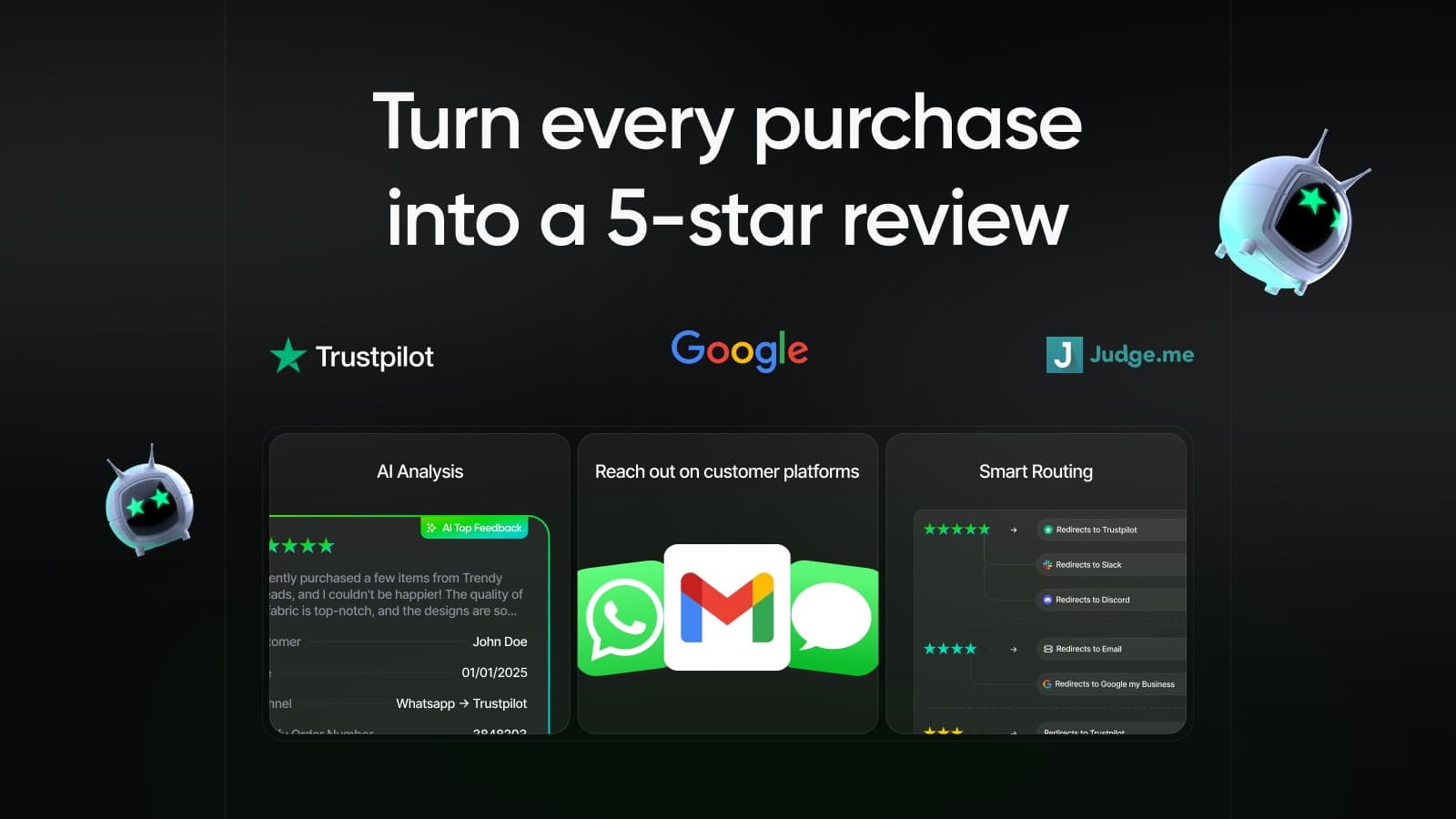
Route happy customers to Trustpilot & Google, capture negatives privately.
Install Reviewz on ShopifyReview request timing for delayed-gratification products
High-AOV products often involve delayed gratification. Furniture takes a week to live with before you know how you feel. Custom jewelry takes a few wears. A watch takes a month to settle into a rotation. Sending the review request too early misses the moment when the buyer has actually formed an opinion, so getting the send timing right matters even more here than in low-AOV stores.
Suggested timing by category:
| Category | Days after delivery | Why |
|---|---|---|
| Furniture, home decor | 10 to 14 days | Customer needs to assemble, place, live with the piece |
| Watches, fine jewelry | 21 to 30 days | Wearing patterns settle, comfort emerges, opinions form |
| Luxury fashion | 14 to 21 days | Multiple wears, multiple settings, fit confidence |
| Original art, custom work | 21 to 45 days | Installation, framing, settling-in, social reaction |
| High-end electronics | 7 to 10 days | Setup, first real use, daily-use confidence |
One more wrinkle: for products that are gifts, the delivery date is not the start of the clock. Some stores ask at checkout whether the order is a gift; for those orders, the review request should be delayed by 7 to 14 days minimum to allow the gift to be given and used. Sending a review email to the gift-buyer the day after delivery just produces blanks.
What to do when a $2,000 purchase gets a 3-star review
This is the conversation every high-AOV store dreads. The general rule on responding to negative reviews applies, and our guide on responding to negative reviews covers the language. But at high AOV there's an additional layer: the response is being read by future buyers who are about to spend the same amount.
The wrong move: dismissing the review or offering a generic apology. The right move: a public response that acknowledges the specific issue, names a real person at your company, and offers a path to resolution that future buyers can read and think "OK, if I have a problem, this is how they'll handle it."
For genuinely unfair reviews (factual inaccuracies, policy violations), our how to remove a fake Trustpilot review guide walks through the removal flow. But don't reach for removal first. A well-handled negative review with a substantive response often converts better than a removed one, because it shows future buyers that your customer service is real.
Use our AI review response generator as a starting point for the draft, then personalize it heavily. At $500+ AOV, generic responses read as worse than no response at all.
Which review apps actually handle high-AOV well
Honest assessment of what works for $500+ AOV Shopify stores:
Okendo: best for luxury DTC brands. Attribute-based reviews (fit, finish, quality) match how high-AOV buyers think. Video handling is strong. Price reflects the positioning, but if you're shipping $500+ products the math works (if the cost gives you pause, weigh the Okendo alternatives for Shopify).
Yotpo Pro: solid choice if you're already on Klaviyo and want everything in one place. Visual reviews are good. Watch the pricing tier creep as you scale.
Loox: good for photo-heavy luxury categories (fashion, jewelry, home decor). Less good if your category needs text-driven reviews (watches, electronics).
Judge.me: cheap and functional, but the look and feel reads as budget. For a $30 product, no one cares. For a $2,000 product, the review widget aesthetic actually matters to the brand perception. Most luxury stores outgrow Judge.me.
Trustpilot: useful for the trust-layer reviews (overall brand, customer service, delivery). Less useful for product-page reviews on individual SKUs. Our Trustpilot pricing on Shopify breakdown covers when the cost is justified.
Reviewz.ai: best if you want to actively filter what becomes public, which matters more at high AOV where each individual review has outsized weight.
Mistakes high-AOV stores make with reviews
The four mistakes we see most often. One: using the same review collection cadence as low-AOV stores. The volume math doesn't work. Two: hiding behind no-reply automated emails. The buyer just spent a meaningful amount; they expect a person. Three: chasing review counts as a vanity metric. Twenty substantive reviews with photos beat 200 one-line reviews on a $2,000 product page. Four: ignoring Google reviews. For high-consideration purchases, buyers are searching the brand name on Google before they ever land on the product page.
The Harvard Business Review research on online reviews shows that review depth and recency matter more than count for high-consideration purchases. Invest in fewer, better reviews. The collection process should look more like getting a magazine quote than running a marketing campaign.
FAQ
Should a $500+ AOV Shopify store use a review app at all?
Yes, but mainly for display, schema, and the back-end management of the reviews you collect. The collection itself should lean human. Use the app to surface reviews on product pages, handle photo and video uploads, generate the right schema markup so reviews appear in Google rich results, and aggregate to a brand-level trust score. But the actual ask, especially below 300 weekly orders, should be a personal email from the founder or a named team member, not an automated trigger from the app.
How do I get more video reviews on a luxury product?
Ask specifically. "Would you mind sending a quick 30-second clip of it in your space?" works far better than a generic "add a photo or video" prompt in a review widget. Frame the ask around the context of use ("how it looks in your living room" for furniture, "how it sits on the wrist" for watches), not around the review widget UX. Offer a small incentive if appropriate (a future credit, free engraving, a hand-written thank you), but the incentive should not feel transactional or it cheapens the brand and the review.
Is Judge.me good enough for a high-AOV store?
Functionally yes, aesthetically usually no. Judge.me does the job for any AOV, but the default widget aesthetic reads as low-cost ecommerce, which can quietly damage brand perception on a $2,000 product page. Most luxury stores either heavily custom-style Judge.me, switch to Okendo or Yotpo for the design system match, or move to Reviewz.ai when they want the routing logic (happy customers to Google/Trustpilot, unhappy ones to private feedback). The right answer depends on whether your bottleneck is collection, display, or routing.
How many reviews does a high-AOV product page need to convert?
Fewer than you'd think, but each one needs to do more work. The Spiegel research shows that the marginal conversion lift of additional reviews flattens after the first 10 to 20 for most products. For a $2,000 product, 15 substantive reviews with photos or video, recent dates, and visible owner names typically outperform 100 one-line reviews from anonymous users. Focus on the quality and depth of the first 20 reviews you collect. If they're strong, you don't need 200.
Should I respond publicly to every review on a high-AOV store?
Yes for negative and neutral reviews, selectively for positive ones. Every 1, 2, or 3-star review needs a substantive public response within 48 hours; future buyers read those exchanges as a proxy for what their own experience will be like if something goes wrong. For 5-star reviews, a personal thank-you on the standout ones (those with photos, video, or particularly detailed text) signals attention without being performative. Auto-responding "Thanks for your review!" on every single 5-star is fine on a $30 product page and looks robotic on a $2,000 one.
Route happy customers to Trustpilot & Google, capture negatives privately.
Install Reviewz on Shopify
About the author
Nicolas Provost · Founder of Reviewz.ai
Nicolas built Reviewz.ai after auditing 500+ Shopify review setups while running Kanal (WhatsApp marketing for Shopify). He has spent four years inside the Shopify ecosystem and writes about review collection, brand trust SEO, and the actual economics of running customer-feedback flows on ecommerce sites.
