

Social proof is the evidence that other people bought, used and approved what you sell. For an online store, the examples that work best are the simplest: a star rating and a review count next to the product, a customer number, an expert who uses the product, a rating hosted on a third-party platform. The 13 social proof examples below come from live stores we checked on October 4, 2026, with the way to reproduce each one on Shopify.
Start with customer proof: stars and a review count on every product card and under every product title. Then add what you have earned: a customer or units-sold number, a press quote, a certification, a Trustpilot or Google rating. Put each piece where the doubt appears, not in the footer, and never invent a number. A real 4.6 with 40 reviews beats a suspicious 5.0.
Reviewed by Nicolas Provost, founder of Reviewz.ai. Insights based on auditing 500+ Shopify review setups and analyzing public pricing, schema, and conversion data across the leading review platforms. LinkedIn
What social proof means in marketing
The term comes from Robert Cialdini's work on persuasion. The idea, as his firm Influence at Work summarizes it: when people are unsure, they look at what other people do to decide what to do themselves.
The same page describes a hotel experiment that every store owner should know. A card telling guests that 75% of guests reuse their towels raised reuse by 26%. Changing the wording to say that 75% of the people who stayed in this room reused their towels raised it by 33%. Proof works, and proof from people who resemble the shopper works better.
Does social proof work? The numbers
- Reviews multiply purchases. The Spiegel Research Center at Northwestern University found that a product with five reviews is 270% more likely to be bought than a product with none. Displaying reviews lifted conversion by 190% for lower-priced products and by 380% for higher-priced ones.
- Shoppers set a bar. In the BrightLocal Local Consumer Review Survey 2026 (1,002 US adults, about local businesses), 49% trust online reviews as much as personal recommendations, and 31% will only use a business rated 4.5 stars or more, up from 17% a year earlier.
- People trust people. In Nielsen's 2021 Trust in Advertising study, 88% of respondents said they trust recommendations from people they know, more than any other channel.
More figures, with sources, are in our customer review statistics.
The six types of social proof
| Type | What it tells the shopper | Examples below |
|---|---|---|
| Customer proof: ratings, reviews, quotes | People like me bought it and liked it | Brooklinen, Dr. Squatch, Glossier |
| Crowd proof: customer and sales numbers | Many people made this choice | Knix, Huel, Grind |
| Expert proof | Someone who knows the field uses it | HexClad |
| Media and award proof | An independent outlet tested it | Monos, Simba, Away |
| Certification proof | A third party audited the company | Pura Vida |
| Platform proof | The rating lives where the seller cannot edit it | Grind, Simba, Shopify App Store |
Customer proof examples
1. Brooklinen: stars and a count on every product card
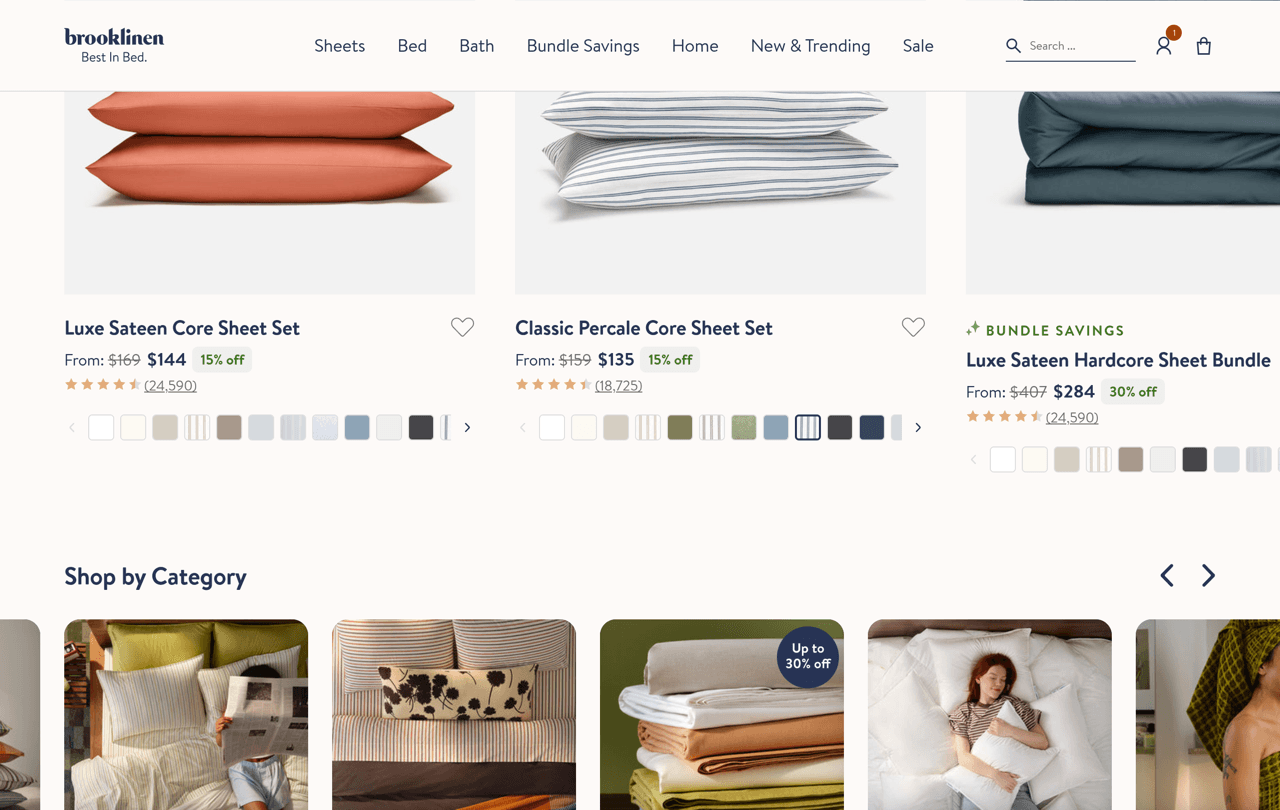
On Brooklinen's homepage, each product card shows a star rating and a review count under the price: 24,590 for the Luxe Sateen Core Sheet Set, 18,725 for the Classic Percale Core Sheet Set. The shopper sees the proof before clicking on anything.
How to copy it: in the Shopify theme editor, add your review app's star rating block to the product card, not only to the product page.
2. Brooklinen again: the review count as a headline
Lower on the same page, a section is titled with the brand's total of 175K+ five-star reviews, above three short customer quotes, each signed with a first name and an initial.
How to copy it: once your total is large enough to impress, turn it into a homepage headline and keep the quotes to one sentence each.
3. Dr. Squatch: one number for the brand, one for each product
Dr. Squatch's homepage announces 100,000+ reviews from its customers, and every product card carries its own count. On the Pine Tar soap page, the summary shows a 4.5 average across 28,393 reviews and the share of reviewers who would recommend the product: 88%.
How to copy it: a "would recommend" percentage is easier to read than a star average. If your review form asks the question, display the answer.
4. Glossier: proof at the exact point of decision
On the Boy Brow page, the rating (4.4) and the review count (7,134) sit directly under the product name, next to a Best Seller badge. Three one-line customer quotes appear with five stars in the product information area, and other products in the recommendations carry Top-Rated badges.
How to copy it: place the rating above the fold, and use "best seller" and "top rated" badges only on products that are.
Crowd proof examples
5. Knix: units sold
Knix's homepage states that more than 20 million pairs have been sold, "and counting". No adjective, one number.
How to copy it: you have this figure in your Shopify analytics. Orders shipped, units sold or customers served all work, as long as you can prove the number if asked.
6. Huel: customers on one side, studies on the other
Huel's European store shows two figures on its homepage: 4M+ happy customers and 100+ peer-reviewed studies. The first says the product is popular, the second says the claims have been examined.
How to copy it: pair a popularity number with a credibility number (lab tests, years in business, repairs honored).
7. Grind: a customer count next to a third-party rating
Grind, a UK coffee brand on Shopify, invites visitors to join its 250,000+ happy customers and embeds Trustpilot widgets on the same landing page. The count is the brand's claim, the Trustpilot rating is the evidence it cannot edit.
How to copy it: our Trustpilot and Shopify integration guide covers the widget setup.
Expert, media and certification examples
8. HexClad: a chef who puts his name on it
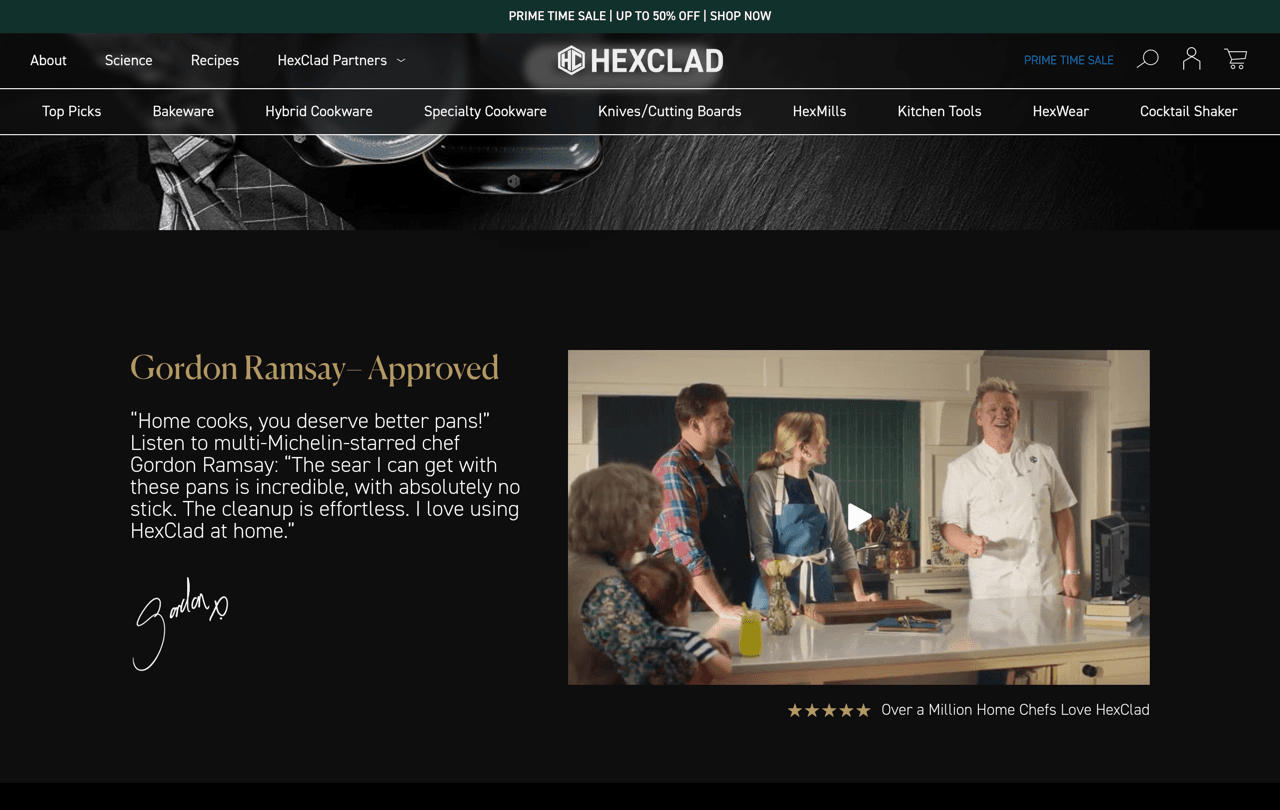
HexClad's homepage has a section headed "Gordon Ramsay-Approved", with a short statement from the chef, his signature and a video. Under the video, a line says that over a million home chefs love the brand. Further down, a "Culinary Council" lists other well-known chefs, including Massimo Bottura, Clare Smyth and Dominique Crenn, and a banner counts 50,000+ five-star reviews.
Why it works: expert proof answers "is it good?", crowd proof answers "is it good for people like me?". HexClad uses both, in that order.
How to copy it: you do not need a celebrity. A dermatologist, a professional barista or a physiotherapist who uses your product is an expert for your shopper. Name the person, state the relationship, and disclose it if they are paid.
9. Monos: reviews first, press second
On its European store, the luggage brand Monos displays a count of 15,000+ five-star reviews, immediately followed by a carousel of short press quotes, each with the logo of the publication.
How to copy it: one sentence per outlet, with the logo. If you have a single press mention, one quote is enough.
10. Simba: stacking four kinds of proof
The mattress brand Simba opens its homepage with 400,000+ five-star reviews, lists five awards from the UK consumer organization Which?, states that it is a certified B Corp, and embeds a Trustpilot widget. Customer, award, certification and platform proof on one page.
11. Away: one adjective, earned
Away describes its suitcases as "award-winning luggage" in its homepage copy. It is the lightest possible form of social proof: two words, in the sentence the visitor reads anyway.
How to copy it: if you have won something, put it in the headline, and name the award on the product page.
12. Pura Vida: a certification and a cause
Pura Vida's homepage says the company is a Certified B Corp and has donated over $5 million to causes, then shows a "Featured in" press section. Some products carry a "Top Rated" badge.
How to copy it: certifications only count when a third party issues them. Our guide to trust badges for Shopify explains which ones shoppers recognize.
Platform proof example
13. The Shopify App Store: ratings as the default layout
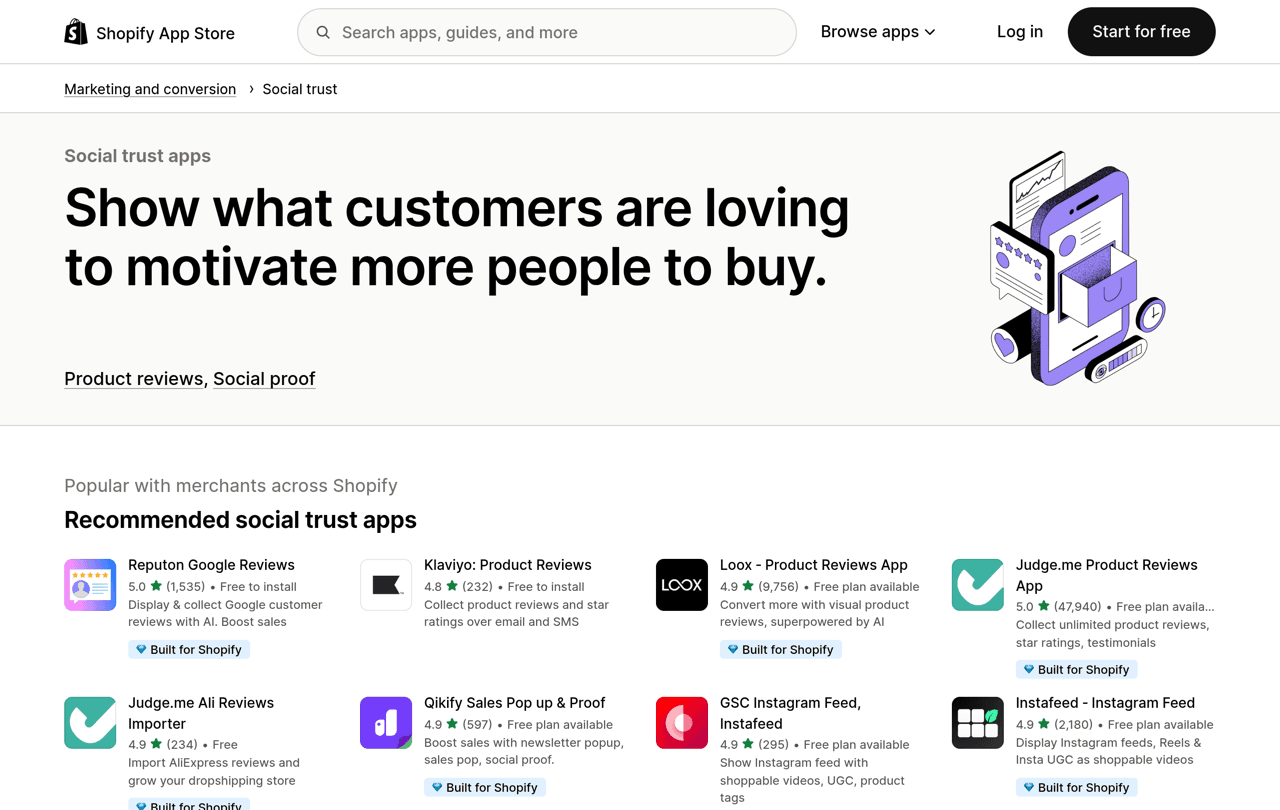
Shopify uses social proof on merchants too. In the App Store's social trust category, every listing shows a star rating and a review count before the description: Judge.me at 5.0 with more than 47,000 reviews, Loox at 4.9 with more than 9,700. Some listings add a "Built for Shopify" badge, a certification from the platform itself.
Where to put social proof on a Shopify store
Social proof works where a doubt appears. Match the proof to the page.
| Page | The shopper's doubt | Social proof to show |
|---|---|---|
| Homepage | Is this a real, known brand? | Total review count, one customer quote, press logos, customer number |
| Collection page | Which product do I pick? | Stars and review count on each card, best seller badges |
| Product page | Will it work for me? | Rating under the title, reviews with photos and reviewer details, expert statement |
| Cart and checkout | Is it safe to pay here? | Third-party rating, guarantee, payment and security badges |
| Google results | Is this link worth a click? | Review stars through structured data |
| Emails and ads | Why should I care? | One customer quote with a name |
The checkout row matters more than it looks. In Baymard Institute's checkout research, 19% of shoppers who abandoned a checkout said they did not trust the site with their card details. For Google, the stars come from review markup: see the review schema guide or generate the code with the free review schema generator. For ads, our testimonial advertising examples show the formats.
How to build it, in order
- Collect reviews first. Every other example above depends on a number you do not have yet. Ask every customer after delivery: the method and templates are in how to ask customers for reviews. The first five reviews on a product matter most, as explained in how many reviews a product needs.
- Display the stars on product pages and product cards. The steps for the theme editor are in how to add reviews to Shopify.
- Open a third-party profile (Trustpilot or Google) and embed its rating, so part of your proof lives outside your own site.
- Add crowd proof once the number is worth showing: orders shipped, customers served, reviews collected.
- Add earned proof as it arrives: press quotes, awards, certifications, an expert who uses the product.
- Reuse customer content. Photos and videos from buyers are social proof with a face: see our user-generated content examples.
Step 1 is where most stores stall, and it is what Reviewz handles. The app asks every customer for a review after an order over WhatsApp, SMS and email, sends customers who rate 4 or 5 stars to your public profile on Trustpilot, Google or Judge.me, and gives the others a private feedback form so your team can reply. More than 350 Shopify stores use it. It is free to start, and paid plans are on the pricing page.
Social proof starts with reviews. Ask every customer for one over WhatsApp, SMS and email, automatically.
Install Reviewz on ShopifyWhat not to do
- Do not invent it. The FTC's rule on fake reviews and testimonials prohibits fake reviews, AI-generated ones included, and the buying or selling of fake indicators of social media influence such as bot followers or views. The FTC can seek civil penalties against knowing violators.
- Do not fake activity. A pop-up announcing a recent order is social proof when the order exists, and deception when it does not.
- Do not chase a perfect 5.0. The Spiegel study cited above found that purchase likelihood peaks between 4.0 and 4.7 stars and falls as the average approaches 5.0.
- Do not let reviews go stale. In the BrightLocal survey, 74% of consumers look for reviews written in the last three months.
- Do not bury it. A wall of logos in the footer convinces nobody. One number next to the Add to cart button does. Social proof is one of the levers we rank in our guide to Shopify conversion rate optimization.
Related reading: Testimonial examples.
FAQ
What are examples of social proof?
Star ratings and review counts on product pages, customer quotes, numbers such as units sold or customers served, an expert or chef who endorses the product, press quotes, awards, certifications such as B Corp, and a Trustpilot or Google rating embedded on the site.
What are the main types of social proof?
Six matter for ecommerce: customer proof (ratings and reviews), crowd proof (numbers), expert proof, media and award proof, certification proof and platform proof (ratings hosted on a third-party site).
What is social proof in marketing?
It is the use of other people's behavior and opinions to reduce a buyer's uncertainty. The term comes from Robert Cialdini's research on persuasion: when people are unsure, they look at what others do.
What is the most effective social proof for an online store?
Customer reviews displayed next to the product. Research from Northwestern University found that a product with five reviews is 270% more likely to be purchased than a product with none.
How do I add social proof to my Shopify store?
Collect reviews from every customer, add the star rating block to product pages and product cards in the theme editor, embed a third-party rating, then add customer numbers, press quotes and certifications as you earn them.
Is fake social proof illegal?
In the United States, yes. The FTC rule on fake reviews and testimonials bans fake reviews and the buying or selling of fake social media indicators, and allows civil penalties against knowing violators.

About the author
Nicolas Provost · Founder of Reviewz.ai
Nicolas built Reviewz.ai after auditing 500+ Shopify review setups while running Kanal (WhatsApp marketing for Shopify). He has spent four years inside the Shopify ecosystem and writes about review collection, brand trust SEO, and the actual economics of running customer-feedback flows on ecommerce sites.
