

A testimonial is a customer's statement about a product that the brand chooses to display in its own marketing: a quote, a starred review under a headline, a video, a before-and-after photo, an expert's opinion, a social post or a case study. The 15 testimonial examples below come from 11 brand sites we opened on October 7, 2026, each with the page, what is on it, and how to copy it.
The testimonials that work are short, signed and placed next to the product they talk about. Start from reviews you already have, keep the sentence that states a result, show the name and the product, and mark what you trimmed. Ask before you reuse a customer's words, disclose anything you gave in exchange, and never rewrite an opinion.
Reviewed by Nicolas Provost, founder of Reviewz.ai. Insights based on auditing 500+ Shopify review setups and analyzing public pricing, schema, and conversion data across the leading review platforms. LinkedIn
Testimonial or review: the difference, and the seven formats
A review is what a customer posts, on a page you do not curate. A testimonial is the piece you select and display. Many customer testimonial examples on store sites started as reviews.
| Format | What it is | Examples below |
|---|---|---|
| Quote | One or two sentences, signed | Ritual, Olive & June, Branch |
| Star-rated review | A review shown with its stars and source | Purple, Casper, Saatva, Magic Spoon |
| Video | The customer on camera | Lume, Tonal |
| Before and after | Two dated photos and a result | Nutrafol |
| Expert | A professional who vouches for the product | Nutrafol, Eight Sleep |
| Social post | A public post displayed on the site | Eight Sleep, Caraway |
| Case study | A customer story with numbers | Branch |
Origin matters. The Spiegel Research Center at Northwestern University found that a verified buyer badge improves the odds of purchase by 15%. In the BrightLocal Local Consumer Review Survey 2026 (1,002 US adults), 35% of consumers said it matters that a reviewer is named, and 36% that a photo or video comes with the review.
Quote testimonial examples
1. Ritual: one sentence, one emphasized phrase
On Ritual's homepage, a carousel shows one customer excerpt at a time under five stars. Each is a sentence or two with its key phrase in italics, signed with a first name and a last initial, and labeled with the product bought. Shortened excerpts open with an ellipsis.
How to copy it: keep one sentence per review, emphasize three or four words, and show where you cut.
2. Olive & June: the section title is a customer sentence
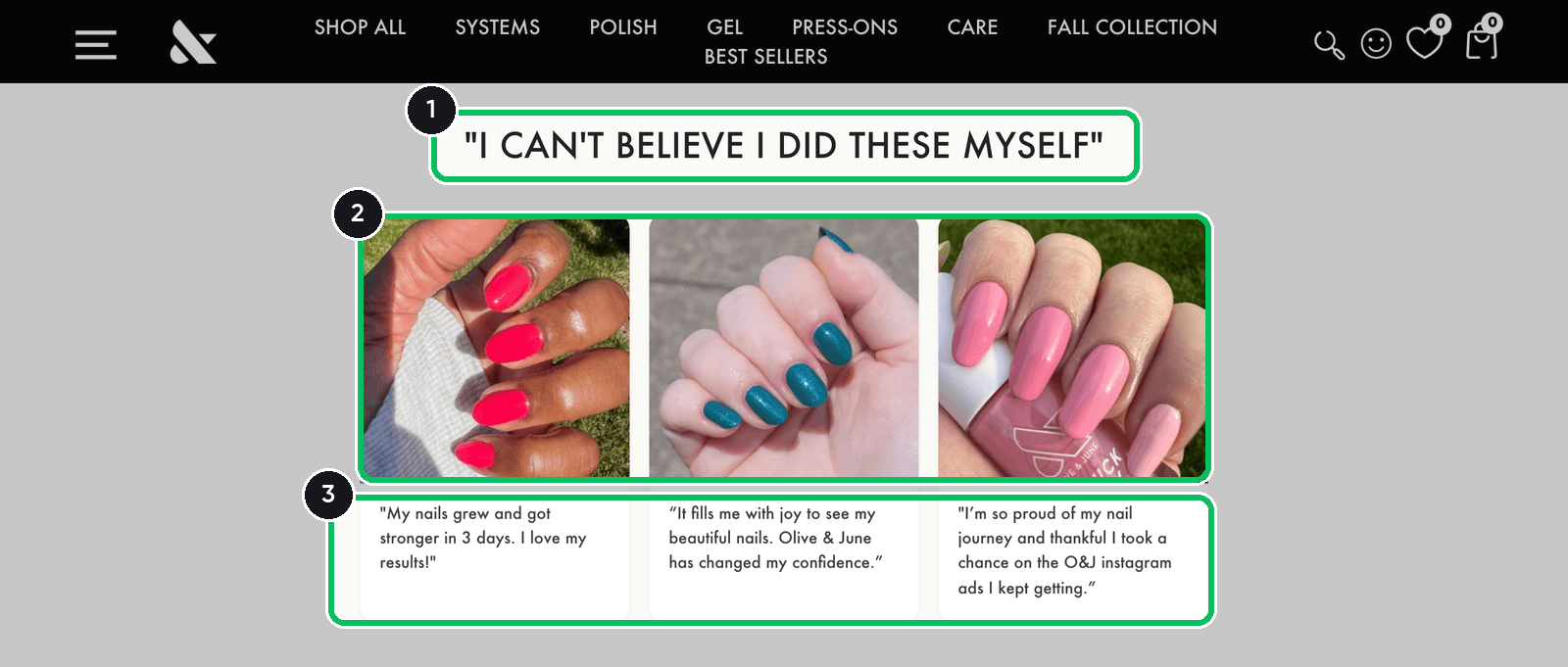
Olive & June's homepage has a testimonial block whose heading is written in a customer's voice, about not believing they did their own nails. Under it sit three short quotes, each next to a customer photo. All three describe a result, such as stronger nails or more confidence.
How to copy it: use a real customer sentence as the heading of your testimonial section, and choose quotes about outcomes.
3. Branch: four quotes that cover the catalog
Branch sells office furniture. A homepage section titled Our customers say it best shows four quotes signed with a first name and an initial, split between chairs and desks, with a link to more reviews.
How to copy it: one quote per product family, so every visitor finds theirs.
Star-rated reviews used as testimonials
4. Purple: testimonials sorted by the shopper's problem
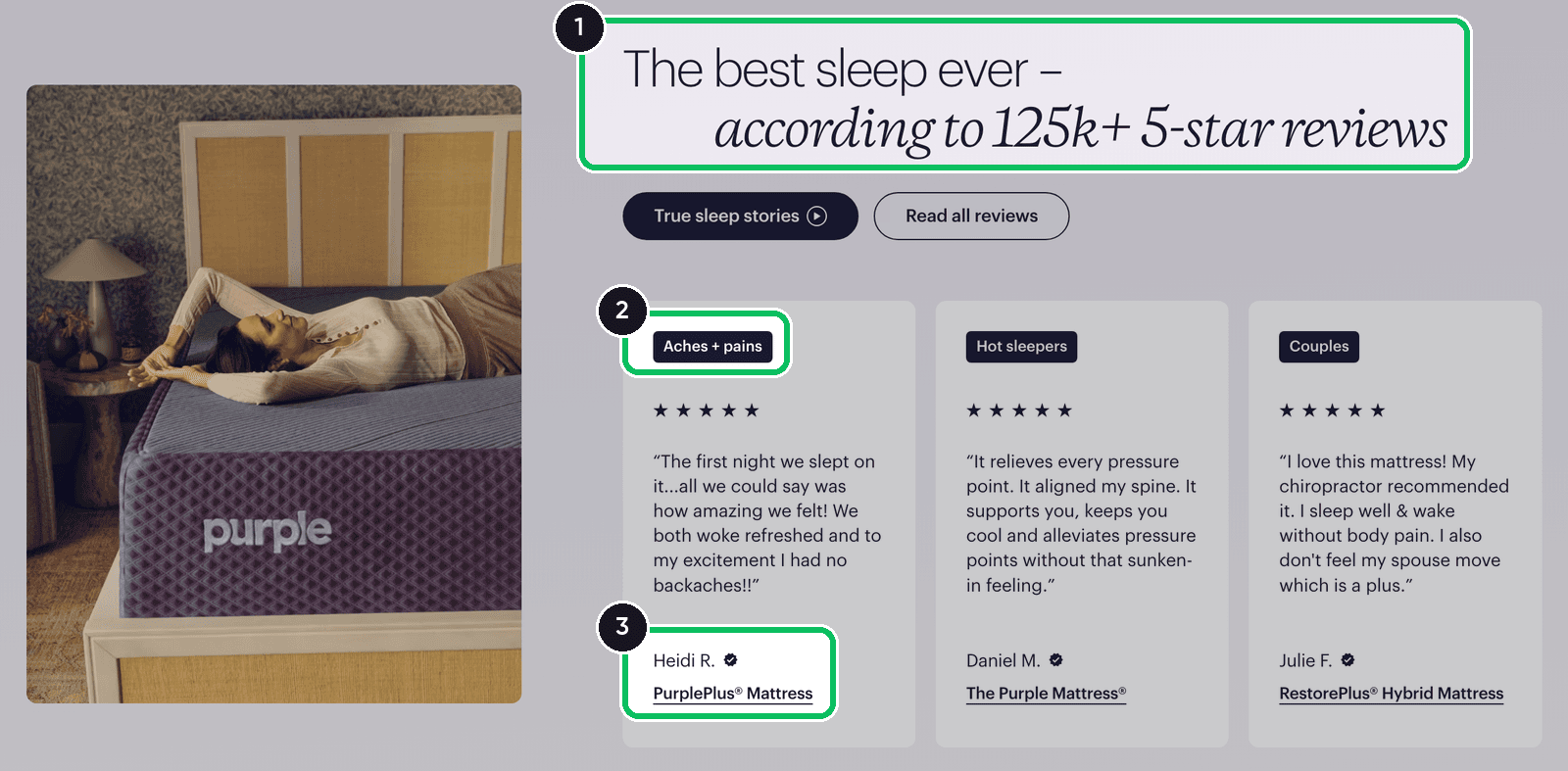
On Purple's homepage, the headline credits its claim, the best sleep ever, to 125k+ five-star reviews. Three review cards follow, each tagged with a type of sleeper: aches and pains, hot sleepers, couples. Every card carries five stars, a name with a verified check mark and a link to the mattress reviewed.
How to copy it: tag each testimonial with the objection it answers, and link it to the product it mentions.
5. Casper: a count with a footnote
Casper's homepage lists 110,000+ five-star reviews among its promises, with an asterisk. The footnote says what is counted: reviews from its ecommerce, retail and wholesale channels. Lower down, a featured review shows its title, the customer's first name, last initial and city, and the mattress reviewed.
How to copy it: if you publish a big number, say where it comes from. A city next to the name helps too.
6. Saatva: a full page, low ratings included
Saatva has a dedicated reviews page. It opens with a carousel of five-star reviews, then survey figures (97.5% of surveyed customers would recommend the brand), footnoted as coming from Saatva's own satisfaction survey. Below: a 4.8 average based on 12,546 reviews with the full star breakdown, 154 one-star reviews included, and links to its profiles on the Better Business Bureau, Google, ResellerRatings and Trustpilot.
How to copy it: build one page that gathers everything, and send readers to platforms you do not control.
7. Magic Spoon: the count as a banner
Magic Spoon repeats 80,000+ five-star reviews in its announcement bar. Product cards show a rating and a count, and a later block pairs five stars with two one-sentence reviews. One of them reads: "This was like a box of good news coming to my house finally." It is signed Ferdinand R.
How to copy it: choose the sentence no copywriter would have written.
Video testimonial examples
8. Lume: customer videos above the written reviews
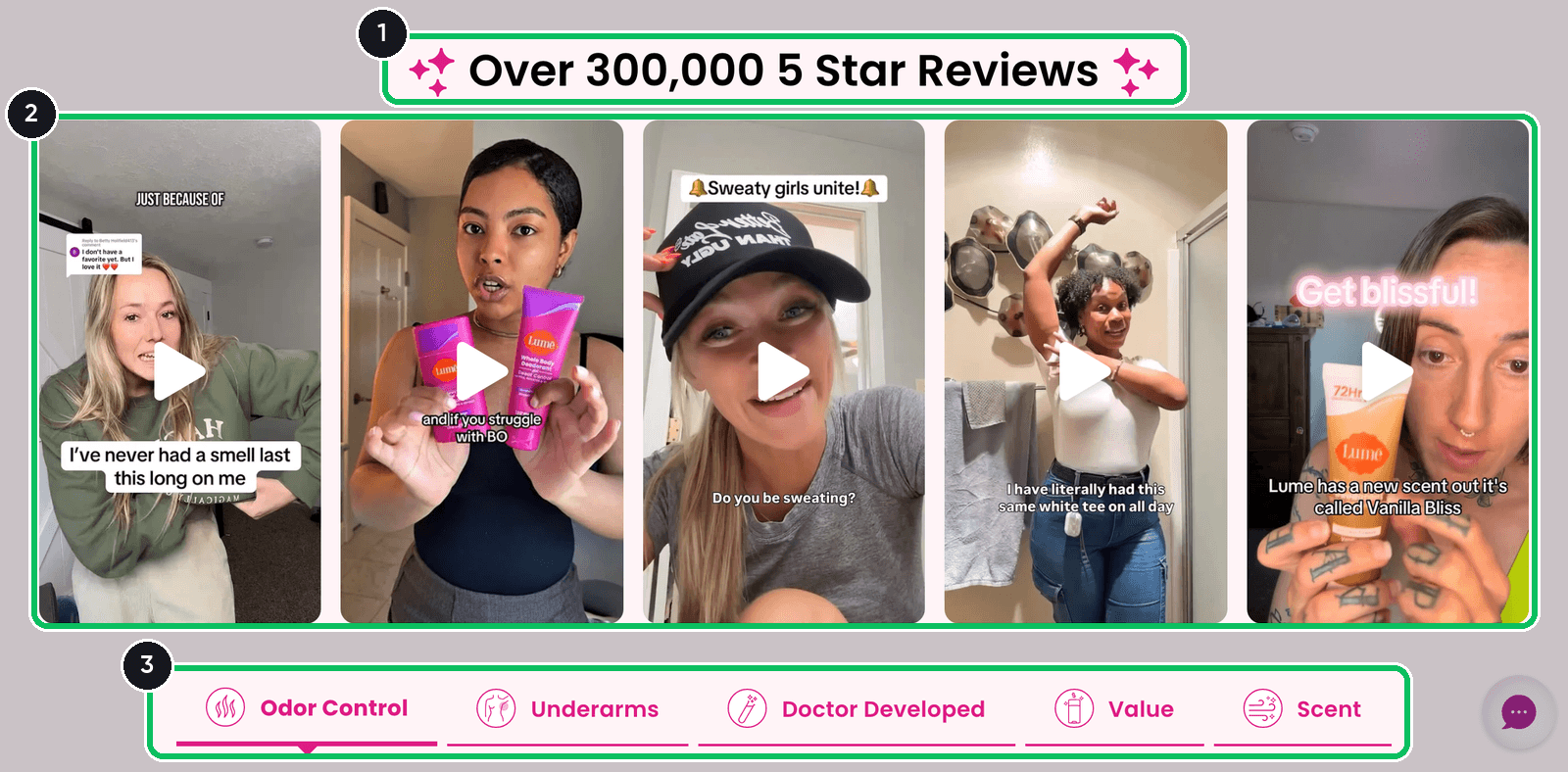
On Lume's homepage, a block titled Over 300,000 5 Star Reviews starts with a row of five vertical, phone-shot videos of people talking about the product, with captions on screen. Under them, tabs sort written reviews by topic (odor control, value, scent), and each review gets a pull-quote headline above the full text.
How to copy it: ask your best reviewers for a 20-second selfie video and add captions.
9. Tonal: video stories with the disclosure in view
Tonal's member stories page combines community numbers, written member quotes that can be filtered by goal (weight loss, longevity, busy lives) and video stories with a one-line summary each. One note on the page says some members shared their experience as part of optional giveaway entries. Another says the members in the videos were compensated for their time, and that results vary.
How to copy it: let visitors filter stories by goal, and print each disclosure next to the content it covers.
Before-and-after testimonial example
10. Nutrafol: two photos and the fine print
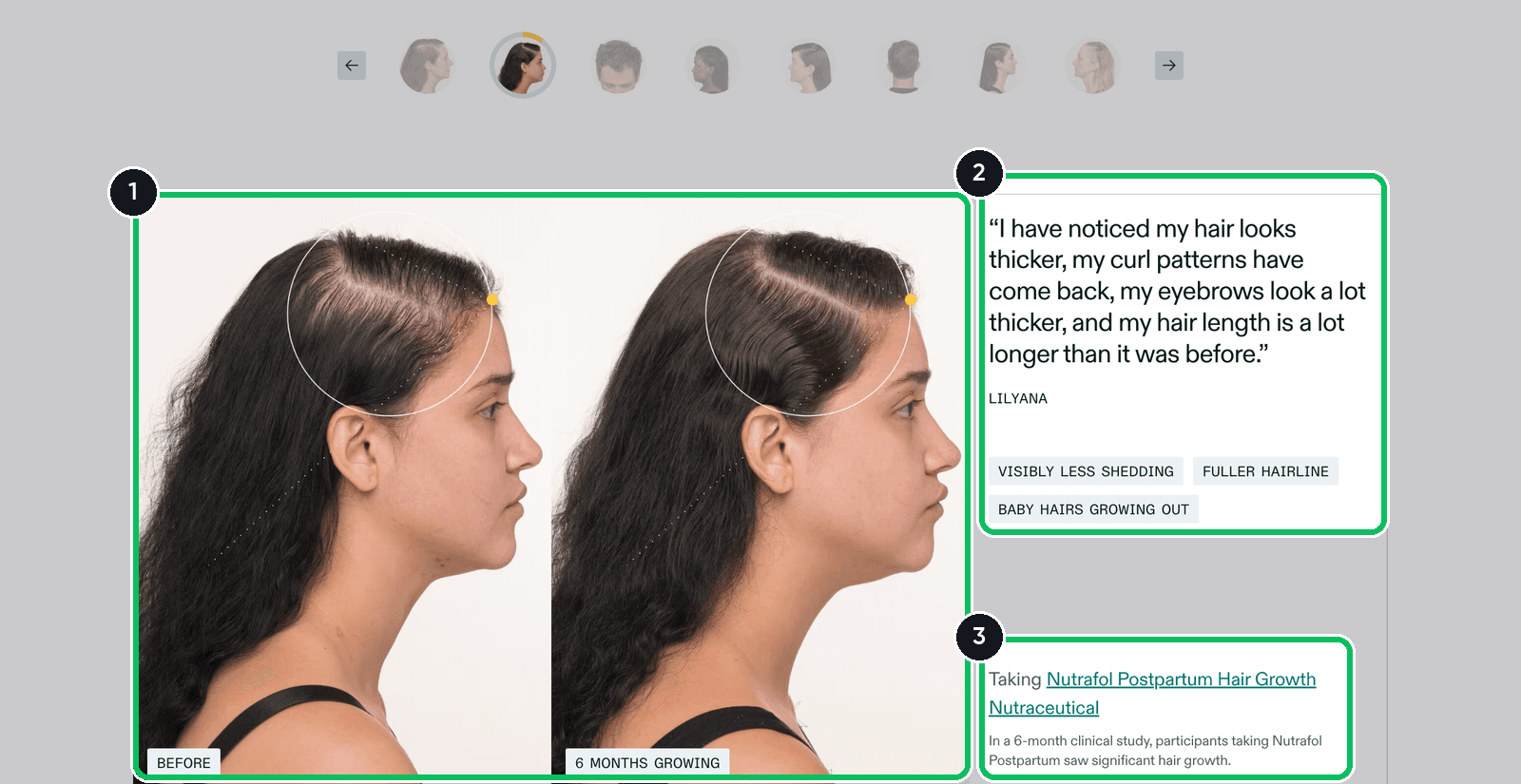
Nutrafol's homepage has a carousel of customer results. Each slide pairs two photos, one labeled Before and one labeled with the months of use (three, four or six), with a quote signed by first name, three result tags, the product taken, and a line pointing to its clinical study.
How to copy it: same angle, same light, a dated label on each photo. If the result is exceptional, say what most customers can expect.
Expert testimonial examples
11. Nutrafol again: experts, and who pays them
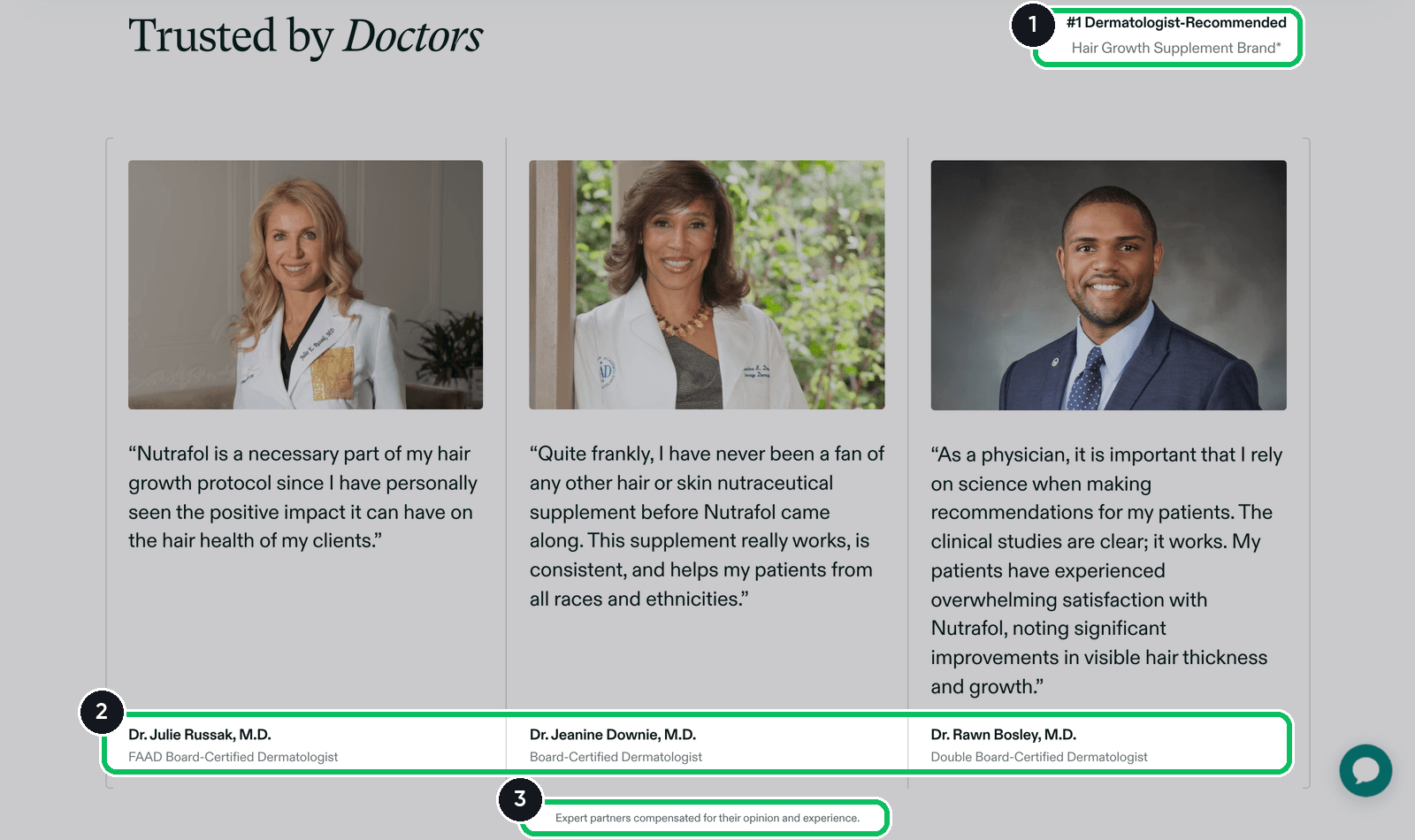
Further down the same page, a section titled Trusted by Doctors shows three board-certified dermatologists, each with a photo, a quote, a name and credentials. The claim of being the number one dermatologist-recommended brand in its category carries a footnote naming the survey behind it. And a line under the quotes states that these expert partners are compensated.
How to copy it: show credentials, source every ranking claim, disclose payment.
12. Eight Sleep: athletes and a scientific board
Eight Sleep's homepage quotes athletes as top performers who trust the product, among them race car drivers Charles Leclerc and Fernando Alonso and Royal Ballet principal Francesca Hayward. A separate scientific advisory board block names neuroscientists Andrew Huberman and Matthew Walker with their university roles.
Why it works: the athletes answer "does it perform?" and the scientists answer "is it serious?". A physiotherapist or a barista can play that role for a small store.
Social post testimonial examples
13. Eight Sleep again: posts from X next to member quotes
On the same page, under a 4.5 rating based on 30,000+ reviews, a wall mixes quotes from customers labeled Eight Sleep Member with posts from X, shown with the author's name, handle and timestamp. One is a July 2023 post in which Mark Zuckerberg says he dialed in his sleep with Eight Sleep and Oura.
How to copy it: ask the author before you display a post, and keep the handle and the date visible.
14. Caraway: creator videos credited by handle
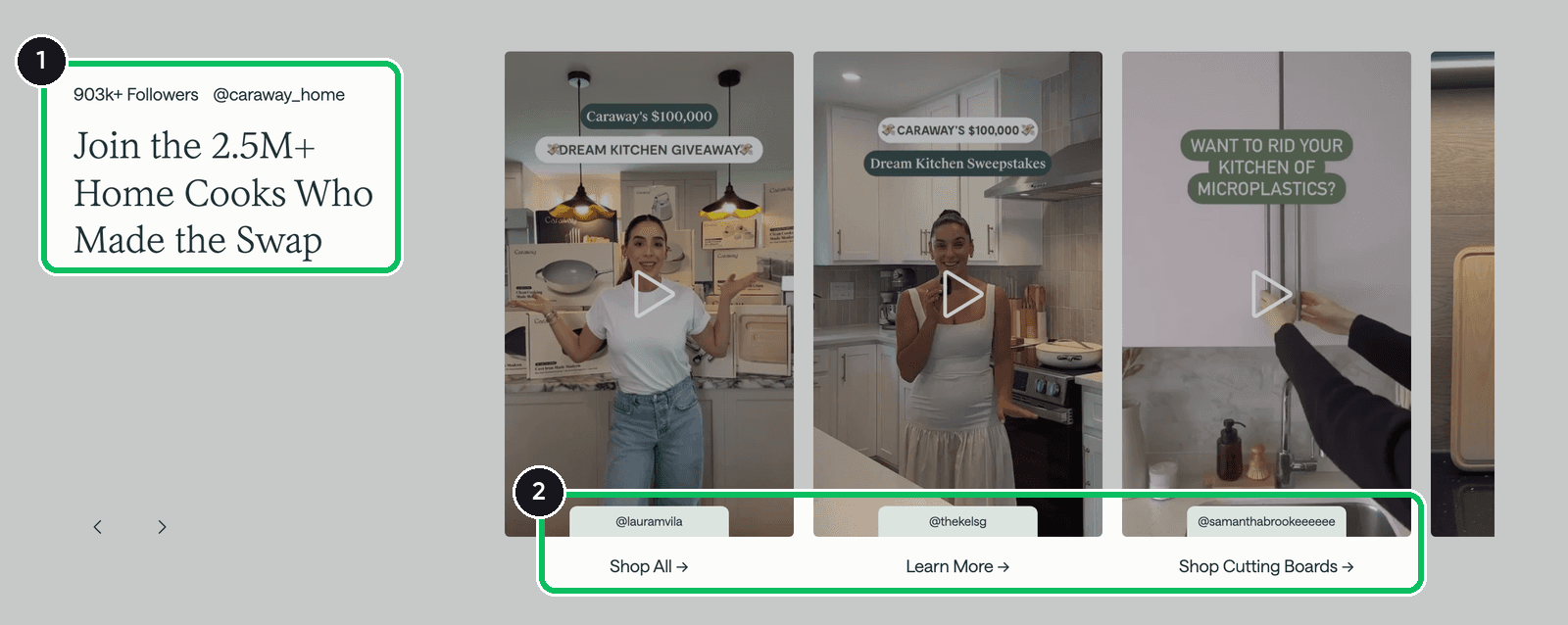
Caraway's homepage invites visitors to join the 2.5M+ home cooks who made the swap, next to its Instagram follower count (903k+). The carousel beside it plays vertical social videos, each credited with the creator's handle and followed by a shop link.
How to copy it: credit the handle, link the product, and label partner content. A creator you paid or gifted is an endorser, and viewers have to be told.
Case study example
15. Branch again: case studies for business buyers
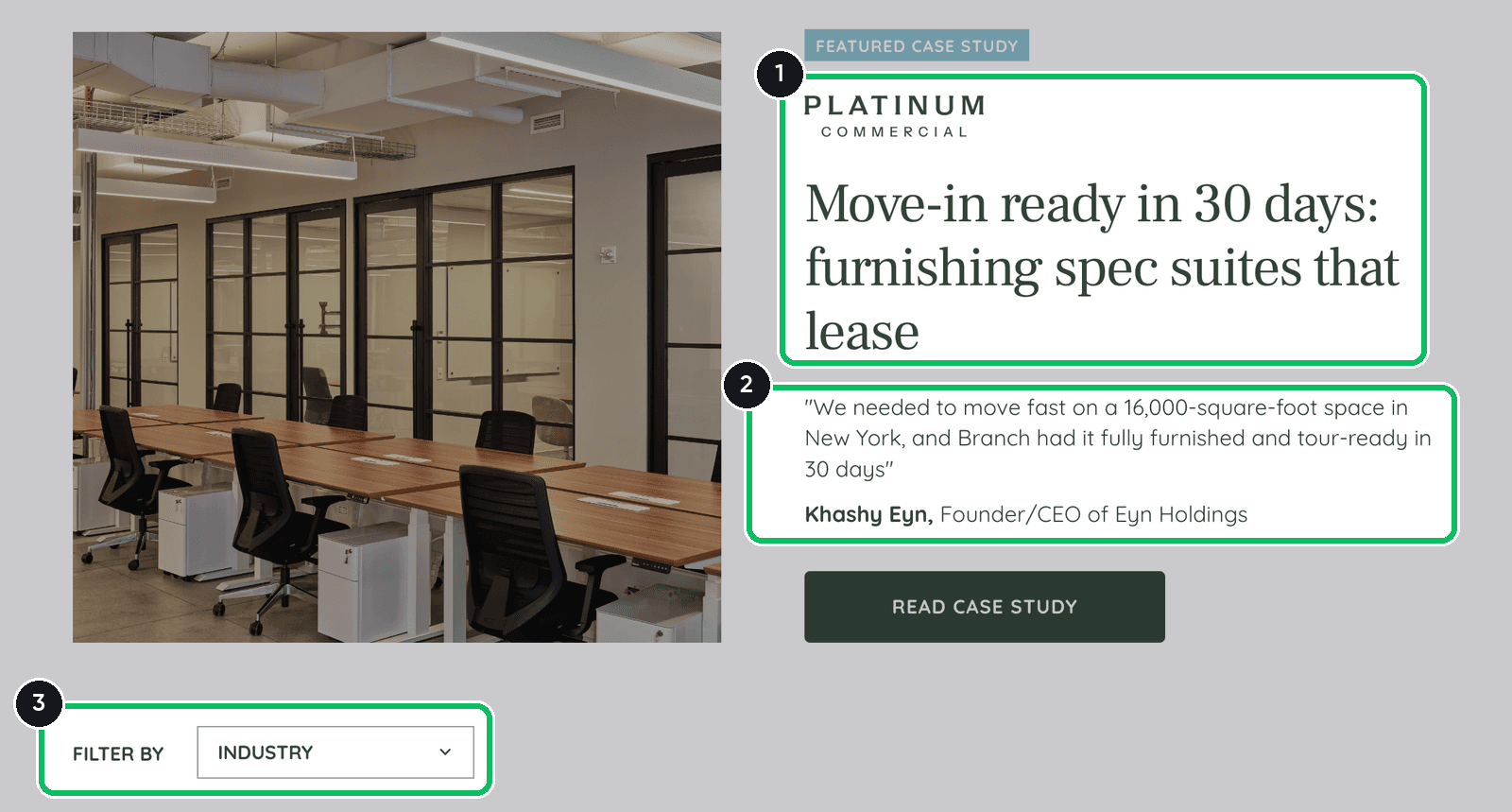
Branch also sells to companies, and its case studies page is the business version of a testimonial. A featured case study leads with the client's logo, a headline built around a result (move-in ready in 30 days) and a quote from the client's founder with name and title. Under it, a grid can be filtered by industry, and each card gives a headcount or a square footage and a city.
How to copy it: if you sell wholesale or to businesses, write three short case studies: the client, the problem, the number, one quote.
What these testimonials have in common
- A result, not an adjective. Thirty days, three months, fewer aches.
- A name. A first name and an initial at least. A city, a role or a verified mark adds weight.
- The product, named and linked.
- A way to check. A link to all reviews, or a third-party profile.
- Fine print where it belongs. Casper's footnote, Tonal's disclosures, Nutrafol's study line.
For where to place them on a store, see our social proof examples. For paid social, see testimonial advertising examples.
A testimonial template
Four questions get you the raw material:
- What was going on before you bought [product]?
- What made you choose it?
- What changed after [time]?
- Who would you recommend it to?
The answers fit this testimonial template:
Before [product], I [problem or situation]. After [time], [specific result, with a number if there is one]. I would recommend it to [who].
[First name and last initial], [city or role]
The customer writes it. You may shorten it, not change its meaning.
How to ask for a testimonial
The easiest testimonial to get already exists as a review. Ask permission to display it.
By email:
Subject: May we quote you?
Hi [First name], thank you for your review of [product]. One sentence stood out: "[the sentence]". May we display it on our website, signed [First name and last initial]? Reply YES and we will take care of the rest. If you would rather not, no problem.
[Your name], [Store]
By WhatsApp or SMS:
Hi [First name], it is [Your name] from [Store]. We loved your review of [product]. May we quote it on our site, signed [First name and last initial]? Reply YES or NO, either is fine.
For a photo or a video, see the permission rules in our user-generated content examples.
No reviews to quote yet? Start with how to ask customers for reviews, and see our positive review examples for the kind of sentence worth quoting. This is the step Reviewz automates. It is a Shopify app, used by more than 350 stores, that asks every customer for a review after an order over WhatsApp, SMS and email, sends customers who rate 4 or 5 stars to Trustpilot, Google or Judge.me, and gives the others a private feedback form. Check each platform's invitation rules before you choose where to send people. It is free to start, with paid plans on the pricing page.
Testimonials start as reviews. Ask every customer for one over WhatsApp, SMS and email, automatically.
Install Reviewz on ShopifyThe FTC rules for testimonials
Real customers, real opinions, no rewriting. The FTC's Endorsement Guides require a testimonial to reflect the honest opinion or experience of someone who used the product. Under section 255.1, an ad that uses quotation marks is presenting the customer's exact words, and an endorsement may not be presented out of context or reworded in a way that distorts the customer's opinion. Trimming is fine, changing the meaning is not. Since October 21, 2024, the FTC's rule on consumer reviews and testimonials also bans testimonials from someone who does not exist or never used the product, with civil penalties for knowing violations.
Disclose what you gave, and what is typical. The FTC's Endorsement Guides FAQ says you can ask customers about their experience and quote them in your ads. If they expected a benefit when they spoke (a free product, a discount, a giveaway entry, a payment), say so next to the testimonial, as Tonal and Nutrafol do. The same FAQ says a testimonial from an employee or a relative is misleading unless the connection is made clear, and that an ad built on an exceptional result must make clear what customers can generally expect. Rewards tied to a positive opinion are prohibited: see discount for reviews and our FTC audit of 50 Shopify stores.
FAQ
What is a good example of a testimonial?
A short, signed statement of a result, shown next to the product. On Purple's homepage, each five-star quote is tagged with a type of sleeper, signed and linked to the mattress reviewed.
What is the difference between a testimonial and a review?
A review is posted by the customer on a page the brand does not curate. A testimonial is customer feedback the brand selects and displays in its own marketing.
How do I ask a customer for a testimonial?
Start from a review they already wrote and ask permission to quote it, by email, WhatsApp or SMS. Name the sentence and how it will be signed.
Can I edit a customer testimonial?
You can shorten it. Under the FTC's Endorsement Guides, you cannot reword it in a way that changes the customer's opinion.
Do I have to disclose that I paid for a testimonial?
Yes. If the customer expected a payment, a free product or a discount when they gave it, the FTC says to disclose it.

About the author
Nicolas Provost · Founder of Reviewz.ai
Nicolas built Reviewz.ai after auditing 500+ Shopify review setups while running Kanal (WhatsApp marketing for Shopify). He has spent four years inside the Shopify ecosystem and writes about review collection, brand trust SEO, and the actual economics of running customer-feedback flows on ecommerce sites.
