
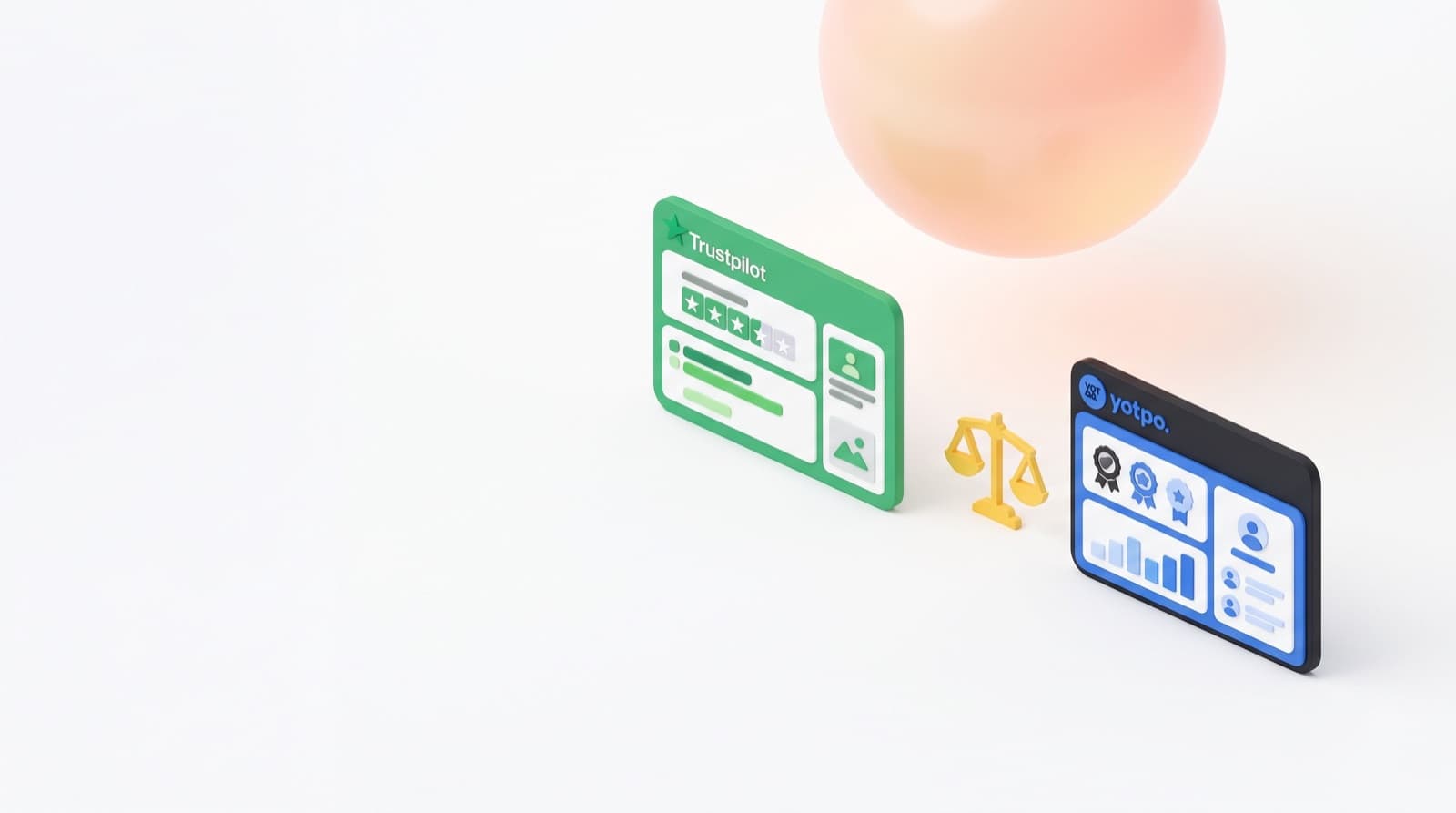
Yotpo vs Trustpilot is not a like-for-like choice, and for most Shopify stores under $5M ARR the answer is neither alone: Yotpo puts product reviews on your own store (free up to 50 orders a month, then from $15/month and rising with order volume), while Trustpilot hosts brand-level reviews on trustpilot.com (free for 50 invitations a month, then $1,188 to $9,588 a year). Most merchants get most of the value from a Judge.me free + Trustpilot free + Reviewz routing stack. Pick Yotpo only if you want product reviews and a loyalty program from the same vendor. Pick Trustpilot if brand-level trust signals (visible in Google SERP) are critical to your buyer journey.
Reviewed by Nicolas Provost, founder of Reviewz.ai. Insights based on auditing 500+ Shopify review setups and analyzing public pricing, schema, and conversion data across the leading review platforms. LinkedIn
Yotpo vs Trustpilot: the short answer
Trustpilot and Yotpo solve different problems. Trustpilot is a brand-trust platform: a third-party site customers Google to validate you before buying. Yotpo is an on-site reviews platform: product-page reviews and visual UGC, with a separate loyalty and referrals product, all designed to drive conversion on your store (see the FTC final rule banning fake reviews and testimonials).
For most Shopify stores under $1M ARR, the right answer is neither: Judge.me is much cheaper for product reviews, Trustpilot Free is enough for brand SERP, and you don't need loyalty from the same vendor. This article breaks down where each one wins, what they cost, and the migration paths if you outgrow either. For the full shortlist, our roundup of the best Shopify review apps covers seven platforms.
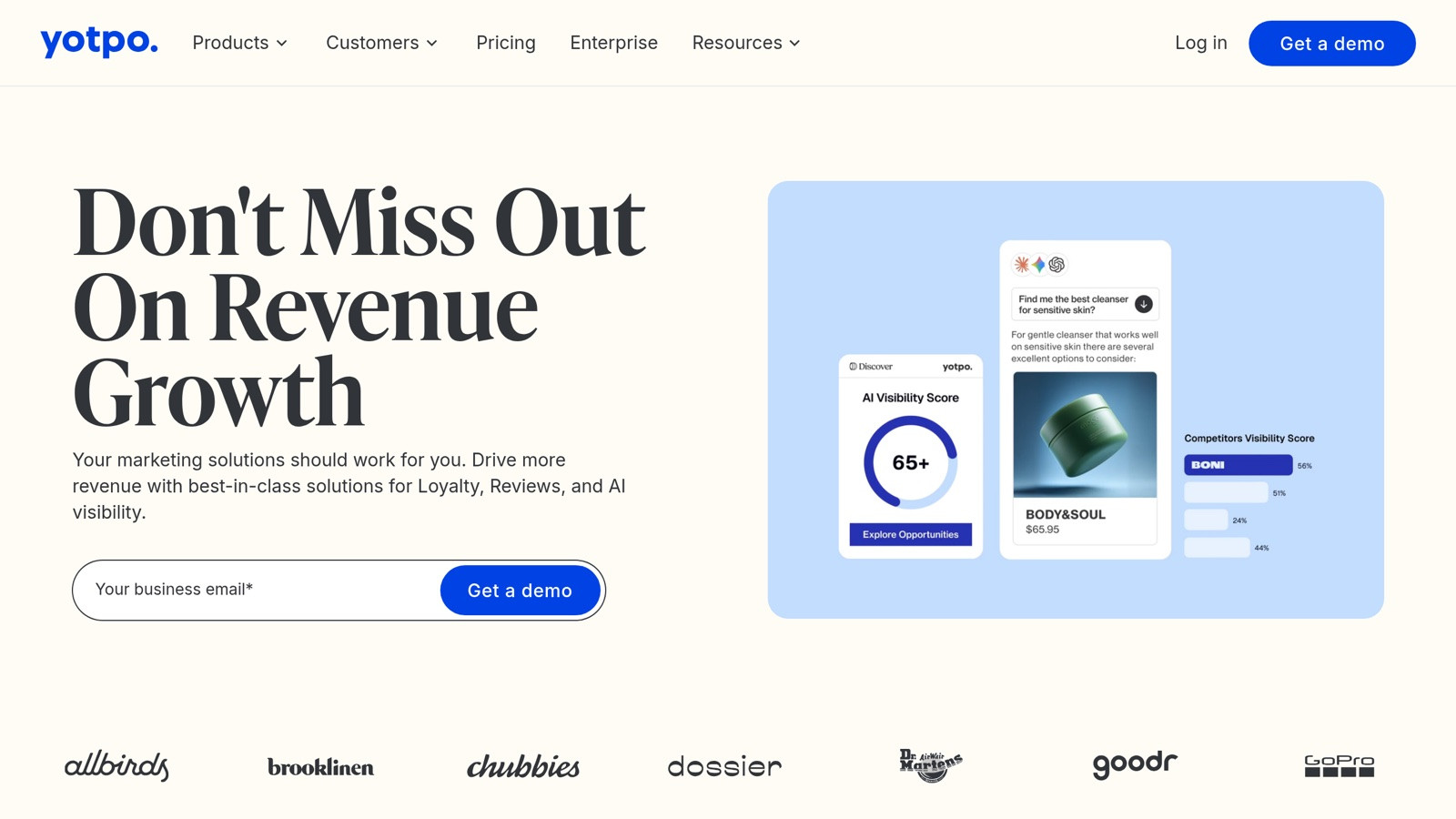
Yotpo prices its reviews plans by monthly order volume. In October 2026 its products are Reviews & UGC, Loyalty & Referrals and Discover, and the reviews app is free up to 50 orders a month.
What each platform actually does
Trustpilot
Trustpilot is an independent review site (we cover the full picture in what Trustpilot is). Customers leave reviews on Trustpilot.com about your business overall (not specific products). Reviews appear on your public profile, in Google SERPs when people search your brand name, and via embeddable TrustBox widgets you can place on your store.
Best for: brand-level trust. When someone Googles "yourstore reviews", a Trustpilot profile in the top 3 results with a 4.5/5 score is a major conversion signal. The leverage is real: BrightLocal's Local Consumer Review Survey finds most consumers read reviews before they trust a business, and the Spiegel Research Center at Northwestern measured conversion lifts of up to 270% when reviews are displayed.
For honest analysis of Trustpilot's strengths and weaknesses, see our Is Trustpilot legit? guide. To start driving invited reviews to your profile, our Trustpilot review URL generator builds the exact link for post-purchase emails.
Yotpo
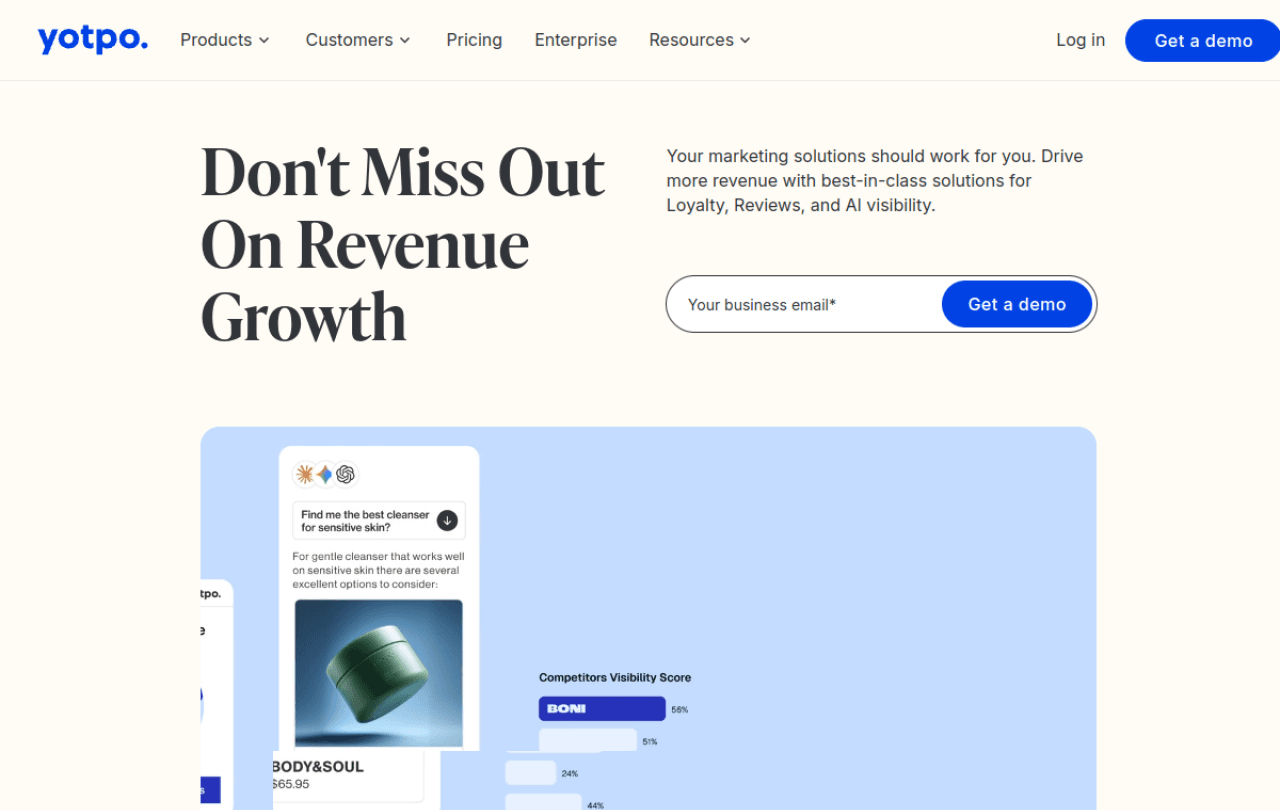
Yotpo is a Shopify-integrated reviews and loyalty platform. The Reviews product collects reviews tied to Shopify orders, displayed inline on product pages with star-rating widgets and Google rich snippets. A separate product covers Loyalty & Referrals (points, tiers, referrals), and a third, Discover, is aimed at AI visibility. Yotpo's Email & SMS app is no longer available on the Shopify App Store, so the older "reviews, loyalty, SMS and subscriptions in one suite" description no longer holds.
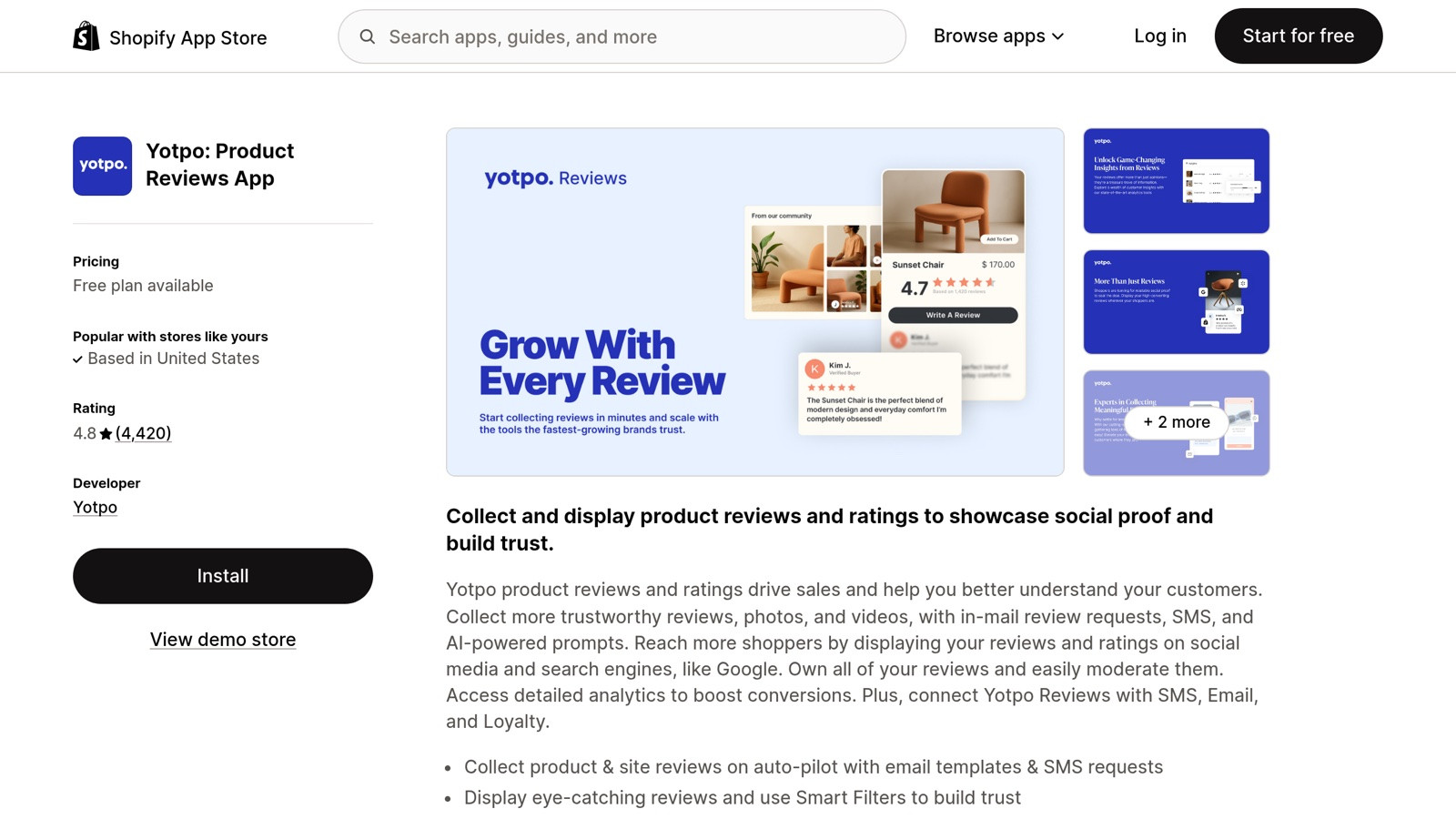
Yotpo on the Shopify App Store, rated 4.8 from 4,628 merchant reviews in October 2026.
Best for: conversion-focused stores who want reviews + retention tools in one platform. Especially good for fashion, beauty, and visual product categories where photo reviews drive AOV. Yotpo is one of the established players in the space, with a 4.8 rating from 4,628 merchant reviews on the Shopify App Store, and its pricing is built to grow with order volume rather than stay flat.
Yotpo vs Trustpilot: side-by-side comparison
| Feature | Trustpilot | Yotpo |
|---|---|---|
| Where reviews live | Trustpilot.com profile | Your Shopify product pages |
| What gets reviewed | Your business (product reviews are a paid add-on) | Your products, plus site reviews |
| Verification | Verified label on reviews from automatic invitations; organic reviews are open to anyone | Reviews requested after a Shopify order |
| Free plan limits | 50 invitations/month, 1 widget, 1 user | Up to 50 orders/month, review requests and on-site display |
| Lowest paid plan (2026) | $1,188/year (Starter, 100 invitations/month) | $15/month (Starter), rising with order volume |
| Product reviews with photos and videos | Product reviews are an add-on on every plan | Photos and videos from the Starter plan |
| Loyalty + rewards | ✗ | Separate Yotpo product, paid tiers from $199/month |
| SMS marketing | ✗ | ✗ (the Email & SMS app is no longer on the App Store) |
| Brand SERP authority | ✓ (high) | ✗ (your domain only) |
| Stars in Google Ads (seller ratings) | ✓ (Google review partner) | ✓ (Google review partner, Pro plan) |
| Google Shopping product ratings | Paid add-on, not in the core plans | From the Starter plan |
| Contract | 12-month commitment, prepaid, on paid plans | Monthly, or yearly at a discount |
| Shopify App Store rating | 2.7 (18 reviews) | 4.8 (4,628 reviews) |
Sources: Trustpilot's pricing page, Yotpo's pricing page, both Shopify App Store listings and Google's lists of review partners for seller ratings and product ratings, checked on October 4, 2026.
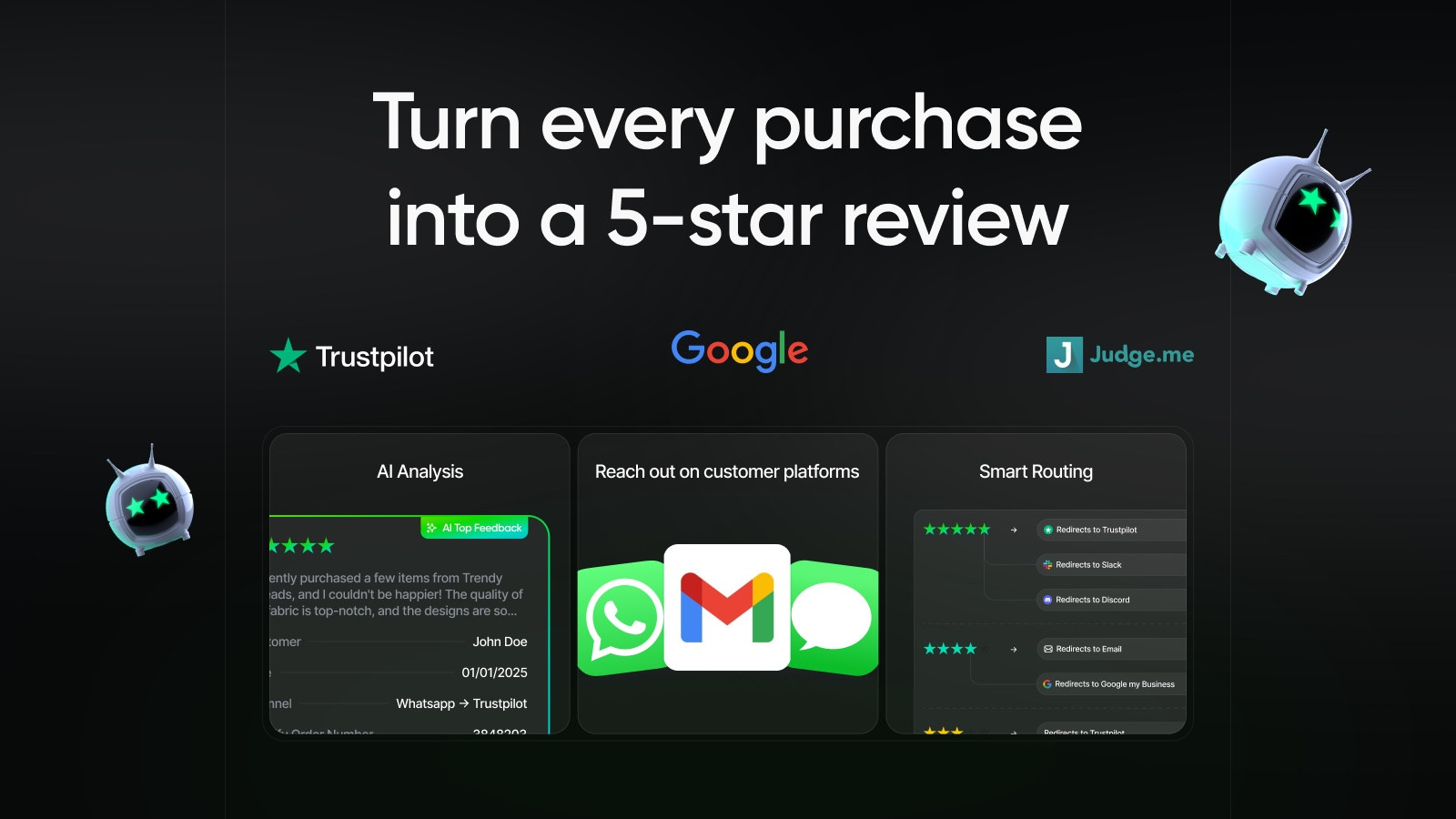 |
| Reviewz.ai for Shopify automatically routes happy customers to leave reviews on Trustpilot, Google, and Judge.me, while privately catching unhappy ones in a feedback portal before they post a public 1-star. Re-engage every reviewer with upsell offers via WhatsApp, email, and SMS. Install Reviewz on Shopify |
Which one for which type of Shopify store?
Pre-revenue / first 100 orders
Neither yet. Both platforms benefit from review volume, which you don't have. Use Judge.me's free plan (much more generous than Trustpilot or Yotpo free) to display product reviews from day one. Add Trustpilot once you have 50+ organic reviews on it.
Small Shopify stores ($10K-$100K/month)
Judge.me + Trustpilot Free. Don't pay for either Trustpilot or Yotpo at this scale. Judge.me handles product reviews ($15/month all-features tier). Trustpilot free gets you the brand SERP signal, with 50 invitations a month. That avoids both a Yotpo bill that grows with orders and a Trustpilot contract that starts at $1,188 a year.
Mid-sized Shopify stores ($100K-$1M/month)
A paid Trustpilot plan + Judge.me ($15/mo). At this scale the free plan's 50 invitations a month no longer cover your orders. Starter raises the cap to 100 invitations a month ($1,188 a year), Plus to 300 ($3,828) and Premium to 1,000 ($9,588), and reviews from those automatic invitations carry the Verified label. Our Trustpilot pricing breakdown has the plan-by-plan detail. Yotpo at this scale is overkill unless you specifically want loyalty from the same vendor.
Large Shopify Plus stores ($1M+/month)
Yotpo if you need integrated marketing, otherwise Trustpilot + Judge.me.
The case for Yotpo: if you want reviews, UGC, Google Seller Ratings and loyalty handled by one vendor, consolidating can save engineering and integration time. Expect a quote at this tier: Yotpo's published reviews prices stop at 4,000 orders a month on the Pro plan ($379/month), and loyalty is priced on top.
The case against Yotpo: best-in-class point solutions usually beat one-platform-for-everything. Klaviyo for email/SMS, Smile for loyalty, Judge.me for reviews, Trustpilot for brand often delivers better results per dollar. If you go that route, our Klaviyo reviews integration guide shows how to wire review requests into your flows, and our list of Yotpo alternatives for Shopify covers the lighter replacements.
Direct cost comparison: Trustpilot vs Yotpo at three Shopify scales
Both vendors publish list prices, and they scale on different things: Trustpilot on the number of review invitations you send, Yotpo on your monthly order volume. Here is the annual cost of asking every customer for a review at three Shopify scales, using the prices on each vendor's pricing page on October 4, 2026.
| Shopify scale | Trustpilot (inviting every customer) | Yotpo Reviews, Starter | Yotpo Reviews, Pro (adds Seller Ratings) |
|---|---|---|---|
| 100 orders/mo | $1,188/yr (Starter, 100 invitations) | $24/mo, or $288/yr | $119/mo, or $1,428/yr |
| 300 orders/mo | $3,828/yr (Plus, 300 invitations) | $89/mo, or $1,068/yr | $169/mo, or $2,028/yr |
| 1,000 orders/mo | $9,588/yr (Premium, 1,000 invitations) | $129/mo, or $1,548/yr | $269/mo, or $3,228/yr |
Both also have a free plan: Trustpilot's covers 50 invitations a month at any store size, and Yotpo's covers stores up to 50 orders a month. Yotpo's yearly billing is discounted against the monthly figures above, and its loyalty product is billed separately.
Two things to read from the table. First, on list price Yotpo Starter is cheaper than Trustpilot at every scale, by a factor of roughly four to six once you invite every customer. Yotpo Pro costs a little more than Trustpilot at 100 orders a month and much less from 300 orders up. Second, the two bills buy different things, so the cheaper one is not automatically the right one.
The structural difference: Trustpilot owns its review domain (trustpilot.com), Yotpo does not. A Trustpilot review sits on a public profile that ranks when shoppers search your brand name. A Yotpo review lives on your own product pages. For brand-level search results, Trustpilot is structurally stronger at any price. For product-page conversion through star ratings and photo reviews, Yotpo is more capable. And if you only need product reviews on your store, Judge.me does it for $0 to $15 a month, which is why Trustpilot vs Judge.me is the more common pairing.
Migration: how to switch between them
From Yotpo to Trustpilot + Judge.me
Yotpo exports reviews to CSV from Settings → Export. Judge.me imports from CSV in 5 minutes. Trustpilot doesn't accept review imports (their integrity model rejects bulk imported reviews), so you start fresh on Trustpilot, but you can run both platforms in parallel for 60-90 days while you build the Trustpilot base.
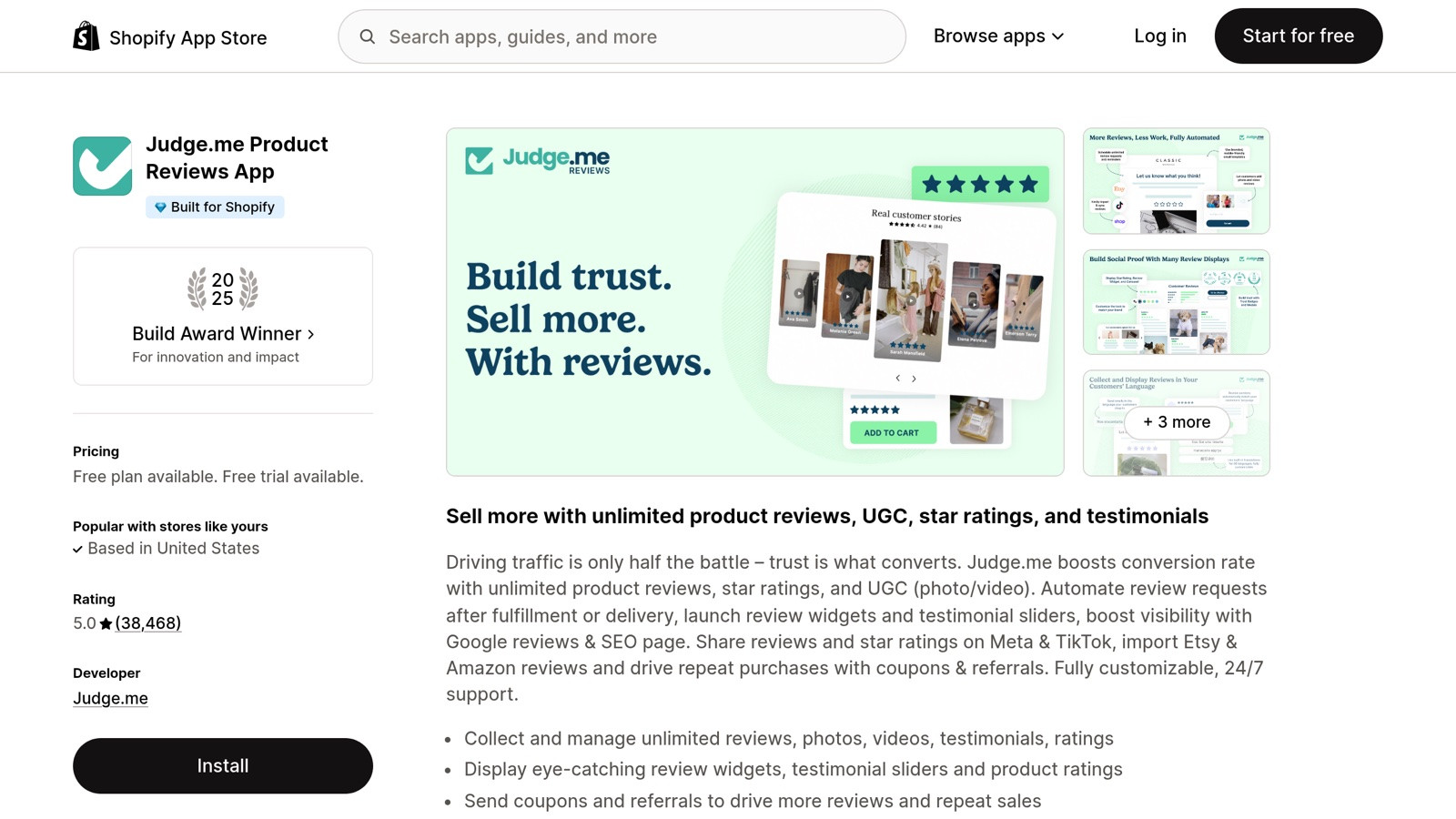
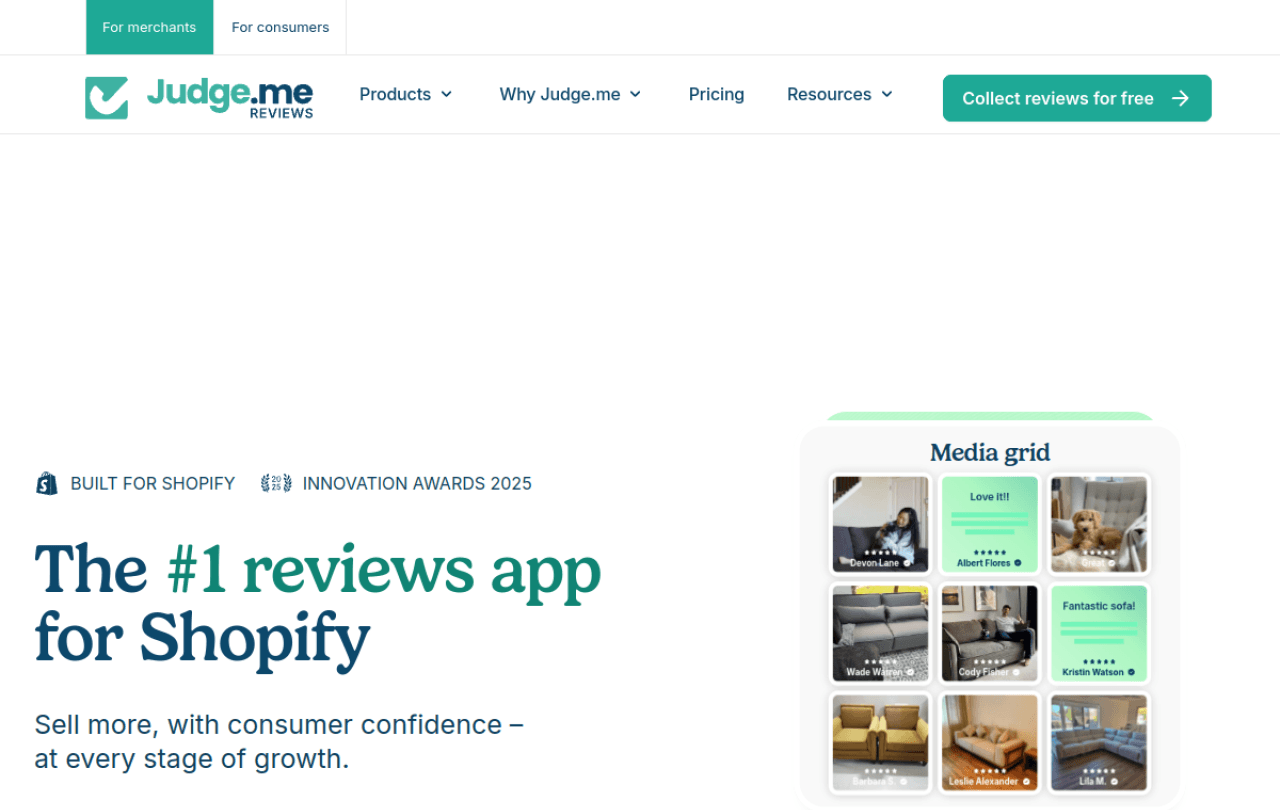
Judge.me on the Shopify App Store, rated 5.0 from 47,950 merchant reviews in October 2026.
From Trustpilot to Yotpo
You can't migrate Trustpilot reviews into Yotpo directly (Trustpilot reviews live on trustpilot.com, you don't own the data). What you can do: export your invite list and have Yotpo re-invite those customers for product reviews on your store.
Reasons people switch
Yotpo → Trustpilot/Judge.me: a bill that grows with order volume, against a flat $0 to $15 for Judge.me. Trustpilot → Yotpo: wanting product reviews, Seller Ratings and loyalty from one vendor. Either → Reviewz.ai: wanting automated multi-platform routing over WhatsApp, SMS and email. The short versions are on the comparison pages for Trustpilot and Yotpo, and the long one is Reviewz vs Yotpo.
|
| Reviewz.ai for Shopify automatically routes happy customers to leave reviews on Trustpilot, Google, and Judge.me, while privately catching unhappy ones in a feedback portal before they post a public 1-star. Re-engage every reviewer with upsell offers via WhatsApp, email, and SMS. Install Reviewz on Shopify |
The bottom line
Trustpilot vs Yotpo isn't the right framing for most Shopify merchants. They're built for different problems, and most stores need neither at the paid tier. The 90% solution: Judge.me free + Trustpilot free. Add a paid Trustpilot plan once you want more than 50 invitations a month and the Verified label matters for your category. Add Yotpo at $5M+ ARR if you want reviews and loyalty from one vendor.
The strategic move that beats both: active review collection process. Whichever platform you pick, the difference between a 2% review rate (passive) and a 12% review rate (active timed invites with NPS pre-filtering) is more important than the platform choice itself. Model your own promoter pool with the NPS calculator, then make those product-page stars render in Google with our free review schema generator.
The contract trap: what to read before you sign Yotpo or Trustpilot
The two vendors bill very differently, and the differences matter more than the headline price.
Commitment length
Trustpilot states on its pricing page that all contracts are a 12-month commitment, and its paid plans are billed annually. Yotpo's reviews plans on the Shopify App Store can be paid monthly, or yearly at a discount. If you are not sure the platform fits, that asymmetry is a reason to test Yotpo month to month, and to stay on Trustpilot's free plan until you are certain.
Auto-renewal notice period
Annual contracts usually renew automatically unless you give notice before a deadline, and that deadline is in your order form, not on the pricing page. Miss the window and you're locked for another year, even if you stop using the platform. Action: put the cancellation deadline in your calendar the day you sign.
Price changes at renewal
Ask whether the renewal-year price is locked, and get the answer in writing. With Yotpo there is a second effect: the price follows your order volume, so a good year for your store moves you up a tier even if the list prices do not change.
Data ownership
You cannot take Trustpilot reviews with you: they live on trustpilot.com and Trustpilot does not accept imported reviews. Yotpo reviews can be exported, but check what the export contains (photos, order references) before you rely on it for a migration. Our Yotpo to Judge.me migration guide walks through the export.
Add-ons
Read the plan table for what is not included. On Trustpilot, product reviews and API access are add-ons. On Yotpo, loyalty is a separate product.
The takeaway: a paid Trustpilot plan is an annual commitment and should be evaluated like one. Treat the contract seriously, and document everything in writing.
Frequently asked questions
Yotpo vs Trustpilot: what is the difference?
Yotpo collects product reviews and shows them on your own Shopify product pages. Trustpilot collects reviews of your business and shows them on a public profile on trustpilot.com that ranks when people search your brand name. They answer different questions for a shopper, which is why some stores run both.
Does Yotpo work with Trustpilot?
There is no built-in sync that copies reviews from one to the other. Stores that use both ask some customers for a Yotpo product review and send others to their Trustpilot review link, ideally with one tool deciding who gets which request so nobody is asked twice.
Is Yotpo cheaper than Trustpilot?
On list price, yes for the Starter plan. At 300 orders a month, Yotpo Starter is $89 a month while inviting every customer through Trustpilot needs the Plus plan at $3,828 a year. Both have a free plan: Yotpo up to 50 orders a month, Trustpilot up to 50 invitations a month.
Which one puts stars in Google?
Both are on Google's list of review partners for seller ratings in ads, with Yotpo offering it on its Pro plan. For product ratings in Google Shopping, Google's partner list says Yotpo includes syndication from the Starter plan and Trustpilot sells it as a paid add-on.
References:
- Yotpo. Plans and pricing, including the order-volume slider (checked October 4, 2026). Link
- Trustpilot. Plans and pricing (checked October 4, 2026). Link
- Shopify App Store: Trustpilot listing. Link
- Google Ads Help. About seller ratings, including the list of review partners. Link
- Google Merchant Center Help. Product ratings partners. Link
- Trustpilot Terms of Service. Link
- Shopify App Store: Yotpo Reviews listing. Link

About the author
Nicolas Provost · Founder of Reviewz.ai
Nicolas built Reviewz.ai after auditing 500+ Shopify review setups while running Kanal (WhatsApp marketing for Shopify). He has spent four years inside the Shopify ecosystem and writes about review collection, brand trust SEO, and the actual economics of running customer-feedback flows on ecommerce sites.
