

Judge.me wins on price and scale, Loox wins on photo-review conversion lift for DTC. If you ship over 2,000 orders a month and need unlimited review requests, Judge.me's flat $15 Awesome plan crushes Loox economically. If you sell visual products (fashion, home, beauty) under 1,000 orders a month, Loox's photo and video collection rates justify its higher per-order cost. Most stores end up needing both: Judge.me for volume, Loox for hero products.
Reviewed by Nicolas Provost, founder of Reviewz.ai. Insights based on auditing 500+ Shopify review setups and analyzing public pricing, schema, and conversion data across the leading review platforms. LinkedIn
The 30-second verdict: which one wins
Judge.me and Loox solve the same on-paper problem (collect Shopify product reviews) but they price and position completely differently. Judge.me is the unlimited-everything flat-rate workhorse at $15/month. Loox is the photo-first DTC darling that charges per order request, starting at $9.99/month and scaling up fast.
Judge.me wins if you ship a lot of orders, sell across many SKUs, or just want predictable cost as you scale. Loox wins if your conversion depends on visual proof (clothing, jewelry, home decor, beauty) and your AOV justifies paying for higher-quality user-generated content. If you also want to weigh the third giant, see how all three stack up in Yotpo vs Loox vs Judge.me.
For most stores past $50k MRR, the honest answer is to run both, with a router layer like Reviewz.ai deciding which platform gets each customer based on order value, product category, and sentiment.
What each app actually does
Judge.me launched in 2014 and built its reputation on the contrarian promise that review collection should be a commodity. One flat fee, unlimited requests, unlimited products, unlimited reviews. Its 2026 paid plan (Awesome) is still $15/month flat. It does Q&A, video reviews, photo reviews, in-email forms, syndication to Google Shopping, and rich snippets out of the box.
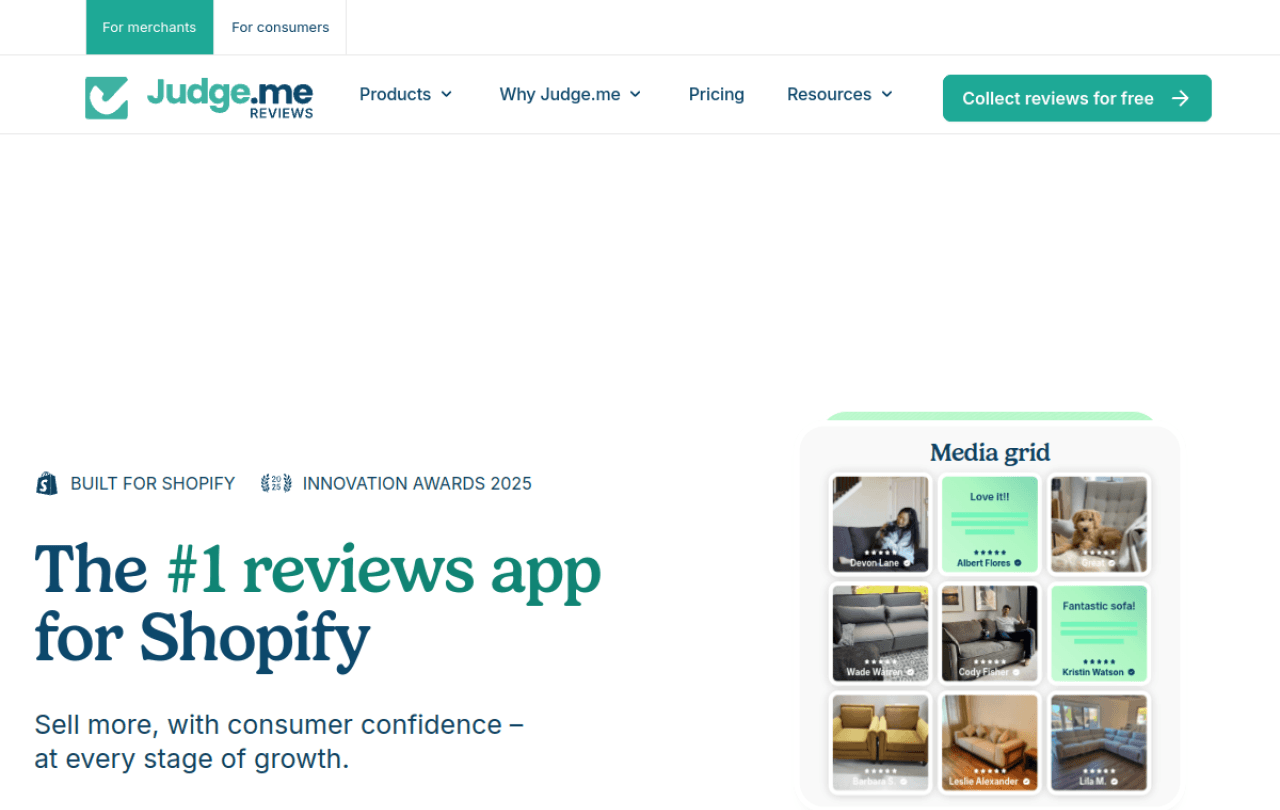
Loox started in 2017 with a sharper focus: photo and video reviews displayed in pretty grids and carousels. The bet was that visual social proof converts harder than text, especially for DTC brands selling apparel, beauty, and home. Loox's pricing scales with monthly orders, not features, which is exactly the opposite philosophy from Judge.me.

If you want a more general overview of the category, our roundup of the best Shopify review apps covers eight platforms in detail. For a Trustpilot-shaped contrast, see Trustpilot vs Judge.me on Shopify.
Side-by-side feature comparison
| Feature | Judge.me | Loox |
|---|---|---|
| Pricing model | Flat $15/mo unlimited | $9.99 to $299.99/mo by order volume |
| Free plan | Yes, forever free | 14-day trial only |
| Photo reviews | Yes, on paid plan | Yes, core feature |
| Video reviews | Yes, paid | Yes, from Advanced tier |
| AliExpress import | Yes, built in | Yes, from Beginner tier |
| Google Shopping syndication | Yes, included | Yes, from Growth tier |
| Rich snippet schema | Yes | Yes |
| Referrals / discounts for reviews | Coupons only | Yes, full referral loop |
| Shopify App Store rating | 5.0 (40k+ reviews) | 4.9 (22k+ reviews) |
Pricing at 3 scales: 500, 2,000, 10,000 orders per month
Pricing matters more than features for most stores, because both apps cover the basics. The economic question is whether you pay flat or per-order.
| Monthly orders | Judge.me cost | Loox cost | Delta |
|---|---|---|---|
| 500 / mo | $15 (Awesome) | $34.99 (Scale) | +$20 for Loox |
| 2,000 / mo | $15 | $99.99 (Unlimited) | +$85 for Loox |
| 10,000 / mo | $15 | $299.99 (Enterprise) | +$285 for Loox |
At 10,000 orders, Loox costs 20x what Judge.me does. The question is whether Loox's photo-review machine generates 20x more conversion lift than Judge.me's plain-text reviews. For most stores, the answer is no. For visual DTC brands at the 500-order tier, the math is closer, and Loox's higher photo-collection rate can justify the premium.
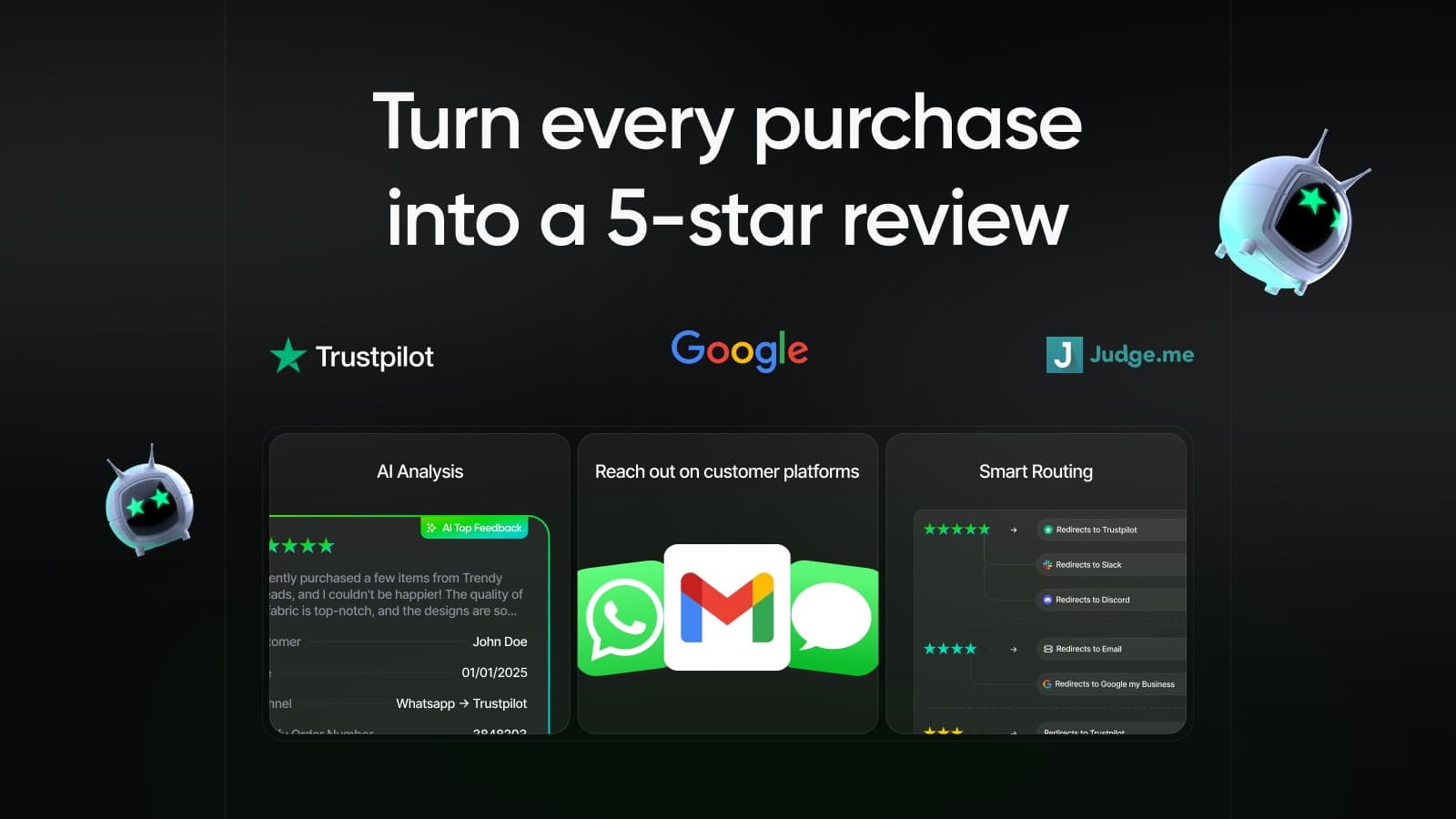
Route happy customers to Trustpilot & Google, capture negatives privately.
Install Reviewz on ShopifyWhich app wins for which store type
Choose Judge.me if you: ship 1,000+ orders a month, sell across 50+ SKUs, want predictable cost, run a multi-store setup, or care more about general review volume than photo conversion. Judge.me's flat-fee model is also the best on this list for stores with seasonal volume spikes.
Choose Loox if you: sell visual products (apparel, beauty, jewelry, home decor, kitchen), have AOV above $50, ship under 1,500 orders a month, and your conversion rate would visibly benefit from a photo carousel on PDPs. Loox's grid widgets are objectively prettier than Judge.me's.
Use both if you: are past $100k MRR and split your catalog into hero SKUs (Loox) and long-tail SKUs (Judge.me). Reviewz.ai can route review requests to either platform based on rules you define, and you can see how that approach compares head-to-head in Reviewz vs Judge.me. See also our breakdown on Judge.me alternatives for Shopify and Loox alternatives for Shopify if you've outgrown both.
Migration considerations: switching between them
Both apps support CSV import and export, which sounds easy until you try it. Judge.me reviews export with reviewer email, rating, body, and timestamp. Loox exports the same plus image URLs. The issue is that re-importing into the other platform breaks one critical SEO asset: the original publish date.
If your reviews predate 2020, that historical timestamp drives schema-rich snippets on Google. Re-importing makes every review look new, which is suspicious to the FTC and counterproductive for SEO. Our piece on why bulk-imported reviews flag fake-review systems explains why this matters. The cleaner migration approach is dual-running: keep the old app's data live, install the new one, and only retire the old after 6 months of fresh review accumulation.
Also: both apps follow the FTC final rule banning fake reviews, but the burden is on you to keep purchase verification proof for every review. Don't migrate without it.
Common pitfalls when picking between Loox and Judge.me
The biggest mistake is picking on UI rather than economics. Both apps are pretty enough. The decision should be cost per review at your real order volume.
The second mistake: assuming Loox's photo conversion lift is universal. Spiegel Research has documented a 270% conversion lift from displaying reviews, and BrightLocal's Local Consumer Review Survey shows how heavily shoppers weight review signals before buying, but the lift from photo-vs-text is far smaller and category-dependent. Skincare, supplements, and apparel benefit. Office supplies, dropshipped electronics, and food don't.
Third mistake: ignoring negative review routing. Both Loox and Judge.me publish every review publicly by default. If you want to filter so only happy customers leave public reviews and unhappy ones route to support, you need a layer on top. That's what Reviewz.ai does, regardless of which platform you keep underneath.
FAQ
Is Judge.me really unlimited at $15/month?
Yes, the Judge.me Awesome plan is genuinely unlimited on reviews, requests, products, and storefronts. The only friction is that the free plan is intentionally limited (no photo reviews, no rich snippets, no Q&A), so the $15 paid tier is where the real value sits. There are no per-order overages, no review caps, and no hidden fees, which is why Judge.me has dominated Shopify pricing comparisons for a decade. The catch: support is slower than premium-priced apps, and customization requires liquid edits or paid agency help.
Does Loox have a free plan?
No, Loox does not offer a forever-free plan in 2026. It has a 14-day free trial, but paid plans start at $9.99/month (Beginner, 100 orders) and scale up to $299.99/month (Enterprise, unlimited orders). If you want a genuinely free Shopify review app, look at Judge.me's free tier, Stamped's free tier, or Yotpo's free tier. We compared all free options in our roundup of the best free Shopify review apps.
Which one is better for SEO?
Both apps emit valid Review and AggregateRating schema, which is what drives Google rich snippets. In our schema audits across 200+ Shopify stores, Judge.me's emitted markup is slightly cleaner and validates more consistently in Google's structured-data guidance for review snippets. Loox occasionally produces nested-itemtype warnings that don't break snippets but generate noise in Search Console. If you ever need to drop standalone markup into a custom theme section, our review schema generator outputs valid AggregateRating JSON-LD. If pure schema hygiene matters, Judge.me edges out. If you want photo carousels in your snippets (which actually drive higher CTR), Loox handles image schema better.
Can I run Loox and Judge.me at the same time?
Technically yes, but only one app should emit AggregateRating schema per product page, or Google will flag duplicate structured data. The practical setup is: Loox runs the visual storefront widgets and review collection for hero products, Judge.me runs the long-tail catalog. You disable Judge.me's storefront display on Loox-covered products and vice versa. This is a 20-minute Liquid edit, or about an hour of agency work. Reviewz.ai sits above both and decides which platform each customer's review request goes to.
Does either one route negative reviews privately?
Neither Loox nor Judge.me have native negative-review routing as of 2026. Both publish every submitted review publicly by default, with the option to manually moderate. That manual moderation is risky under FTC and EU rules, because hiding negative reviews while publishing positive ones can be classified as deceptive practice. The compliant approach is to use a sentiment-routing layer that asks customers to rate privately first, then asks high-raters to publish publicly. That's the core of what Reviewz.ai does on top of whatever platform you keep.
Route happy customers to Trustpilot & Google, capture negatives privately.
Install Reviewz on Shopify
About the author
Nicolas Provost · Founder of Reviewz.ai
Nicolas built Reviewz.ai after auditing 500+ Shopify review setups while running Kanal (WhatsApp marketing for Shopify). He has spent four years inside the Shopify ecosystem and writes about review collection, brand trust SEO, and the actual economics of running customer-feedback flows on ecommerce sites.
