

The median review submission rate across Shopify stores is 3.2 percent on single-touch email and 5.5 percent on two-touch sequences. Anything under 2 percent is broken (usually wrong trigger or wrong timing). 5 percent puts you in the top quartile. 8 percent or higher is elite territory and almost always involves a combination of email plus SMS, delivery-confirmation timing, and category-specific delays. The fastest single fix for low rates: switch the trigger from order-based to delivery-based.
Reviewed by Nicolas Provost, founder of Reviewz.ai. Insights based on auditing 500+ Shopify review setups and analyzing public pricing, schema, and conversion data across the leading review platforms. LinkedIn
What submission rate actually means
Before benchmarking, define the number. Review submission rate is reviews collected / review requests sent. Not orders shipped, not subscribers emailed, just the percentage of recipients who actually submitted a review after receiving a request.
Two adjacent metrics that get confused with submission rate:
- Coverage rate: percentage of orders that have at least one review. Different denominator, useful for cohort tracking.
- Open-to-submission rate: of recipients who opened the email, what percent submitted. This is usually 15 to 25 percent and is more useful for diagnosing email content versus list quality.
When industry blog posts cite "review collection rates of 20 percent or higher", they are usually quoting open-to-submission. Honest submission rate (off send) is always single-digit percent. If a vendor claims their app achieves "40 percent review rate", ask for the denominator definition.
Industry benchmarks by category
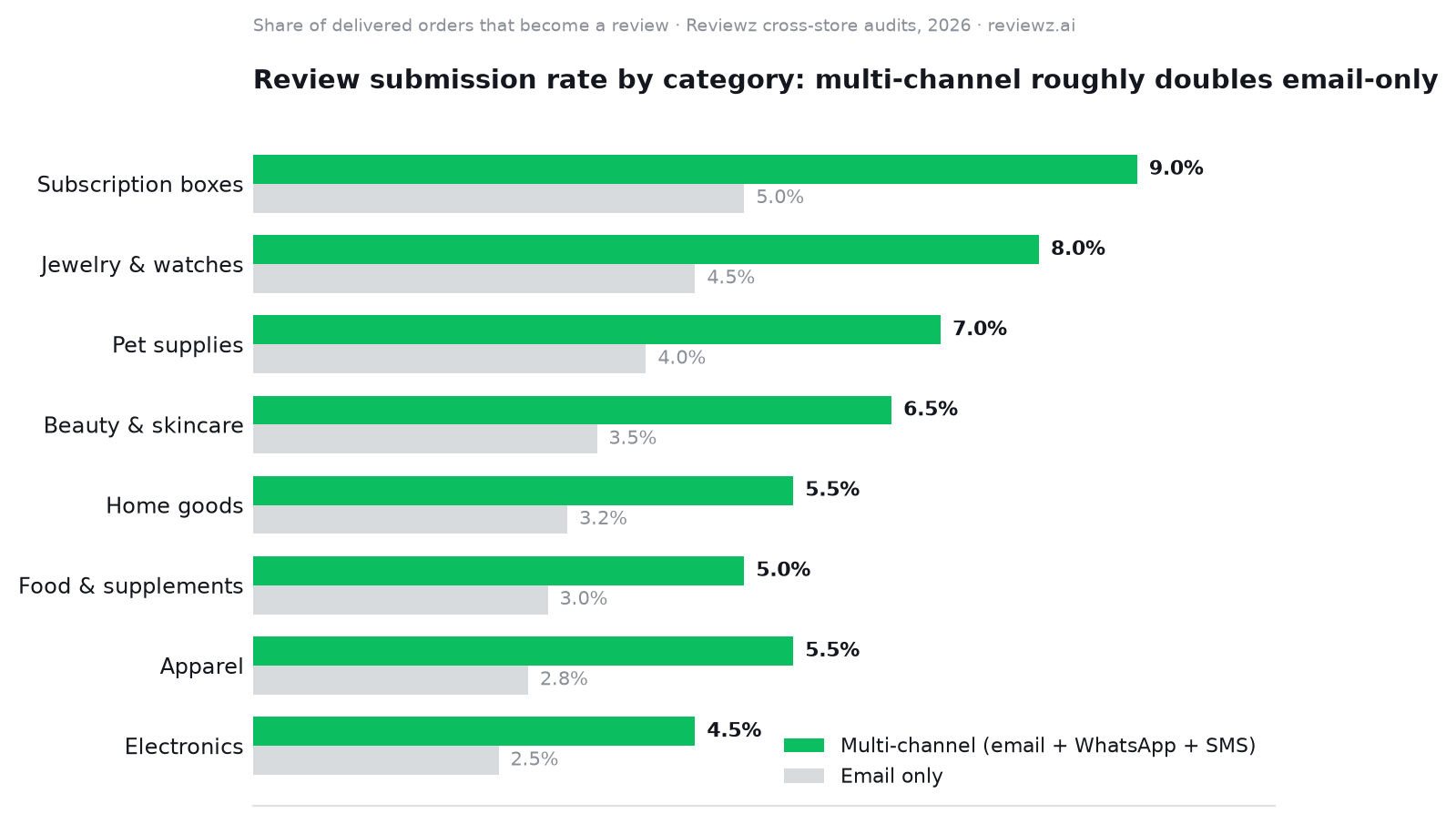
Submission rates vary significantly by what you sell. The pattern: lower-emotional-investment categories (consumables, basic apparel) hit lower rates. Higher-engagement categories (jewelry, custom items, subscriptions) hit higher rates. Here are the benchmarks from cross-store audits across 500+ Shopify stores running standard review request flows:
| Category | Median rate (single-touch) | Top quartile (multi-touch) |
|---|---|---|
| Apparel and accessories | 2.8 percent | 5.5 percent |
| Beauty and skincare | 3.5 percent | 6.5 percent |
| Consumer electronics | 2.5 percent | 4.5 percent |
| Food, beverage, supplements | 3.0 percent | 5.0 percent |
| Home goods and decor | 3.2 percent | 5.5 percent |
| Jewelry and watches | 4.5 percent | 8.0 percent |
| Pet supplies | 4.0 percent | 7.0 percent |
| Subscription boxes | 5.0 percent | 9.0 percent |
| Custom and personalized | 5.5 percent | 10.0 percent |
The category effect is real but smaller than the timing and channel effects. A pet store on order-based timing with single-touch will hit 1.8 percent. A pet store on delivery-based timing with two-touch email plus SMS will hit 8 percent. Same product, same brand, fourfold submission rate difference. Submission rate also feeds the larger volume question of how many reviews a product needs to convert.
Email vs SMS vs in-product collection: the channel benchmarks
Channel choice accounts for the second-largest variance after timing. The three primary options:
| Channel | Median submission rate | Notes |
|---|---|---|
| Email (single-touch) | 3.2 percent | Baseline for most stores |
| Email (two-touch) | 5.5 percent | Best ROI for most stores |
| SMS (single-touch) | 5.0 percent | Requires opt-in, higher cost per send |
| Email + SMS combo | 7.5 percent | Elite tier, watch fatigue |
| In-product QR code (with package insert) | 1.5 percent | Looks good in theory, weak in practice |
| WhatsApp (where opt-in exists) | 6.0 percent | Strong in EU and LATAM markets |
Practical recommendation for most Shopify stores: start with two-touch email. Add SMS once email is dialed in. Skip QR-code package inserts as a primary channel (they are fine as a passive add-on but not a driver).

Route happy customers to Trustpilot & Google, capture negatives privately.
Install Reviewz on ShopifyWhat to do if you are below benchmark
If your current submission rate is under 2 percent, the cause is almost always one of four issues. Audit them in this order:
- Trigger problem: are you firing on order placement instead of delivery confirmation? Fix this first. Expect 2 to 4x lift. See best time to send a review request.
- Delay problem: are you sending in the right post-delivery window for your category? Apparel at 3 days underperforms apparel at 9 days by roughly 40 percent.
- Subject line problem: are you using your review app's default subject line? Test against 3 alternatives. Subject line drives 30 to 40 percent of variance.
- Single-touch problem: do you only send one email? Add a second touch 5 to 7 days after the first. Expect 50 to 80 percent volume lift.
For stores at 2 to 4 percent, the order changes. Focus on email content quality, segmentation by purchase value, and adding SMS as a second channel. The review request email generator and the review request email Shopify guide cover the content side.
What elite (5 percent+) submission rates look like operationally
Stores hitting 5 percent or higher consistently share a small set of operational habits:
- Delivery-trigger every order: no order-based timing anywhere in the flow.
- Category-specific delays: configured per collection, not globally.
- Two-touch sequences as default: the second touch is rewritten, not a copy of the first.
- Refund and return exclusion: orders with any refund event in 30 days are auto-excluded.
- Email plus at least one secondary channel: SMS, WhatsApp, or post-purchase widget.
- Timezone-aware sending: respect the customer's local 10am to 2pm window.
- Subject line A/B testing: quarterly tests with a 5,000-recipient sample minimum.
Elite is not a magic plugin. It is the result of fixing 6 to 8 small things that each contribute 10 to 30 percent lift. The compound effect gets you from a 2 percent baseline to 6 to 8 percent over a quarter of methodical optimization.
The numbers that should trigger an audit
Treat these as red flags warranting immediate review of your setup:
- Submission rate under 1.5 percent: almost certainly a trigger or deliverability problem.
- Open rate above 40 percent but submission rate below 2 percent: content or landing page problem.
- Submission rate dropping 20 percent quarter-over-quarter: deliverability degradation or subject line fatigue.
- SMS opt-out rate above 5 percent: cadence too aggressive, throttle frequency.
- Average review rating jumping or dropping more than 0.4 stars in a quarter: either suspicious activity or a real product change. Investigate either way using the review sentiment analyzer.
The BrightLocal Local Consumer Review Survey confirms that 98 percent of consumers read reviews before buying. The cost of a broken funnel is not abstract: every 1 percent improvement in submission rate translates directly to more on-site reviews, more rich-result eligibility, and more conversion lift on every visitor afterward. This is the whole reason customer reviews are important to the bottom line, not just a vanity metric. The Spiegel Research Center study on online reviews quantifies the downstream impact at up to 270 percent conversion lift once the reviews are visible, one of many figures in our roundup of customer review statistics for 2026.
FAQ
Is a 1 percent submission rate ever acceptable?
Only for very high AOV stores where each review represents a $500+ order. For typical Shopify stores with AOV under $200, 1 percent indicates a setup problem. The fixes are mechanical: switch to delivery-trigger, send at the right delay for your category, add a second touch. Most stores can get to 3 percent within 2 weeks of those changes. If you're stuck at 1 percent after fixing those four levers, audit your email deliverability and your Shopify customer-consent settings.
Why is my SMS submission rate lower than expected?
SMS submission rates depend heavily on whether customers explicitly opted in to marketing SMS during checkout. Stores that send to all customers (including non-opted-in transactional contacts) see lower submission rates because they trigger spam filters and opt-outs. Run an audit: count actual marketing-opted-in SMS contacts versus total. If your eligible base is small, the absolute submission count will look low even at healthy submission rates.
Does offering an incentive (discount, free shipping) for reviews work?
It lifts submission rate by 30 to 60 percent but creates two problems. First, it can violate Trustpilot terms of service and the FTC fake-review rule if not disclosed properly (the FTC requires "clear and conspicuous" disclosure of any compensation). Second, incentivized reviews tend to be shorter and less useful for product feedback. If you must use incentives, use a small ($5 to $10) post-submission credit, disclose it transparently, and never make the incentive contingent on a positive rating. Our guide to offering a discount for reviews walks through the compliant way to set this up.
How does sentiment routing affect submission rates?
Sentiment routing (showing happy customers a Trustpilot link, unhappy customers a private feedback form) reduces public-facing submission rate by roughly 15 to 25 percent (because negatives never make it to the public review). But it dramatically improves the visible average rating on Trustpilot and Google. The tradeoff is usually worth it for stores where SERP control matters more than total review volume. Reviewz routes happy buyers to public review platforms and captures negatives privately for customer service follow-up.
Should I benchmark against my industry or against competitors?
Against your industry's median for diagnosis (am I broken?), against your immediate competitors' total review count for SERP positioning (am I behind?). The two questions have different answers. You can hit a 4 percent submission rate (above median for most categories) and still be behind a competitor with three years of accumulated reviews. The fix is patience plus volume. The best Shopify review apps comparison shows which platforms make the volume game easier through automation.
Route happy customers to Trustpilot & Google, capture negatives privately.
Install Reviewz on Shopify
About the author
Nicolas Provost · Founder of Reviewz.ai
Nicolas built Reviewz.ai after auditing 500+ Shopify review setups while running Kanal (WhatsApp marketing for Shopify). He has spent four years inside the Shopify ecosystem and writes about review collection, brand trust SEO, and the actual economics of running customer-feedback flows on ecommerce sites.
