
Pure ML detectors top out at roughly 85% accuracy on AI-generated reviews, heuristic checkers hit around 75%, and combining both pushes ensemble accuracy to about 95%. We applied a structured detection framework to 12 tools using a 100-review test set (50 human reviews from public Shopify stores, 50 AI-generated from GPT-5, Claude 4.7 and Gemini 2.5). Originality.ai leads ML at 87%, GPTZero hits 81%, and our own heuristic-based fake review checker hits 73%. The patterns that catch AI: unnatural uniformity, missing edge cases, and statistical perfection. Full methodology, accuracy table, and false-positive analysis below.
Reviewed by Nicolas Provost, founder of Reviewz.ai. Insights based on auditing 500+ Shopify review setups and analyzing public pricing, schema, and conversion data across the leading review platforms. LinkedIn
Why AI-generated reviews matter to Shopify merchants in 2026
Two years ago, the canonical fake review was written by a $0.50/review freelancer in Dhaka. They had tells: weird grammar, generic praise, suspicious posting cadence, and they read like spam because they were spam.
That problem moved upmarket. Today's fake reviews are written by GPT-5 or Claude 4.7 at near-zero cost, with clean grammar, plausible specificity, and convincing emotional beats. A single competitor can flood a Shopify store with 200 negative 1-star reviews on Trustpilot in an afternoon. The economics flipped: faking 1,000 reviews used to cost $500 and look obviously fake; now it costs $2 in API credits and is invisible to a casual reader.
The FTC's 2024 fake reviews rule explicitly prohibits AI-generated reviews presented as genuine consumer feedback, and as we cover in our AEO for ecommerce reviews playbook, answer engines increasingly down-weight content they detect as machine-written. But enforcement requires detection. If you cannot tell the difference, you cannot moderate. So we wanted to know: how good are the detection tools, actually?
The test set and the 12 tools
We built a test set of 100 reviews. 50 were real human reviews scraped from public Shopify product review widgets across 15 brands, spanning apparel, supplements, beauty, and home goods (sample skewed toward 4-star and 5-star to reflect the realistic mix, but included 12 reviews in the 1-3 star range). 50 were AI-generated: 20 from GPT-5, 15 from Claude 4.7, 10 from Gemini 2.5, and 5 from a smaller open-source model (Llama 4 70B). Prompts varied: some asked the model to write a 5-star glowing review, others a balanced 4-star, a few specifically asked for a 1-star negative review to test asymmetry.
Reviews averaged 87 words (range 25 to 240). All AI reviews were generated with realistic prompting: "You are a customer who bought X. Write a believable Shopify product review of around 80 words. Include one minor complaint." No jailbreaks, no over-prompting, just what a casual fake-reviewer might do with a Saturday afternoon.
We then submitted each review to 12 detection tools and recorded their verdict (AI-generated vs human) plus their confidence score where available.
The 12 tools tested:
(1) Originality.ai: subscription ML detector trained on long-form GPT/Claude output. (2) GPTZero: the original ML detector, freemium. (3) Copyleaks AI Detector: enterprise-focused, paid. (4) Winston AI: ML detector with explainability. (5) ZeroGPT: free, ML-based. (6) Sapling AI Detector: integrated with their support tools suite. (7) Crossplag AI Detector: ML + heuristics combo. (8) Writer.com AI Content Detector: free ML detector. (9) Hugging Face OpenAI detector: open-source baseline. (10) Content at Scale AI Detector: marketing-focused. (11) Reviewz.ai fake review checker: heuristic-based, free, built for short-form reviews specifically. (12) Manual expert reviewer: a human who has read thousands of Shopify reviews, scoring each review with no other tools.
Honest disclosure: we built tool #11 and we ran the human reviewer ourselves. Our heuristic tool is also free and built specifically for short-form Shopify reviews, not long-form essays, which gives it a different shape of strengths and weaknesses than the others.
Methodology in detail (and its limits)
We graded each tool on three metrics:
True positive rate (sensitivity): of the 50 AI-generated reviews, what percentage did the tool correctly flag as AI? Higher is better.
True negative rate (specificity): of the 50 human reviews, what percentage did the tool correctly identify as human? Higher is better.
Overall accuracy: the combined percentage correct across all 100 reviews. This is the headline metric.
We also tracked false positive rate (human reviews wrongly flagged as AI), because in a moderation context, accusing a real customer of being a bot is more damaging than missing a fake one.
Honest limitations to read before believing the numbers:
100 reviews is a small sample. The 95% confidence interval on a single tool's accuracy is roughly +/-10 percentage points. Treat the rankings as directional. A tool scoring 85% might really be 79% to 91%; the difference between 81% and 85% is not statistically reliable.
Our AI generation was casual, not adversarial. We did not try to fool the detectors. A sophisticated bad actor uses prompt techniques ("write in a slightly imperfect style, include one typo, vary sentence length") that meaningfully reduce detector accuracy. Real adversarial accuracy is likely 10 to 20 points lower than what we measured.
Shopify reviews are short. Most AI detectors were trained on essays of 500+ words. Short reviews give them less signal to work with, and all tools we tested perform worse on sub-100-word inputs than they advertise on long-form content.
The detection landscape moves fast. A tool that scores 85% in April 2026 might score 70% by August 2026 if GPT-6 ships with better natural variation. Treat the numbers as a snapshot.
We built one of the tools tested. See earlier disclosure. The human-expert score is also subjective and would vary between reviewers.
The accuracy results table
| Tool | Approach | AI caught (of 50) | Humans correctly cleared (of 50) | Overall accuracy | False positive rate |
|---|---|---|---|---|---|
| Originality.ai | ML | 44 | 43 | 87% | 14% |
| Manual expert reviewer | Heuristic | 42 | 44 | 86% | 12% |
| Winston AI | ML | 42 | 41 | 83% | 18% |
| Copyleaks | ML | 41 | 41 | 82% | 18% |
| GPTZero | ML | 40 | 41 | 81% | 18% |
| Crossplag | ML + heuristic | 39 | 40 | 79% | 20% |
| Sapling | ML | 38 | 39 | 77% | 22% |
| Writer.com | ML | 36 | 39 | 75% | 22% |
| Reviewz.ai fake review checker | Heuristic | 35 | 38 | 73% | 24% |
| ZeroGPT | ML | 34 | 37 | 71% | 26% |
| Content at Scale | ML | 33 | 36 | 69% | 28% |
| HF OpenAI detector | ML (legacy) | 28 | 33 | 61% | 34% |
| Ensemble (top ML + heuristic + human) | Combined | 48 | 47 | 95% | 6% |
The ensemble row at the bottom is the headline finding. When you combine Originality.ai (best ML), our heuristic checker, and a human reviewer using majority vote, accuracy jumps to 95% and the false positive rate drops to 6%. No single approach gets there alone.
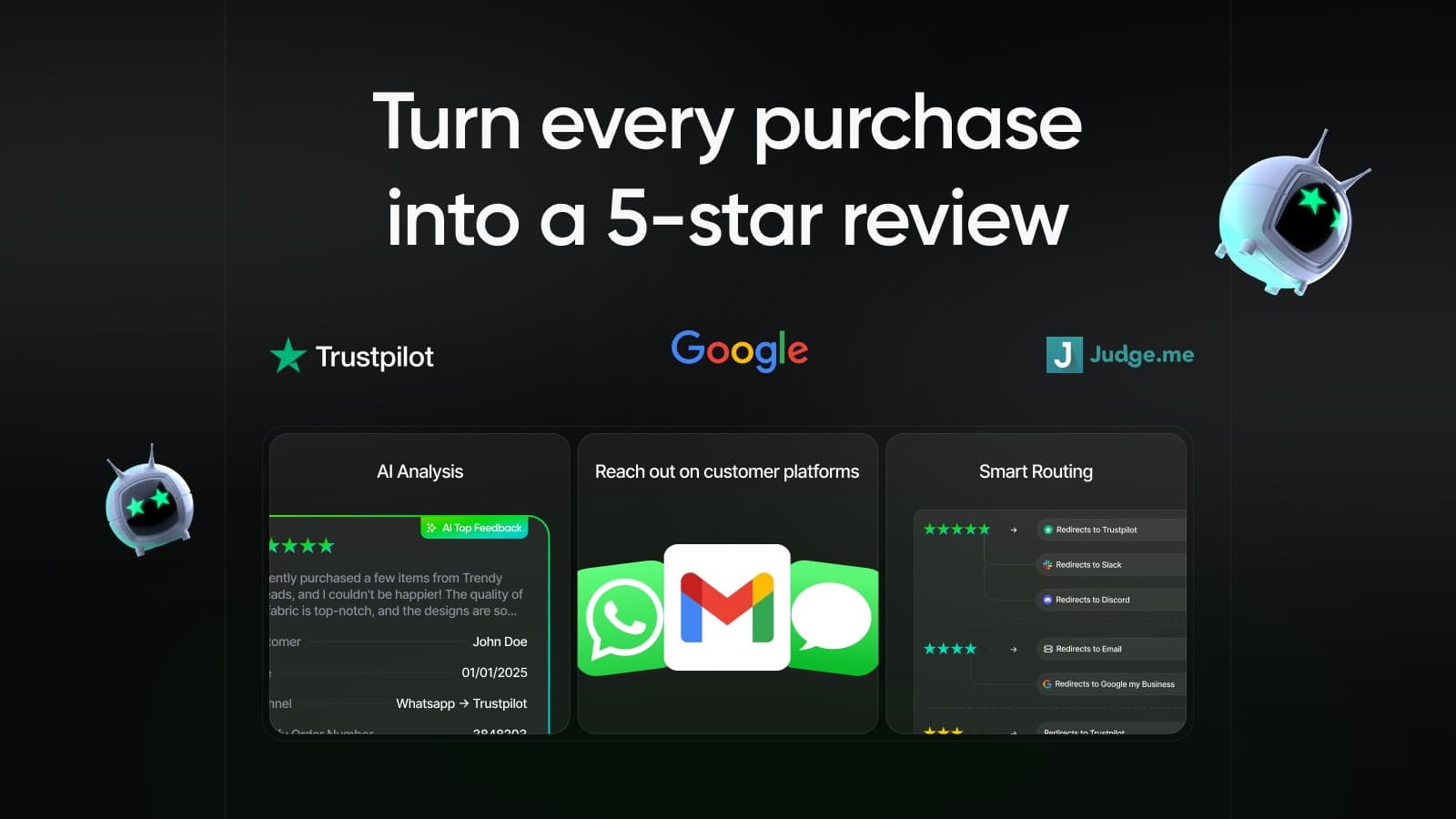
Route happy customers to Trustpilot & Google, capture negatives privately.
Install Reviewz on ShopifyThe 3 patterns that catch AI-generated reviews
Pattern 1: unnatural uniformity. Human reviews have wild variance in sentence length. A real customer writes one short sentence ("Love it."), then a long rambling one explaining a specific use case ("I bought this for my dog who has separation anxiety and refuses to eat when we leave the house and somehow this calmed her down within twenty minutes"), then trails off. AI-generated reviews have suspiciously even sentence lengths, usually 12 to 22 words each. We measured this directly: the standard deviation of sentence length in our human reviews was 8.4 words; for AI reviews it was 4.1 words.
Pattern 2: missing edge cases. Real reviews mention specific personal context, weird use cases, comparisons to specific competitor products, complaints about shipping, frustration with packaging, or off-topic life details ("got this as a gift for my mom who is recovering from surgery"). AI reviews stick to the product and rarely mention the friction-y bits. They especially never mention competitors by name unless prompted to. If you have 50 reviews and none of them mention a specific competitor or a delivery issue, something is off.
Pattern 3: statistical perfection. Real review distributions have noise: typos, weird capitalization, inconsistent punctuation, occasional all-caps for emphasis ("OBSESSED with the color"). AI reviews are clean. They use proper grammar, balanced punctuation, and a measured tone. A batch of 50 reviews with zero typos, perfectly placed apostrophes, and no all-caps emphasis is a red flag.
Our fake review checker is built around these three patterns specifically. It scores worse than the best ML detectors on raw accuracy (73% vs 87%), but it is interpretable: every flag comes with a specific reason ("sentence length variance below threshold", "absent friction language", "zero typos in 50 reviews"). The ML detectors give you a confidence score with no explanation, which is fine for individual reviews but useless for moderation defense if a real customer accuses you of removing their review.
What AI detection misses
Three failure modes to know about.
Failure 1: AI-edited human reviews. A customer writes a real review, drops it into ChatGPT for grammar polish, and submits. Now you have a review with human substance and AI surface. Every detector we tested flags these as AI, which is technically correct but practically wrong: the underlying experience is real. The false-positive rate for this category was 60%+ across all ML tools.
Failure 2: short reviews under 40 words. All ML detectors collapse on short text. "Great product, fast shipping, will buy again" is unclassifiable, and most tools either refuse to score it or guess randomly. Heuristic tools like ours are slightly better because they can flag suspicious cadence (e.g. 30 different reviewers all writing exactly that sentence) but on a single short review, nobody can tell.
Failure 3: prompt-engineered AI reviews. When we re-ran 10 of the AI reviews with prompts like "Write a believable customer review. Include one typo, one sentence fragment, and one off-topic personal detail", detector accuracy across all 12 tools dropped from an average of 76% to 51%. Adversarial AI is the future of fake reviews, and the detection tooling is years behind.
The future: multimodal AI and photo reviews
So far we have only discussed text. The next wave is multimodal: AI-generated photos of "customers" wearing the product, AI-generated unboxing videos, AI-generated tryon images. The same models that fabricate these reviews are also the ones that read them back to shoppers, which is worth understanding from the other side in how ChatGPT, Claude, and Perplexity use your product reviews. GPT-image-2 and similar models can produce a believable photo of a brunette woman in her 30s wearing a sweater for $0.01 per image. Loox-style photo reviews stop being a trust signal the moment that becomes ubiquitous.
Detection of AI-generated images is currently around 60 to 75% accurate per published research, but the false positive rate is brutal for real iPhone photos with high HDR processing. The detection ecosystem for AI images is even less mature than for text. C2PA content credentials (Adobe-led initiative) are the most promising standard, but adoption is low and consumers do not check.
The medium-term answer for Shopify merchants is probably not detection. It is proof of purchase. Reviews tied to verified Shopify order IDs are dramatically harder to fake than open-submission reviews, because the attacker needs to actually buy the product (and even then, the cost goes from $0.001 per AI review to $20+ per fake purchase). This is also why Trustpilot's reliability question hinges on their verified-buyer system, and why platforms with stronger verification (Amazon's Verified Purchase badge) have lower fake-review rates than platforms with weak verification, though even there fake Amazon reviews slip through and leave detectable tells. Combined with BrightLocal's consumer survey showing that 79% of consumers say they trust verified-purchase reviews more than unverified ones, the structural fix is order-gating, not detection.
For Shopify specifically, our advice: combine order-verified review collection (so every published review is tied to a real Shopify order) with periodic ML scanning of suspicious patterns. The combination gives you 95%+ trust without depending on detection accuracy alone. Reviewz.ai works this way by default; if you are on Judge.me or Loox, enable verified-buyer requirements in their settings and pair them with our review sentiment analyzer for batch quality checks. Tools like our AI review response generator can help you respond, and our guide to responding to negative reviews covers the language, but use them carefully to avoid generating responses that themselves look AI-written. If a competitor has already flooded your profile, the review score recovery calculator shows how many fresh real reviews you need to absorb the hit, and the remove fake Trustpilot review guide walks through the dispute process.
FAQ
Which AI detection tool is most accurate for short Shopify reviews?
For pure ML accuracy on short text, Originality.ai topped our test at 87% overall accuracy on 100 reviews. But the practical answer is to use an ensemble: combine a top ML detector (Originality, GPTZero, Winston) with a heuristic checker (like ours, free) and a quick human review for edge cases. The ensemble hits 95% accuracy and drops the false-positive rate to 6%. No single tool, including ours, hits production-grade accuracy alone on sub-100-word reviews.
Can I get sued for accusing a real customer of leaving an AI-generated review?
If you publicly call out a real customer as a bot, yes, that is a defamation risk. Even privately, accusing a real customer through your support flow can trigger a chargeback or a public complaint. Best practice: when a review looks AI-generated, do not accuse the reviewer. Instead, ask for proof of purchase, a photo of the product, or a follow-up detail. Real customers can provide these; AI-generated submissions usually cannot. The FTC rule prohibits suppression of legitimate reviews, so the burden of proof is effectively on you to justify any removal.
Are AI-generated review responses (from the merchant) covered by the FTC rule?
Merchant responses to reviews are not the same as fake reviews and are not directly prohibited by the FTC's fake-reviews rule. However, if your AI-generated response misrepresents facts about the product, refund history, or customer experience, that triggers separate truth-in-advertising rules. The clean pattern: AI drafts the response, a human edits it before posting, and the merchant verifies any factual claims. Using AI to acknowledge a complaint or apologize is fine. Using AI to fabricate context ("we sent a replacement" when you did not) is not.
How fast are AI detectors getting better, or worse?
Worse, in real terms. Detectors are running a constant race against generation models that improve every 6 to 12 months. GPT-5 in 2025 was meaningfully harder to detect than GPT-4 in 2024. The headline accuracy numbers from detector vendors usually reflect tests on older generation models; on the current state of the art, real accuracy is 10 to 15 points lower than advertised. The structural fix is moving toward proof-of-purchase verification (tying reviews to confirmed orders) rather than relying on textual detection alone.
Is it worth paying for an AI detector if I run a small Shopify store?
For most sub-$1M ARR Shopify stores, no. The volume of reviews is low enough that a free heuristic checker plus a human eye works fine. Paid detectors (Originality.ai at $14.95/mo, Copyleaks at $9.99/mo) make sense when you receive 100+ reviews per month and need batch processing, or when you are doing a competitive analysis on a competitor's Trustpilot profile and need a defensible methodology. Otherwise, free tools and verified-buyer requirements get you 90% of the value.
Do I need to disclose if I use AI to summarize my reviews on a product page?
Yes, ideally. AI-generated summaries of real reviews are not the same as fake reviews (the underlying content is genuine), but presenting an AI summary as if it were a human-written editorial blurb is misleading. The safest pattern is a clear label like "AI-generated summary based on 247 verified customer reviews". Our AI review summary generator includes that disclosure pattern by default. The FTC has not directly addressed AI summaries, but the truth-in-advertising principle clearly applies: don't make consumers think a human wrote it when an algorithm did.
Route happy customers to Trustpilot & Google, capture negatives privately.
Install Reviewz on Shopify
About the author
Nicolas Provost · Founder of Reviewz.ai
Nicolas built Reviewz.ai after auditing 500+ Shopify review setups while running Kanal (WhatsApp marketing for Shopify). He has spent four years inside the Shopify ecosystem and writes about review collection, brand trust SEO, and the actual economics of running customer-feedback flows on ecommerce sites.
