

Junip is a clean, mobile-first product review app for Shopify that never charges by order: a free plan with unlimited orders and review requests, then $29, $79 or $299 a month depending on the features you need. It suits design-conscious brands that want fast widgets and a bill that does not move when sales do. The catch is that the features most growing stores end up wanting, such as Google Shopping, Klaviyo and SMS requests, start on the $79 Growth plan.
Verdict: a strong pick for brands that want predictable pricing and a polished review experience, and that will use the Growth plan. Junip holds a 4.8 rating from 1,157 merchant reviews on the Shopify App Store and carries the Built for Shopify badge. Every plan has unlimited orders and unlimited review requests. Free covers the request emails and on-site widgets. Core ($29) adds incentives, follow-up requests and product grouping. Growth ($79) adds syndication to Google Shopping, Meta, TikTok Shop and the Shop app plus marketing integrations. Premium ($299) adds AI, the API and multi-store management. Every number below was checked on 4 October 2026.
Reviewed by Nicolas Provost, founder of Reviewz.ai. Insights based on auditing 500+ Shopify review setups and analyzing public pricing, schema, and conversion data across the leading review platforms. LinkedIn
What Junip is
Junip is a product review app built for Shopify by Junip Inc., a company based in Kitchener, Ontario. It emails customers after an order, collects a rating, text, photos and videos through a form designed for phones, and displays the reviews in lightweight widgets on your store. It launched on the Shopify App Store on November 19, 2019. Its App Store listing shows 1,157 merchant reviews, 92 percent of them five stars, and its own site says it powers reviews for more than 5,000 ecommerce brands.
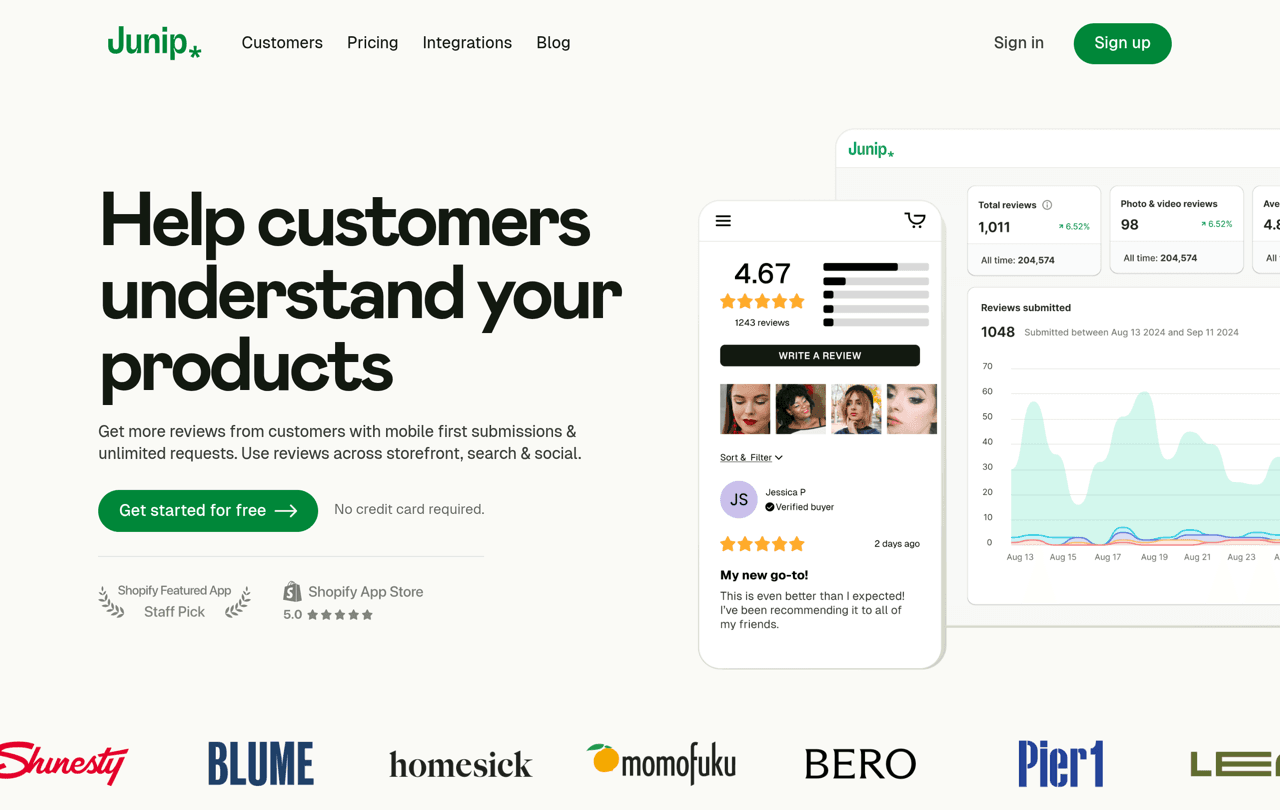
Two ideas define the product. The first is the mobile form: Junip states on its homepage that 85 percent of reviews are submitted on mobile, and its submission flow is built step by step for a phone screen. The second is the pricing model: you pay for features, not for the number of orders you ship.
Junip pricing in 2026
Junip has four plans. All of them include unlimited monthly orders and unlimited review requests.
| Plan | Price | What the App Store listing includes |
|---|---|---|
| Free | $0 | Unlimited orders, unlimited review request emails, mobile-first submissions, product page widgets, rich snippets |
| Core | $29 per month, 7-day free trial | Unlimited review requests with media, incentives, review replies, product grouping, live chat support |
| Growth | $79 per month, 7-day free trial | Google Shopping, TikTok Shop, Shop app and Meta Shops syndication, marketing integrations such as Postscript and Klaviyo, search, custom attributes and filters, all Core features |
| Premium | $299 per month, 7-day free trial | Junip AI (sales agent, summaries, integrations), multi-store management, API and custom apps, all Growth features |
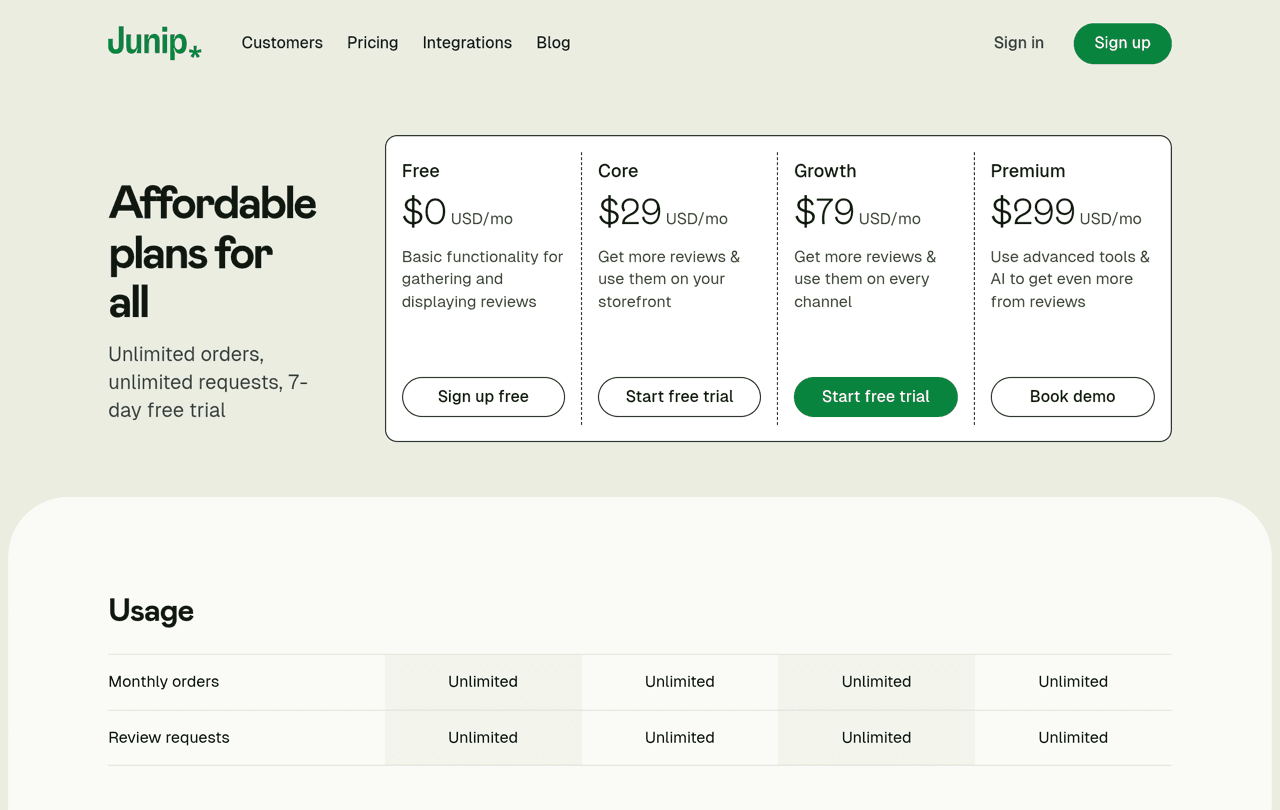
Charges are billed in USD every 30 days. The listing marks Growth as the most popular Junip plan. The plan comparison on Junip's pricing page adds a few details the listing leaves out: user accounts go from 2 on Free to 3 on Core, 7 on Growth and 25 on Premium, and Premium includes 3 storefronts, then $99 a month for each additional store.
What the Free plan really covers
According to the plan comparison on Junip's pricing page, the Free plan includes:
- Unlimited orders and review requests. No cap on either, which is rare at $0.
- Automated review request emails with photo and video reviews.
- Core display. The product page widget, the star rating widget, a dedicated reviews page, homepage carousel and media grid, and rating badges.
- Review replies and a portal where customers can edit their own review.
- Analytics. A dashboard, reports and email analytics.
- Shopify Flow integration.
The limits are just as clear. Follow-up requests, which the comparison lists separately from the first automated email, start on Core. So do incentives and product groups. Support by email and chat is marked as limited. And moderation works differently: on Free, the comparison marks Junip's FTC-compliant moderation as required, while paid plans can opt out. Junip's moderation article explains what that service does: it publishes every review in real time and removes only spam, inappropriate content and reviews that break the FTC guidelines. In practice, a free store cannot switch to manual approval.
One point to confirm before you rely on it: the App Store listing puts rich snippets on the Free plan, while the plan card on Junip's own pricing page lists Google review snippets under Core. If stars in Google results matter to you, ask Junip which applies to your store. Our review schema markup guide explains what that markup does.
What Core, Growth and Premium add
Core at $29 is the plan for collecting more: follow-up requests, incentivized reviews, a media gallery on the product page, product groups and bundles, advanced on-site configuration and full support. Read the rules on offering discounts for reviews before you switch incentives on.
Growth at $79 is the plan for using reviews everywhere: syndication to Google Shopping, Meta, TikTok Shop and the Shop app, messaging integrations such as Klaviyo, Attentive and Postscript, the Gorgias integration, additional custom questions, media incentives, pinned reviews, search and filters in the widget, and dynamic translations.
Premium at $299 is for larger teams: AI summaries, review tagging, the API and custom apps, Bazaarvoice syndication, multi-store management and an onboarding call. The AI sales agent is listed at an additional cost.
Junip vs Judge.me vs Loox on price
The three apps charge in three different ways, so the cheapest one depends on what you need.
| What you need | Junip | Judge.me | Loox |
|---|---|---|---|
| Basic collection and widgets | $0, unlimited orders | $0, unlimited orders | $0 up to 500 total orders |
| Incentives or coupons for reviews | $29 (Core) | $15 (Awesome) | $0 (Beginner, photo review discounts) |
| Google Shopping and Klaviyo | $79 (Growth) | $15 (Awesome) | From $49.99 (Convert), rising with orders |
| Pricing changes with order volume | No | No | Yes, on Convert |
| App Store rating | 4.8 (1,157 reviews) | 5.0 (47,950 reviews) | 4.9 (9,760 reviews) |
On price alone, Judge.me wins the paid rows. Junip costs more for the same checklist and sells on the quality of the experience: the mobile form, the widget design and the support. Loox is the visual specialist and the only one of the three whose paid bill follows your orders. For a wider field, see our ranking of the best Shopify review apps.
Junip pros
No order-based pricing. Unlimited orders and unlimited review requests on every plan, including Free. Your review bill does not grow because you had a good month.
The form is built for phones. If most reviews are written on a phone, as Junip reports, a step-by-step mobile form removes friction at the moment a review is won or lost. Our benchmarks on the average review submission rate show how much that step matters.
Merchants rate it highly. A 4.8 average across 1,157 reviews. Shopify's own summary of those reviews highlights easy setup and migration, mobile-friendly forms, clean customizable widgets and fast support.
Moderation is transparent by default. Reviews are published in real time and a review is not removed because it is negative. That is in line with the FTC rule against suppressing negative reviews, and we saw how often stores get it wrong when we audited 50 Shopify stores against the FTC review rule.
It plugs into your messaging stack. Junip sends review request events to Postscript, Attentive and Klaviyo, so an SMS request goes out from the tool that already holds your subscribers.
Junip cons and limits
The useful plan costs $79. Google Shopping, Klaviyo, Gorgias and extra custom questions all start on Growth. A store that wants those four things pays $79 with Junip and $15 with Judge.me.
The Free plan has no follow-up requests. The comparison gives Free the automated request email but not the follow-ups. If you want a second ask for customers who did not answer, plan on Core.
SMS depends on another tool. Junip's Postscript guide describes Junip sending events and Postscript sending the message. You need an SMS platform and the Growth plan. WhatsApp does not appear on Junip's integrations page.
AI and the API are on Premium. Summaries, tagging and API access sit at $299, and the sales agent costs extra.
Everyone gets the same public flow. As with most product review apps, a delighted customer and a frustrated one receive the same request and the same form. There is no step that asks how the order went first and gives an unhappy buyer a private way to reach you.
It is an on-site review tool. Junip fills your product pages and shopping channels. Its integrations page lists no Trustpilot integration, and we found no flow that sends happy buyers to your Google Business Profile. Brand-level reputation is a separate job.
Is Junip legit?
Yes. Junip has been on the Shopify App Store since November 2019, holds the Built for Shopify badge, and is developed by Junip Inc. in Kitchener, Ontario. For merchants, the legitimacy question is settled.
Shoppers ask a different version of the question: can I trust reviews shown in a Junip widget? By default, Junip publishes every review in real time. A merchant can flag a review, but Junip's moderation article says a flagged review is removed only if it breaks the guidelines. Paid plans can switch to self-moderation, so read the distribution and the recent reviews, not only the average. If a negative review lands on your own store, reply to it: our guide on how to respond to negative reviews has templates.
Who should use Junip
| Your situation | Recommendation |
|---|---|
| New store that wants a free plan with no order cap | Junip Free or Judge.me Free. Compare them in our roundup of the best free Shopify review apps. |
| Design-led brand that already runs Klaviyo and Postscript | Junip Growth at $79. This is the plan the product is built around. |
| Store that wants Google Shopping and Klaviyo at the lowest price | Judge.me Awesome at $15. |
| Group with several storefronts | Junip Premium at $299, which includes 3 stores. |
| Brand leaving Yotpo | Junip lists migration from Yotpo. See the other options in Yotpo alternatives for Shopify. |
| Store whose reputation lives on Trustpilot or Google | Keep Junip for product pages and add a collection and routing tool. |
Where Reviewz fits next to Junip
Reviewz does not replace Junip. Junip is where product reviews live on your store, and its widgets and forms are among the cleanest in the category. Reviewz decides how each customer is asked and builds your reputation outside your own store.
After an order, Reviewz asks every customer for a rating over WhatsApp, SMS and email. Customers who answer 4 or 5 stars are sent to the public site you choose, which can be Trustpilot, Google or Judge.me. Everyone else is offered a private feedback form, so you hear about the problem directly and can fix it. More than 350 Shopify stores use it, and it has collected over 300,000 reviews.
It is free to start. The Starter plan is $59 a month for up to 250 orders, Growth is $119 and Unlimited is $299, all on the pricing page. If Junip's emails already bring the review volume you want and your brand does not depend on Trustpilot or Google, you do not need it. If it does, start with the free plan and run both side by side.
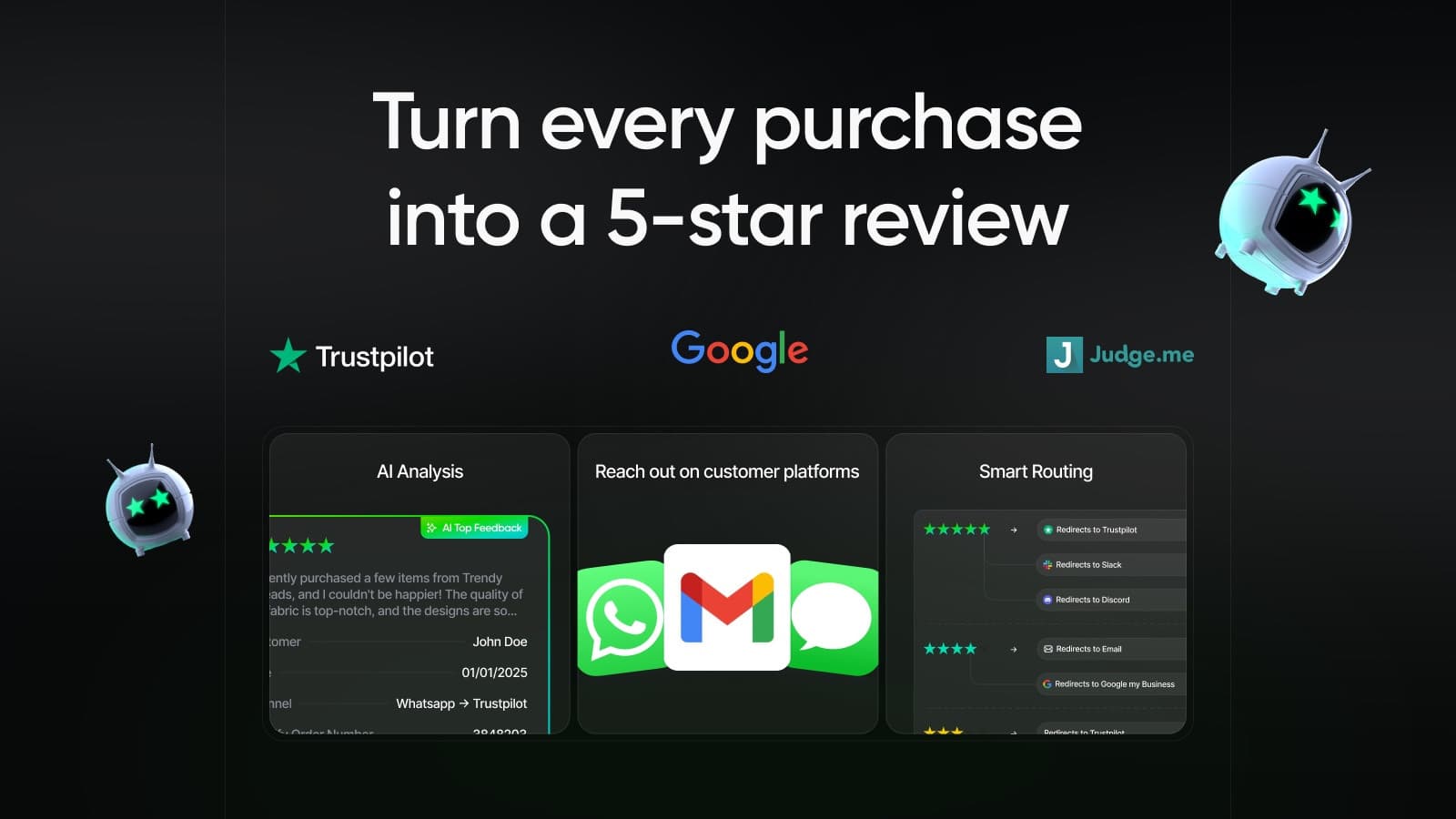
Keep Junip on your product pages. Let Reviewz ask every customer over WhatsApp, SMS and email.
Install Reviewz on ShopifyFAQ
Is Junip free?
Yes. The Free plan has unlimited orders and unlimited review requests. It includes automated review request emails, photo and video reviews, the product page and star rating widgets, a reviews page and analytics. Follow-up requests, incentives and product grouping start on the Core plan at $29 a month.
How much does Junip cost in 2026?
Junip costs $0 on Free, $29 a month on Core, $79 a month on Growth and $299 a month on Premium, billed in USD every 30 days. Every plan includes unlimited orders and review requests, and the paid plans come with a 7-day free trial.
What is Junip?
Junip is a product review app for Shopify made by Junip Inc., based in Kitchener, Ontario. It collects ratings, text, photos and videos through a mobile-first form, displays them in on-site widgets, and on the Growth plan syndicates them to Google Shopping, Meta, TikTok Shop and the Shop app.
Is Junip legit?
Yes. Junip launched on the Shopify App Store in November 2019, carries the Built for Shopify badge and holds a 4.8 rating from 1,157 merchant reviews as of October 2026. By default it publishes every review in real time.
Does Junip send review requests by SMS or WhatsApp?
Junip sends its own requests by email. SMS requests run through integrations with Postscript, Attentive or Klaviyo on the Growth plan, where Junip sends the event and the SMS platform sends the message. WhatsApp does not appear on its integrations page.
Is Junip better than Judge.me?
Junip has a more polished mobile form and widget design. Judge.me is cheaper: Google Shopping and the Klaviyo integration cost $15 a month there and $79 a month on Junip. Both have a free plan with unlimited orders.
Sources, checked on 4 October 2026:
- Junip Product Reviews App, Shopify App Store listing: plans, rating, review count, launch date. Link
- Junip pricing page and plan comparison. Link
- Junip help center: moderation, Postscript guide. Junip integrations page.
- Judge.me and Loox plans: their Shopify App Store listings. Judge.me, Loox

About the author
Nicolas Provost · Founder of Reviewz.ai
Nicolas built Reviewz.ai after auditing 500+ Shopify review setups while running Kanal (WhatsApp marketing for Shopify). He has spent four years inside the Shopify ecosystem and writes about review collection, brand trust SEO, and the actual economics of running customer-feedback flows on ecommerce sites.
