

An incentivized review is a customer review written in exchange for something of value: a discount, a free product, loyalty points, a gift card or a prize draw entry. In the United States it is legal to offer one, as long as the reward does not depend on what the review says and readers are told that a reward was given. Each review platform then adds its own rules, and most of the big ones ban review incentives outright.
Incentivized reviews are legal in the US when the incentive is offered for any review, whatever the rating, and is disclosed. The FTC rule on consumer reviews (16 CFR Part 465, in force since October 21, 2024) bans incentives conditioned on a positive or negative sentiment, with civil penalties of up to $53,088 per violation. Google, Trustpilot, Yelp, Amazon and Shopify's Shop app do not accept incentivized reviews at all. On your own store, review apps such as Judge.me, Loox and Yotpo allow them and can label them.
Reviewed by Nicolas Provost, founder of Reviewz.ai. Insights based on auditing 500+ Shopify review setups and analyzing public pricing, schema, and conversion data across the leading review platforms. LinkedIn
This guide covers the definition, the law and the platform rules. For the practical setup of a reward, read our companion guide on offering a discount for reviews. What follows is general information for US store owners, not legal advice.
What is an incentivized review?
An incentivized review is a real review from a real customer who received, or was promised, something in return for writing it. The FTC rule lists what counts: it defines purchasing a review as providing "something of value, such as money, gift certificates, products, services, discounts, coupons, contest entries, or another review, in exchange for a consumer review" (16 CFR 465.1(m)).
On a Shopify store, review incentives are usually a discount or coupon on the next order, loyalty points, a free product, or a prize draw entry.
An incentivized review is not a fake review. A fake review misrepresents who wrote it or what they experienced, and a different section of the same rule bans it whether or not anyone was paid. It is not a plain review request either: asking with no reward attached is a solicitation, not an incentive.
Reviews for free products, the model behind sampling campaigns and Amazon Vine, follow the same rules: a free product is an incentive like any other.
Are incentivized reviews legal in the US?
Yes, under two conditions that come from two different texts: a federal rule backed by civil penalties, and the FTC's Endorsement Guides.
Condition 1: the incentive cannot depend on the sentiment
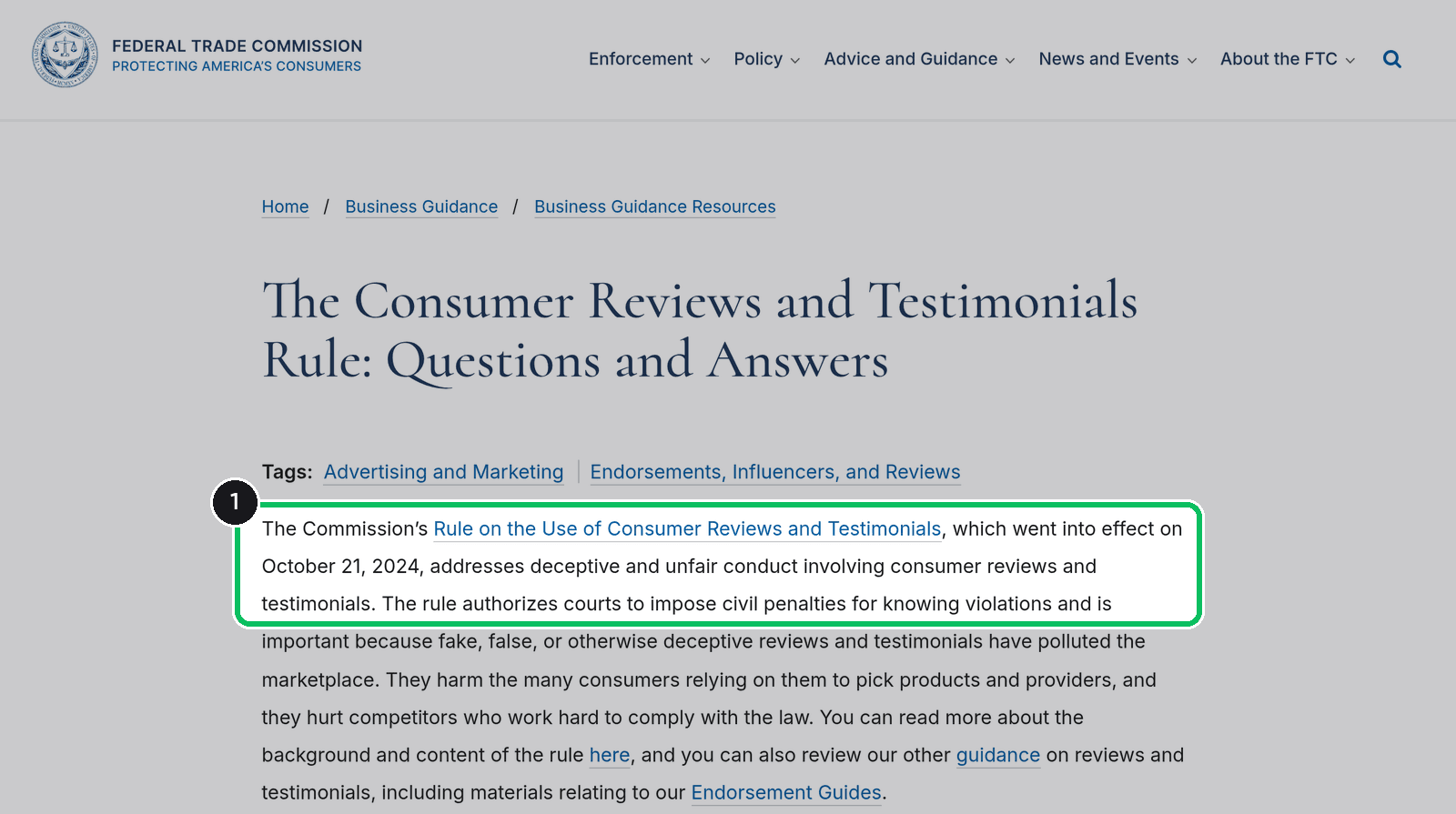
The Rule on the Use of Consumer Reviews and Testimonials (16 CFR Part 465) went into effect on October 21, 2024, as the FTC's questions and answers on the rule confirm. Section 465.4, titled "Buying positive or negative consumer reviews", reads in full:
It is an unfair or deceptive act or practice and a violation of this part for a business to provide compensation or other incentives in exchange for, or conditioned expressly or by implication on, the writing or creation of consumer reviews expressing a particular sentiment, whether positive or negative, regarding the product, service, or business that is the subject of the review.
"Expressly or by implication" means you do not need to write "5 stars" to break the rule. The FTC's own example of an implied condition is: "Tell us how much you loved your visit to John's Steakhouse and get a $5 coupon." The section binds the business that offers the incentive, not the consumer who accepts it, and it applies whether the reviews appear on your own website or on a third-party platform.
A disclosure does not rescue a conditioned reward. Asked whether a business can pay for 5-star reviews as long as the reviewers disclose the incentive, the FTC answers no.
What the rule leaves open is just as clear. In the FTC's words: "The rule does not prohibit giving incentives for reviews, as long as there isn't an express or implied requirement that the reviews have to express a particular sentiment."
The penalty
The rule authorizes courts to impose civil penalties for knowing violations. When FTC staff sent warning letters to 10 companies on December 22, 2025, the agency cited "civil penalties of up to $53,088 per violation", the maximum still listed today in its table of inflation-adjusted penalties (16 CFR 1.98(d)). We checked how real stores measure up in our FTC review-rule audit of 50 Shopify stores.
Condition 2: the incentive has to be disclosed
Section 465.4 says nothing about disclosure. That duty comes from the FTC Act, as the agency interprets it in the Endorsement Guides (16 CFR Part 255). The Guides are not a rule with their own penalty: they describe themselves as "administrative interpretations of laws enforced by the Federal Trade Commission". The principle is in Section 255.5(a):
When there exists a connection between the endorser and the seller of the advertised product that might materially affect the weight or credibility of the endorsement, and that connection is not reasonably expected by the audience, such connection must be disclosed clearly and conspicuously.
The Guides apply it to reviews with an example: a marketer gives consumers a free product and $30 to review it, and makes clear that they are free to be negative. Even then: "Any resulting review that fails to clearly and conspicuously disclose the incentives provided to that reviewer is likely deceptive."
The FTC's plain-language guide, Soliciting and Paying for Online Reviews: A Guide for Marketers, gives the reason. Even when the incentive is not conditioned on a positive review, it says, "the review should disclose the incentive, because its offer may introduce bias or change the weight and credibility that readers give the review."
One detail is easy to miss: the average star rating. Even when every incentivized review carries a disclosure, the Guides say the practice "could still be deceptive" if those reviews materially increase the product's average rating. The marketer then "likely would need to provide a clear and conspicuous disclosure to people who see the average star rating."
What each platform allows
The law is only the floor. Every place where a review can be published has its own policy. We read each one below on the platform's own page on October 7, 2026.
| Platform | Incentivized reviews | What its own policy says | Source |
|---|---|---|---|
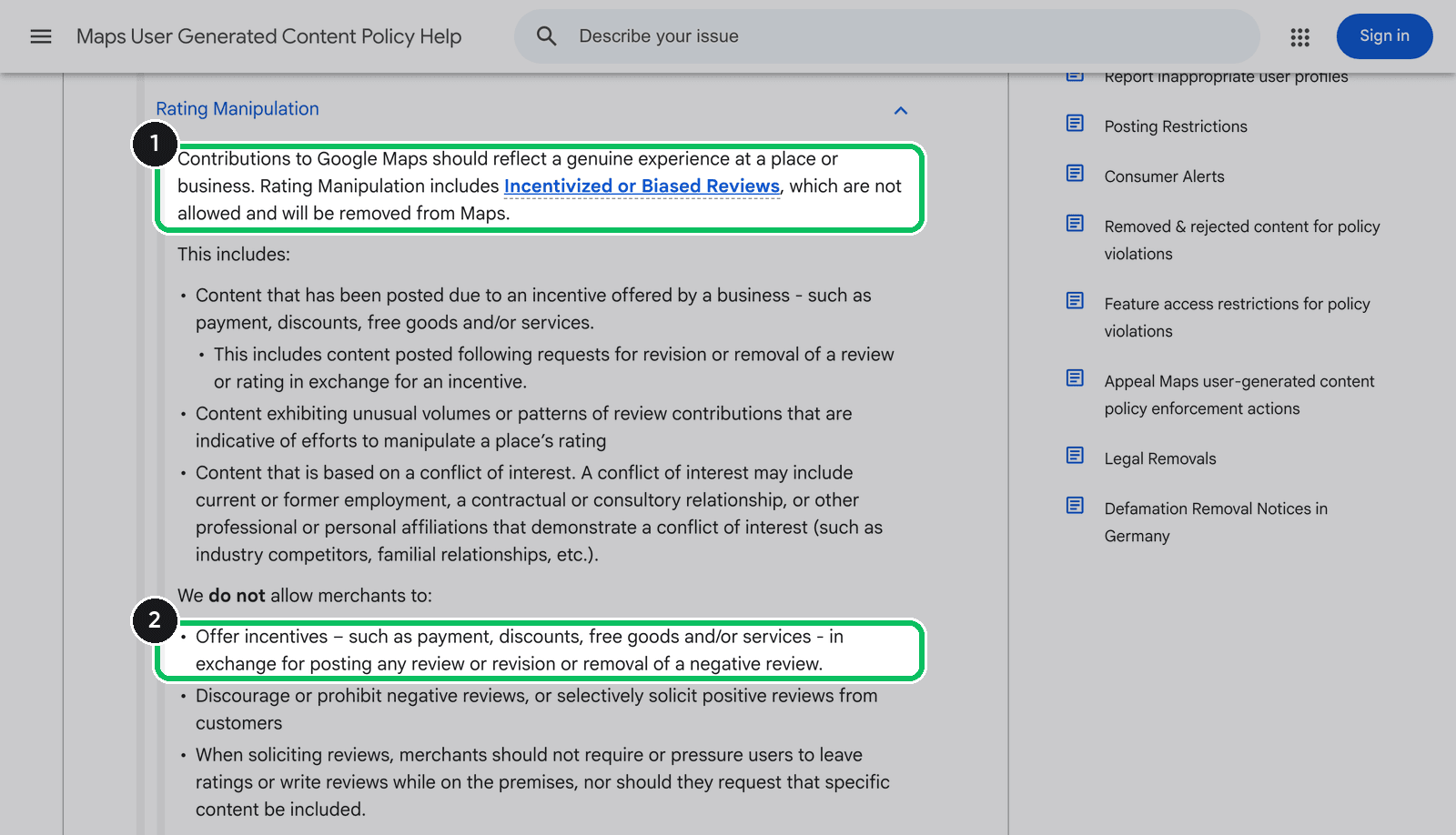
| Google (Business Profile, Maps) | Not allowed | No payment, discounts or free goods or services for posting a review, or for revising or removing a negative one. Incentivized content is removed. | Maps user-generated content policy |
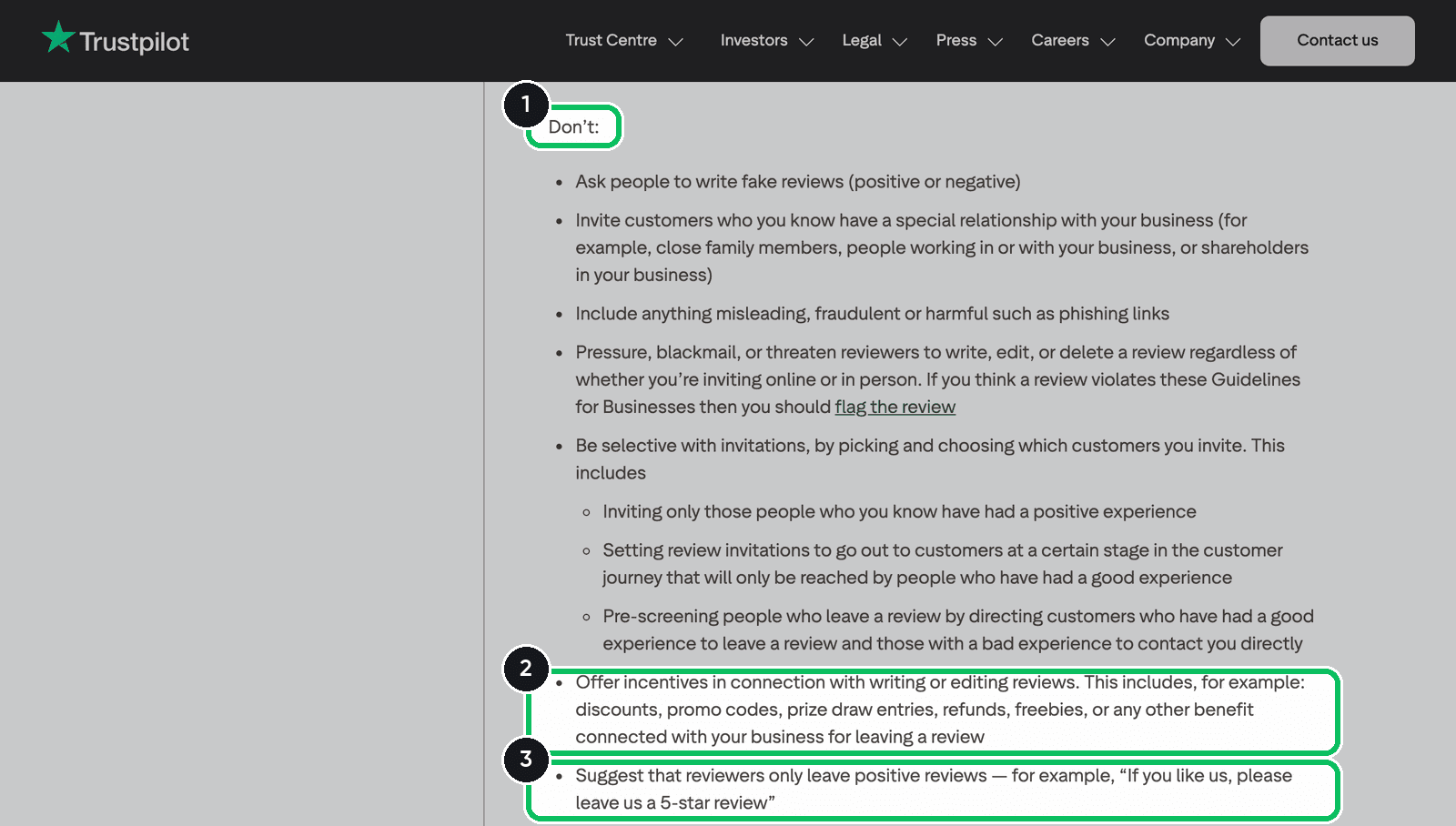
| Trustpilot | Not allowed | No incentives for writing or editing a review: discounts, promo codes, prize draw entries, refunds and freebies are all named. Invitations must be neutral. | Guidelines for businesses |
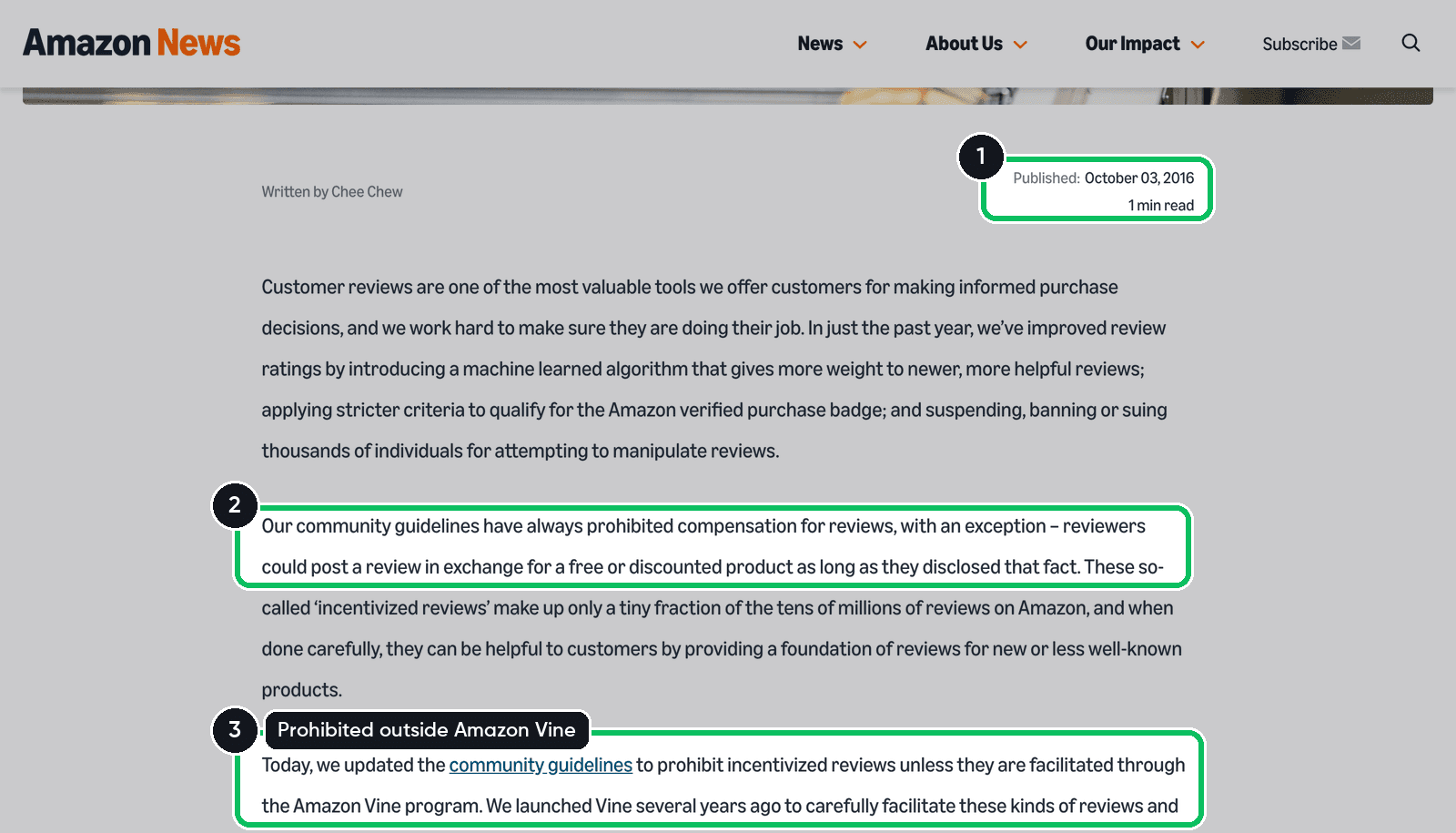
| Amazon | Not allowed, except through Amazon Vine | No review created, edited or removed in exchange for compensation, including refunds, discounts, products and gift cards. Free products only through Vine, whose reviews are labeled. | Community Guidelines |
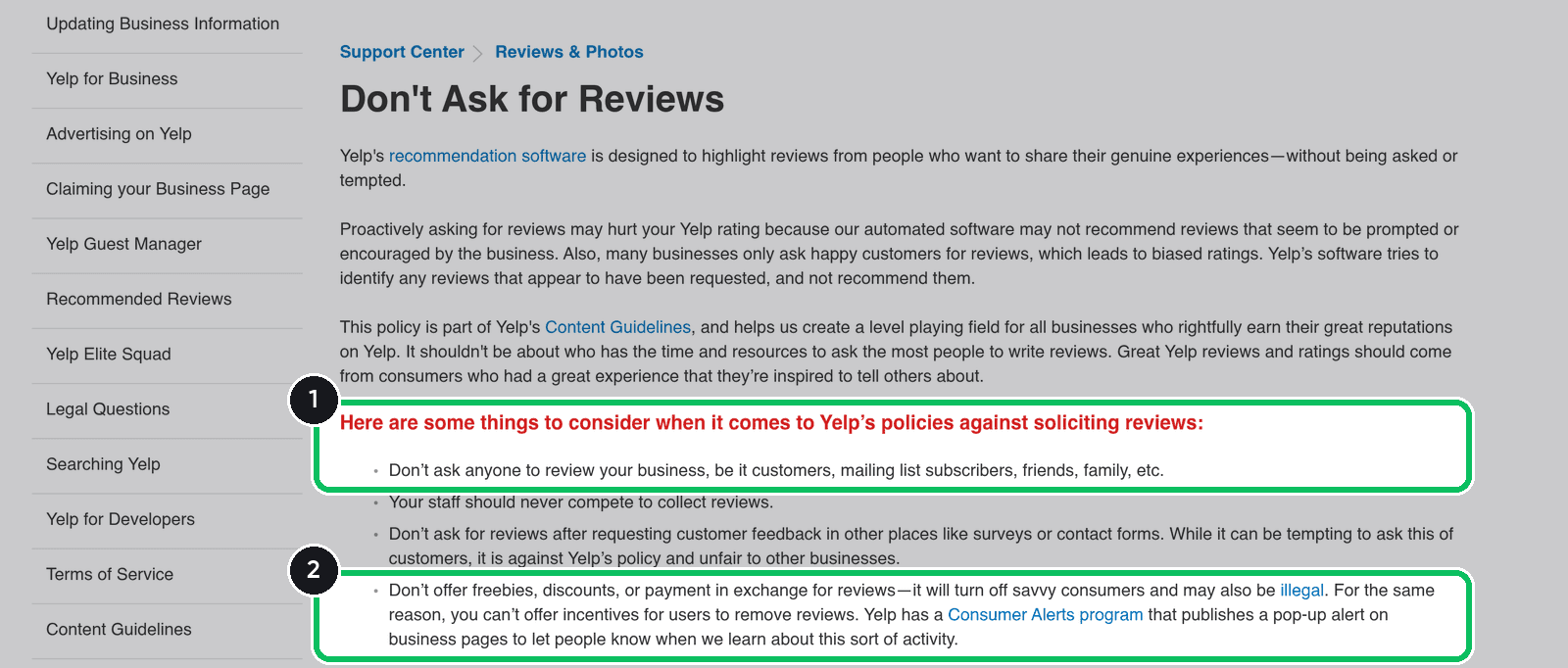
| Yelp | Not allowed, and neither is asking | No review requests at all, and no freebies, discounts or payment for writing or removing a review. Yelp can post a consumer alert on the business page. | Don't Ask for Reviews |
| Shop app (Shopify) | Not allowed | No compensation in exchange for reviews (money, discounts, free products, refunds), and no incentive to change or remove one. | Shop product reviews guidelines |
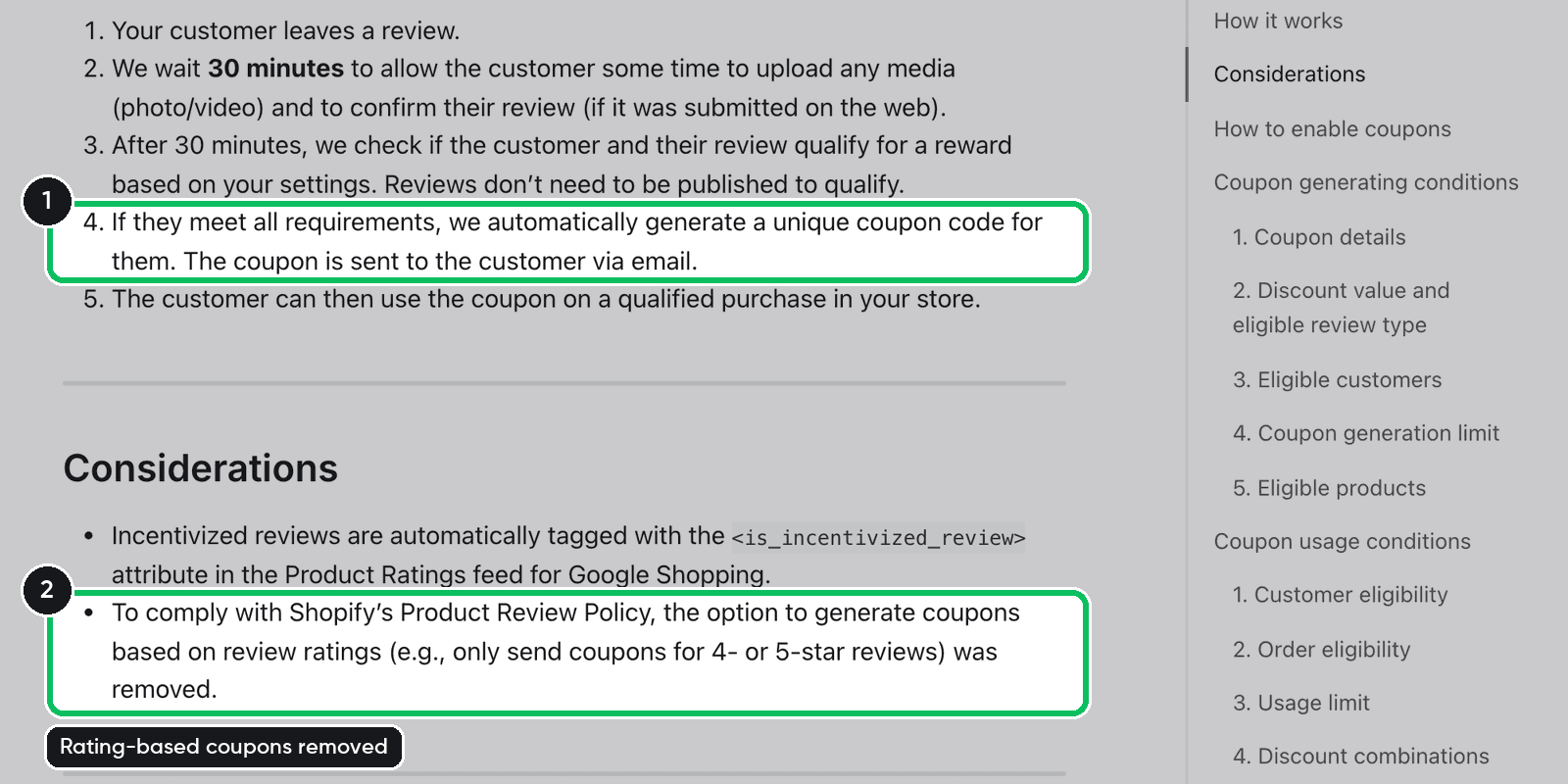
| Judge.me (reviews on your store) | Allowed, same reward for every rating | Coupons can be sent automatically after a review, but no longer based on the star rating. A badge can mark rewarded reviews. | Coupons for reviews, transparency badges |
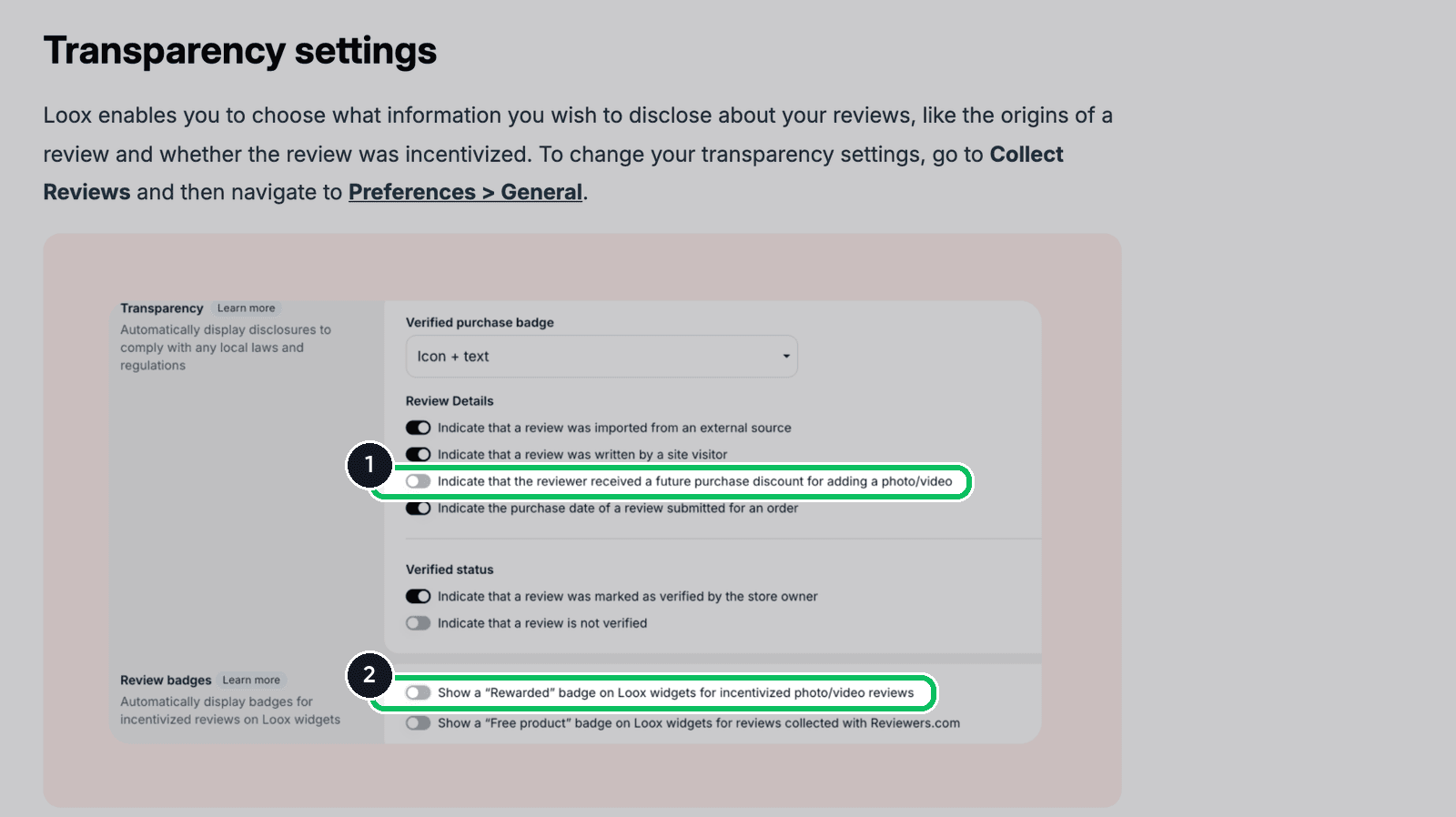
| Loox (reviews on your store) | Allowed, disclosure optional | A future-purchase discount can be offered for adding a photo or video. Settings can display a disclosure and a Rewarded badge on those reviews. | Review transparency |
| Yotpo (reviews on your store) | Allowed, labeled | Reviews rewarded through Yotpo (coupon, loyalty points) get an Incentivized badge automatically. Others have to be marked by hand. | Marking reviews as incentivized |
Here is the Google policy behind the first row.
Three things stand out when you read the eight policies side by side.
Public review platforms say no, on-site review apps say yes. Google, Trustpilot, Yelp, Amazon and Shop all refuse incentives, whatever the rating. An incentive only has a place on the reviews you collect on your own store. Yelp goes further. Its Content Guidelines state: "Businesses should never ask customers to write reviews."
Amazon used to allow it. Until October 3, 2016, a review could be posted in exchange for a free or discounted product if that was disclosed. Amazon then changed its guidelines to prohibit incentivized reviews outside Vine. Our guide on how to spot fake Amazon reviews covers what still slips through.
Rating-based rewards are being designed out. Judge.me says it removed coupons based on the star rating to comply with Shopify's product review policy. If your app still lets you reward only 4 and 5 star reviews, that setting is exactly what the FTC rule prohibits.
Where incentives are refused, a neutral request with a direct link is the only option. Our Google review link generator builds the link, and how to ask customers for reviews has reward-free templates.
Trustpilot lists what a neutral invitation rules out.
Do incentives inflate ratings? What the research says
The disclosure duty exists because a reward changes what people write, even when nobody asks for a good review.
The clearest evidence is a 2021 paper in the Journal of Marketing Research, Incentives Increase Relative Positivity of Review Content and Enjoyment of Review Writing, by Kaitlin Woolley and Marissa A. Sharif. Across a series of controlled experiments, incentivized reviews contained a larger share of positive emotion relative to negative emotion than unincentivized ones, for financial and non-financial incentives alike. The authors trace it to the writing experience: receiving a reward makes writing the review more enjoyable, and that mood carries into the text.
The FTC says the same in its Endorsement Guides FAQ: "Reviewers who are incentivized to write their reviews because they received free products or the like may tend to give more positive reviews."
For a store, the consequence is arithmetic: a handful of rewarded 5-star reviews moves the average of a product with 10 reviews far more than one with 500. It matters most while you are still building toward the number of reviews a product needs.
How to offer a review incentive compliantly
Seven checks, each tied to one of the texts above:
- Offer it to every reviewer, whatever the rating. The 1-star review earns the same reward as the 5-star one.
- Keep the invitation neutral. "Tell us what you think", never "tell us how much you loved it".
- Announce the disclosure upfront. The FTC advises telling customers in advance that they should disclose what they received from you.
- Label the review where shoppers read it. Under the Guides, an online disclosure "should be unavoidable": a mention behind a link or a "more" button does not count.
- Keep rewards away from Google, Trustpilot, Yelp, Amazon and Shop. A rewarded request links to your on-site review form and nowhere else.
- Watch the average. If rewarded reviews materially raise it, add a disclosure next to the summary rating.
- Never trade a reward for an edit or a removal. The rule does not prohibit it, but the FTC says paying consumers to change or remove truthful negative reviews may violate the FTC Act.
In Loox, for example, the label in check 4 is two settings.
The setup itself (which reward, how much, which app settings) is covered in our guide to discounts for reviews. To test a review wall that looks too perfect, use the free fake review checker.
Disclosure wording examples
The FTC does not require special wording. Section 255.5(a) says a disclosure "does not require the complete details of the connection, but it must clearly communicate the nature of the connection sufficiently for consumers to evaluate its significance". The examples below are ours, written to meet that standard.
| Where it appears | Example wording |
|---|---|
| Review request with a coupon | Review your order and get 10% off the next one. The reward is the same whatever rating you give. |
| Label on a review rewarded with a discount | Incentivized review: the reviewer received a discount on a future order for writing it. |
| Label on a review of a free product | The reviewer received this product for free in exchange for an honest review. |
| Label on a review tied to a giveaway | The reviewer was entered into a prize draw for submitting this review. |
| Next to the average star rating | This rating includes reviews from customers who received a reward for reviewing. |
Wording to avoid:
- "Leave us a 5-star review and get 10% off." An express condition on the rating.
- "Loved it? Tell everyone and get a coupon." An implied condition, close to the FTC's steakhouse example.
Start by asking everyone
An incentive only reaches the customers who receive a request. It does nothing for the ones who were never asked. Before adding a reward, check that every order triggers a request, on a channel the customer reads. Reviewz is a Shopify app, built by a small team, that asks every customer for a review after each order over WhatsApp, SMS and email. Plans are listed on the pricing page.
Ask every customer for a review after each order, over WhatsApp, SMS and email.
Install Reviewz on ShopifyRelated reading: Best Shopify review apps, Yotpo vs Loox vs Judge.me, Buying Trustpilot reviews: the risks.
FAQ
What is an incentivized review?
A review that a real customer writes in exchange for something of value: a discount, loyalty points, a free product, a gift card or a prize draw entry. It is not a fake review, which misrepresents who wrote it or what they experienced.
Are incentivized reviews legal in the US?
Yes, on two conditions. The incentive cannot depend, expressly or by implication, on the review being positive or negative (16 CFR 465.4, in force since October 21, 2024), and it should be disclosed to the people who read the review.
Do incentivized reviews have to be disclosed?
The FTC says they should be. Its Endorsement Guides treat a review that fails to clearly and conspicuously disclose the incentive as likely deceptive.
What is the penalty for breaking the FTC rule on incentivized reviews?
The FTC cites civil penalties of up to $53,088 per violation. Courts can impose them for knowing violations.
Does Google allow incentivized reviews?
No. Google does not allow merchants to offer payment, discounts or free goods or services for posting a review. Trustpilot, Yelp, Amazon and Shopify's Shop app have equivalent bans.
Does Amazon allow reviews for free products?
Only through Amazon Vine, where Amazon invites the reviewers and labels their reviews. Outside Vine, its Community Guidelines prohibit reviews written in exchange for compensation, free products included.
Can I reward only 4 and 5 star reviews?
No. That is an incentive conditioned on a positive sentiment, which Section 465.4 prohibits, and a disclosure does not fix it.
References:
- FTC. Rule on the Use of Consumer Reviews and Testimonials, 16 CFR Part 465. Link
- FTC. The Consumer Reviews and Testimonials Rule: Questions and Answers. Link
- FTC. Guides Concerning the Use of Endorsements and Testimonials in Advertising, 16 CFR Part 255. Link
- FTC. Soliciting and Paying for Online Reviews: A Guide for Marketers. Link
- FTC. FTC Warns 10 Companies About Possible Violations of the Agency's New Consumer Review Rule (December 22, 2025). Link
- Woolley, K. and Sharif, M. A. (2021). Incentives Increase Relative Positivity of Review Content and Enjoyment of Review Writing. Journal of Marketing Research, 58(3), 539-558. Link

About the author
Nicolas Provost · Founder of Reviewz.ai
Nicolas built Reviewz.ai after auditing 500+ Shopify review setups while running Kanal (WhatsApp marketing for Shopify). He has spent four years inside the Shopify ecosystem and writes about review collection, brand trust SEO, and the actual economics of running customer-feedback flows on ecommerce sites.
