

Yotpo is the enterprise suite for brands that want reviews, SMS, loyalty, and UGC under one expensive roof, while Reviewz is a focused collection-and-routing tool that starts free. If you are a large brand running three or four marketing channels in one platform, Yotpo earns its price. If you are a Shopify store under a few million in revenue that mainly needs more reviews and a protected public rating, Reviewz is the leaner fit.
Yotpo and Reviewz solve different problems. Yotpo is a powerful, pricey, complex marketing suite that bundles reviews with SMS, loyalty, and UGC, and it shines for enterprise brands that use all of it. Reviewz does one job extremely well: it collects reviews across WhatsApp, SMS, and email, routes happy customers to public sites like Trustpilot, Google, and Judge.me, and catches unhappy ones in a private form, all with a free tier and Shopify-first setup. Choose Yotpo if you want one vendor for your whole marketing stack. Choose Reviewz if you want the highest collection rate and a protected rating without the bundle cost. Full feature matrix below.
What Yotpo does well
Yotpo deserves real credit, because at the high end it is one of the most complete platforms in ecommerce. It does not just collect reviews. It bundles reviews, SMS marketing, email, loyalty and rewards, subscriptions, and user-generated content into a single connected system, with shared customer data flowing between them. For a brand spending serious money on retention, that integration is the whole point: a customer who leaves a five-star review can be automatically enrolled in a loyalty tier and texted an offer, all without stitching together separate tools. Yotpo also brings deep analytics, a mature widget library, Google Seller Ratings syndication, and enterprise-grade support and onboarding. If you are a brand doing eight figures and you want one vendor instead of five, Yotpo is built for exactly that.
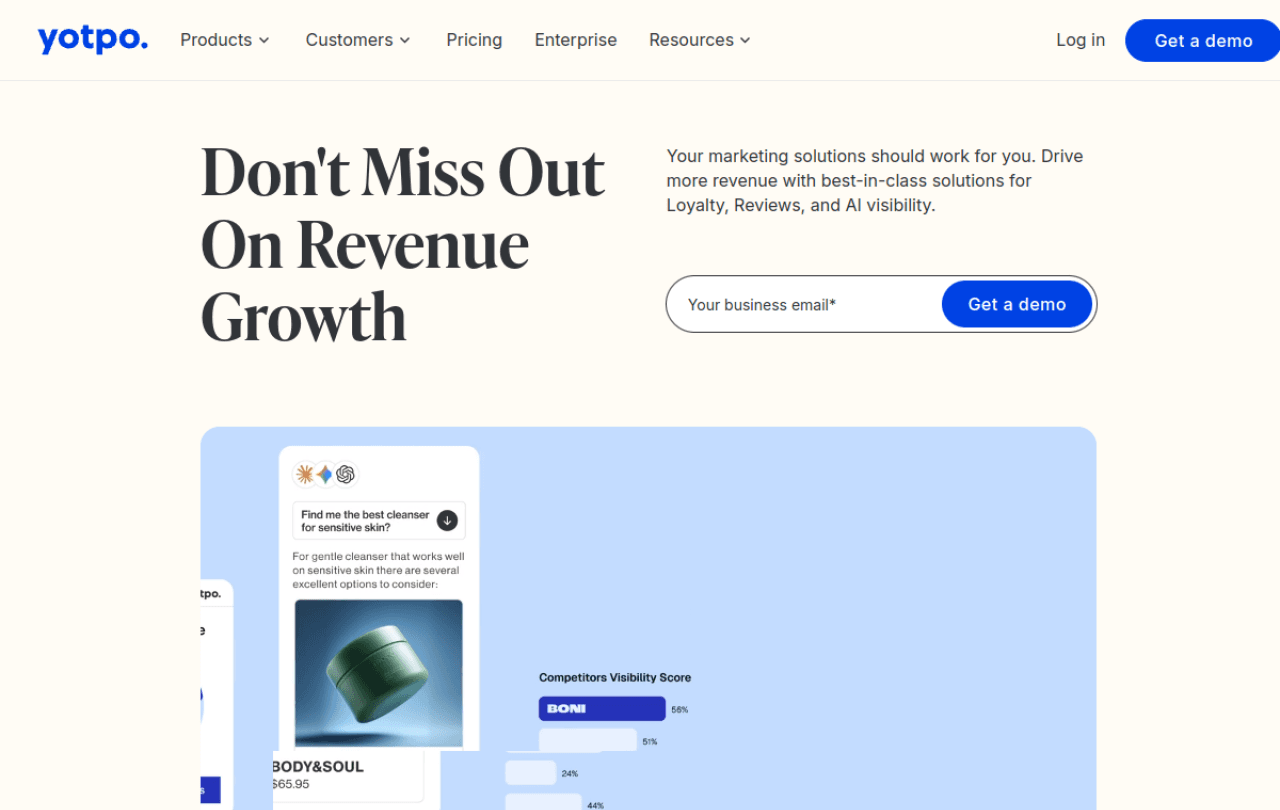
The flip side is cost and complexity. Yotpo pricing scales steeply with order volume and with each module you switch on, and the features merchants most want often sit behind higher tiers. The platform is powerful, which also means there is a lot to configure, and smaller teams frequently end up paying enterprise prices to use a fraction of the suite. We have heard this pattern repeatedly from merchants, which is the core of our Yotpo alternatives for Shopify analysis. Check Yotpo's current pricing directly, because tiers move, but the structural reality is that you buy the bundle.
Where Reviewz fits differently
Reviewz is not trying to be Yotpo. It deliberately narrows its focus to the part of the funnel that most directly grows your review count and protects your rating, and it does that part better than a bundled suite tends to.
Two things define it. First, multi-channel collection: instead of email alone, Reviewz reaches customers on WhatsApp and SMS as well, which is where response rates climb because people open a text far faster than an email. Second, sentiment routing: when a customer signals they are happy, Reviewz sends them to leave a public review on Trustpilot, Google, or Judge.me; when a customer signals they are unhappy, Reviewz routes them to a private feedback form before they can post a public one-star. That mechanic raises your average public rating while still surfacing the negative feedback you need. On top of that, it is built specifically for Shopify and it starts free, so you can run the entire workflow before paying anything.
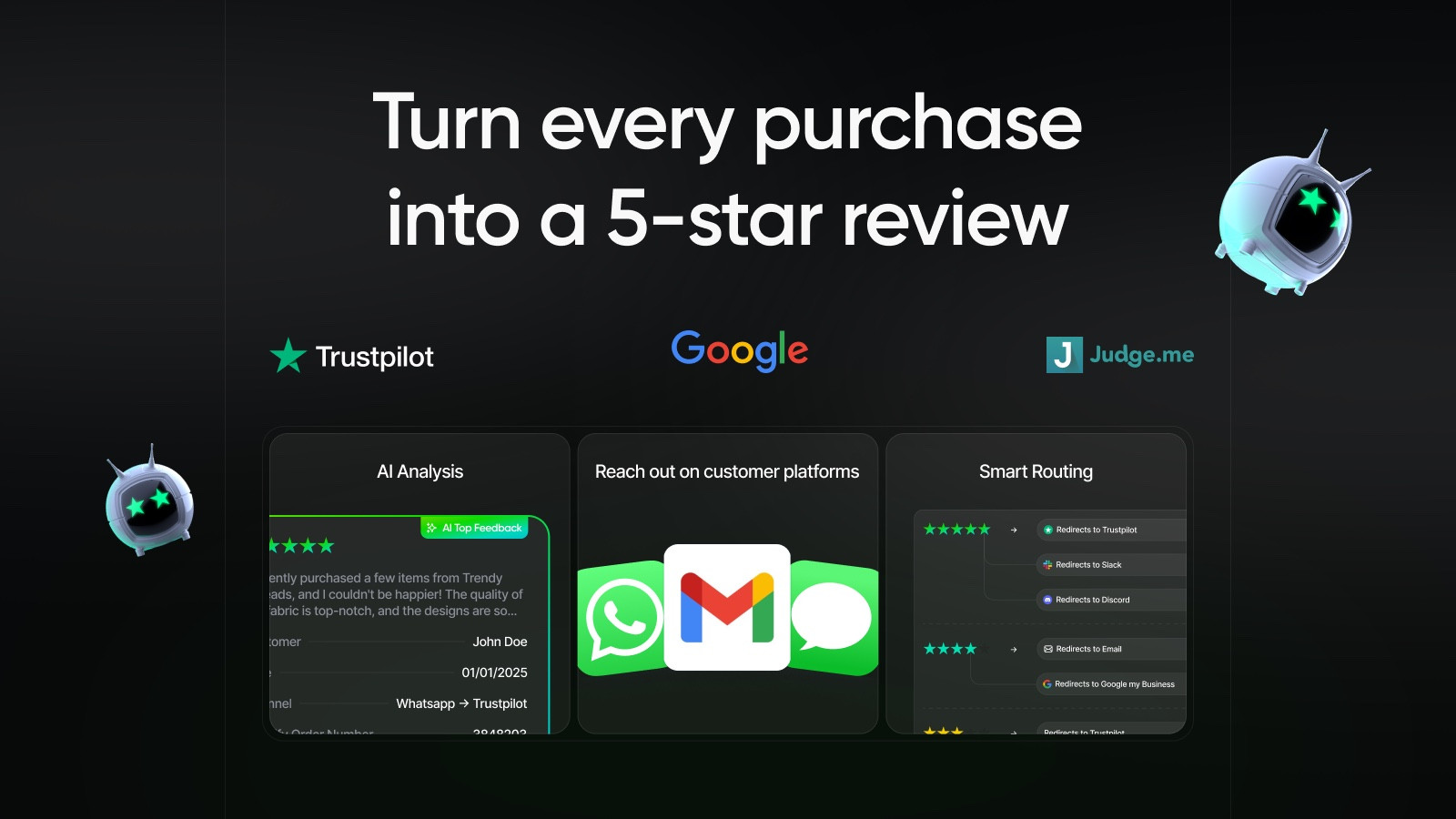 |
| Reviewz.ai for Shopify collects reviews across WhatsApp, SMS, and email, routes happy customers to Trustpilot, Google, and Judge.me, and catches unhappy ones in a private feedback form before they post a public 1-star. Install Reviewz on Shopify |
Feature matrix: Reviewz vs Yotpo
| Reviewz | Yotpo | |
|---|---|---|
| Primary purpose | Review collection + sentiment routing | Full marketing suite (reviews, SMS, loyalty, UGC) |
| Collection channels | WhatsApp, SMS, email | Email, SMS (paid add-on) |
| Sentiment routing (happy public / unhappy private) | Yes | Limited |
| Public platforms supported | Trustpilot, Google, Judge.me | Yotpo on-site, Google syndication |
| Private feedback form | Yes | No native equivalent |
| Loyalty + rewards | No | Yes |
| SMS marketing suite | No (collection only) | Yes |
| Free tier | Yes, full workflow | Yes, limited |
| Built for Shopify | Yes, Shopify-first | Yes, plus other platforms |
| Setup complexity | Low (minutes) | High (suite onboarding) |
| Best fit | Stores under a few million in revenue | Enterprise / multi-channel brands |
Pricing, honestly
We will not put a fake number on either, because both move their tiers. The shape is what matters. Yotpo prices as a suite that scales with order volume and the modules you enable, which is why a store that signed up for reviews can find itself on an enterprise invoice. Reviewz starts free and stays focused, so your cost tracks the collection workflow rather than a whole marketing stack you may not use. Check Yotpo's current pricing before committing, and compare it against what a focused tool plus a display app would cost. For most stores under a few million in revenue, the focused route is meaningfully cheaper.
Migration: moving from Yotpo to Reviewz
If you decide Yotpo is more than you need, switching is not the ordeal it sounds like. Your reviews are your data, and the move is mostly export, import, and reconfigure. We wrote a full step-by-step in migrate Yotpo to Reviewz, but the short version:
- Export your existing Yotpo reviews as a CSV so you keep your star ratings and rich snippets.
- Install Reviewz on your Shopify store and import the CSV.
- Connect the public platforms you want to route to: Trustpilot, Google, Judge.me.
- Configure your WhatsApp, SMS, and email collection cadence and your sentiment-routing thresholds.
- Keep Yotpo's loyalty or SMS modules separately if you still rely on them, since Reviewz does not replace those.
That last point is the honest caveat: if you actively use Yotpo loyalty or its SMS marketing engine, Reviewz does not replace those, and you would pair it with a dedicated loyalty or messaging tool. Reviewz replaces the review-collection and routing layer, which for many stores is the only Yotpo module they truly use.
Which one should you pick
A simple rule:
- Pick Yotpo if you are a larger brand that wants reviews, SMS, loyalty, and UGC in one connected platform and you have the budget and team to run it.
- Pick Reviewz if you mainly want more reviews, higher response rates from WhatsApp and SMS, and a protected public rating, without paying for a suite you will not fully use.
If you are still mapping the wider landscape, our best Shopify review apps roundup and our best customer review software for Shopify guide put both tools in context. For the underlying business case, the Spiegel Research Center found products with reviews convert dramatically better than those without, and the BrightLocal Local Consumer Review Survey tracks how shoppers actually use ratings. Whatever you choose, keep your collection flow compliant with the FTC rule on consumer reviews.
Before you decide, our free NPS calculator shows what your sentiment split looks like, which is the input that drives routing, and the review schema generator gets your imported reviews into rich snippets on day one.
|
| Reviewz.ai for Shopify collects reviews across WhatsApp, SMS, and email, routes happy customers to Trustpilot, Google, and Judge.me, and catches unhappy ones in a private feedback form before they post a public 1-star. Install Reviewz on Shopify |
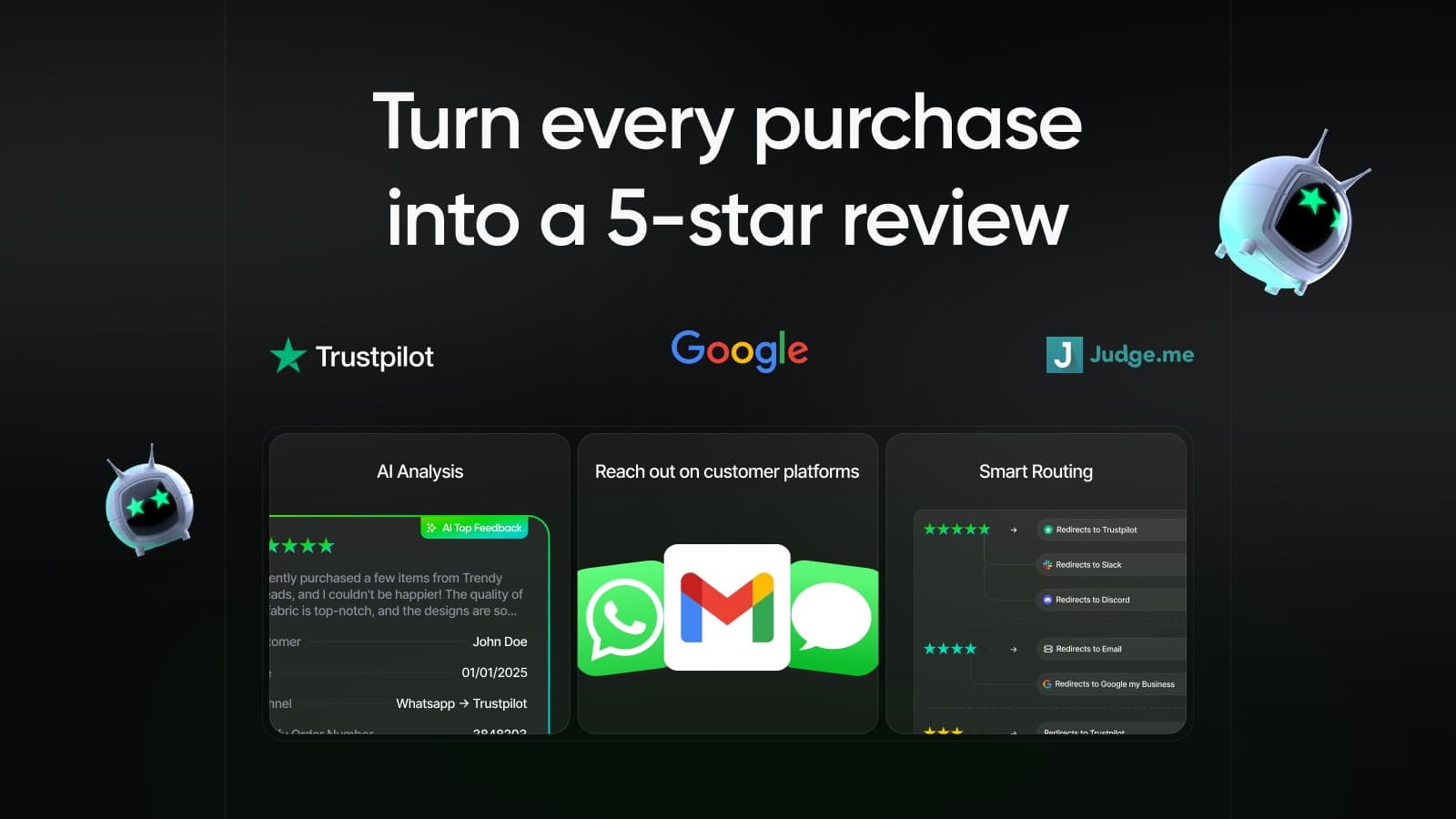
Route happy customers to Trustpilot & Google, capture negatives privately.
Install Reviewz on ShopifyReferences:
- Spiegel Research Center, How Online Reviews Influence Sales. Link
- BrightLocal Local Consumer Review Survey. Link
- FTC Final Rule on Fake Reviews and Testimonials. Link
- Yotpo on the Shopify App Store. Link
- Reviewz on the Shopify App Store. Link

About the author
Nicolas Provost · Founder of Reviewz.ai
Nicolas built Reviewz.ai after auditing 500+ Shopify review setups while running Kanal (WhatsApp marketing for Shopify). He has spent four years inside the Shopify ecosystem and writes about review collection, brand trust SEO, and the actual economics of running customer-feedback flows on ecommerce sites.
